
When Numbers Take Over the Government (and Your Wallet)
In the wild world of banknotes, you’ll find beautiful pieces, rare treasures, and then… things so ridiculous they seem born from a fever dream involving tequila and a broken calculator. Enter the 75 kyat Myanmar banknote: a rectangular relic that’s part birthday card, part economic disaster, and part numerology-induced madness.
Ne Win: Numerologist-in-Chief
Imagine a military dictator who genuinely believes the number 9 holds magical power. That’s Ne Win, the man who ruled Burma (now Myanmar) from 1962 to 1988 like it was his personal astrological experiment.
In 1985, on his 75th birthday, he decided the country should celebrate with a brand-new 75 kyat banknote. Why? Because he turned 75. And because, presumably, a voice in his head (or his horoscope) told him it was the right thing to do.
75 kyat Myanmar banknote: Gorgeous and as Useful as a Chocolate Teapot
The 75 kyat note (Pick P-65) was surprisingly well-made: 164 x 76 mm, printed on good-quality paper with a watermark of national hero Aung San. The obverse features Aung San himself, while the reverse shows Lawkanat, a graceful spirit of prosperity and harmony—because clearly, Myanmar needed spiritual alignment more than fiscal policy.
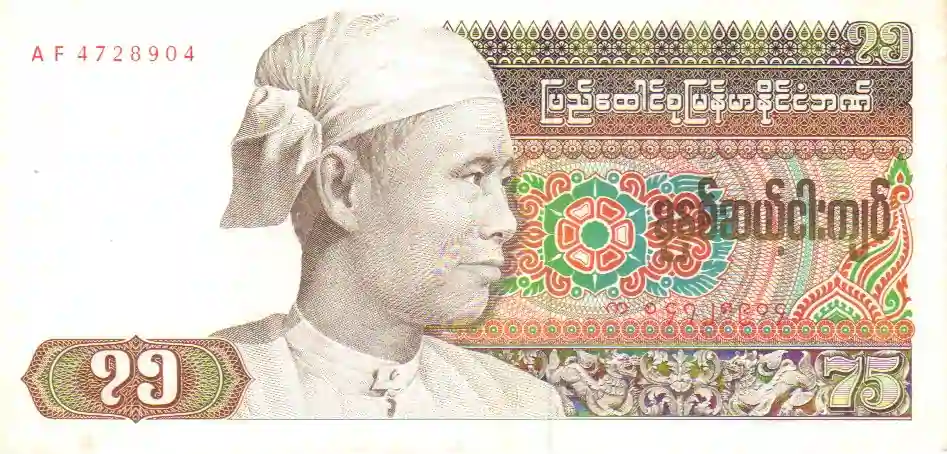
Colors? Earthy browns, greens, hints of blue. Elegant floral patterns, symmetric motifs. A little numismatic jewel… that no one could use.
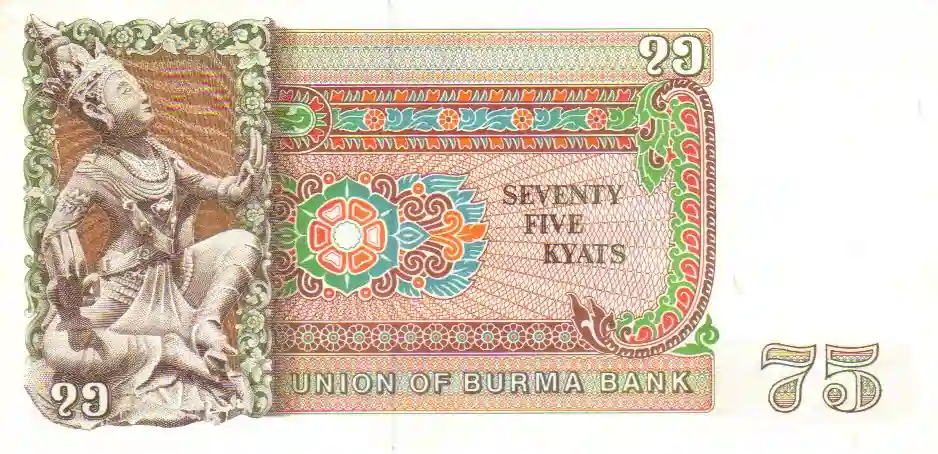
Because let’s face it: 75 is a useless denomination. You can’t round with it. You can’t break it. You can’t even use it at the market without looking like a lunatic. But hey, Ne Win liked it, and that’s all that mattered.
Enter the Circus of Weird Denominations
Just when you thought it couldn’t get any stranger, 1986 brought us 15 and 35 kyat notes. These numbers felt like they’d been picked by a numerologist who’d lost a bet.
Then, on 3 November 1985, just days before the 75 hit circulation, the government demonetized the 50 and 100 kyat notes without warning. Citizens were allowed to exchange only limited amounts. Overnight, trust in the currency took a nosedive—straight into a concrete wall.
The Big Show: Demonetization, Burmese-Style
Fast forward to 5 September 1987. The government, with its usual subtlety, declares the 25, 35, and 75 kyat notes null and void. No warning. No reimbursement. Just pure, unfiltered chaos.
Roughly 75% of the currency in circulation became worthless overnight. A mass extinction event for money.
But not to worry! On 22 September, they launched two brand-new notes: 45 and 90 kyat. Why? Because 4+5=9, and 9+0=9. Ne Win’s favourite number. Not a plan, not a strategy—a superstition turned into national policy.
Riots, Gunfire, and One Very Expensive Lesson
The economy was already on life support. The demonetization pulled the plug. Enter the 8888 Uprising—yes, even the revolution had numerological flair.
Hundreds of thousands of students, monks, and civilians poured into the streets. The regime responded with bullets. Thousands were killed. Ne Win resigned soon after, but the military clung to power. General Saw Maung took over—same mustache, same mess.

Today: A Mystical Relic for Collectors
Today, the 75 kyat Myanmar banknote is a collector’s oddity—a kind of paper fossil from a time when horoscopes decided fiscal policy.
It’s not worth much in dollars, but as a story? Priceless. It’s the monetary equivalent of drag-racing a tractor through Monaco—completely absurd, but impossible to ignore.
While most central banks use charts, data, and economists, Ne Win relied on numerology, incense, and possibly a crystal ball.
Final Thoughts on 75 kyat Myanmar banknote: If This Was Economic Planning, I’m a Bonsai Tree
The 75 kyat isn’t just a banknote. It’s a warning. A reminder that superstition, ego, and unchecked power can print disaster on paper.
It’s bizarre. It’s tragic. It’s Burma in 1985. And if you think your government is bad, just be grateful you never had to shop with a birthday-card-turned-currency dreamed up by a paranoid mystic.