In January 2009, while the Western world was still busy dealing with the subprime mortgage crisis and wondering whether investing in Lehman Brothers had been a wise decision (spoiler: it hadn’t), on the other side of the planet a country was printing money as if it were handing out flyers for a village fair.
Except there was no fair. And no functioning country either. Just desperation.
The 100 Trillion Zimbabwe Dollar Note: Birth of a Monetary Monster
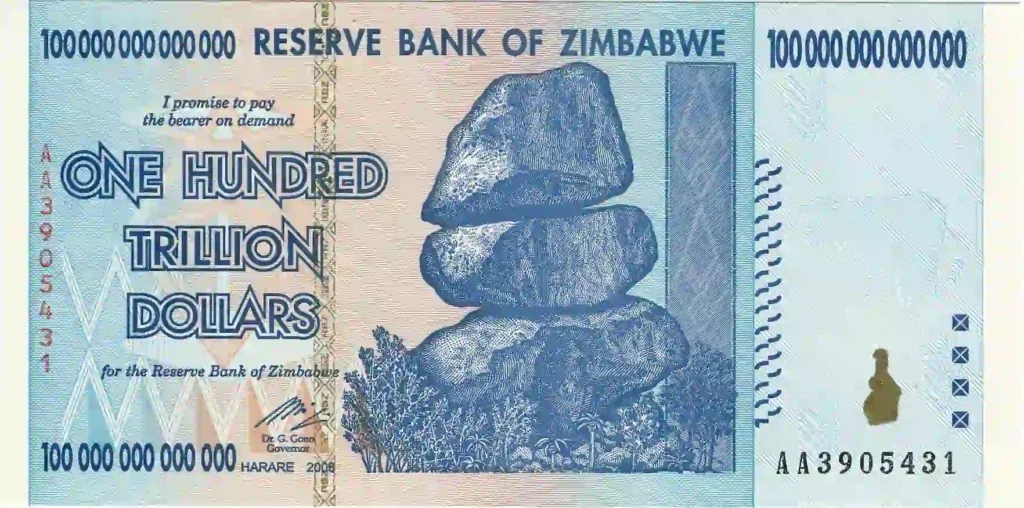
Zimbabwe, once the agricultural jewel of Africa, ruled by a president who dubbed himself “eternal” and a central bank that printed more ink than the Sunday Times crossword, reached the peak of monetary absurdity with a 100,000,000,000,000 dollar note.
Yes, you read that right: one hundred trillion, with fourteen zeros. A banknote that sounded more like a joke than legal tender. Issued by the Reserve Bank of Zimbabwe, it came into the world with the same grace of someone who’s already lost everything—including their grip on reality.
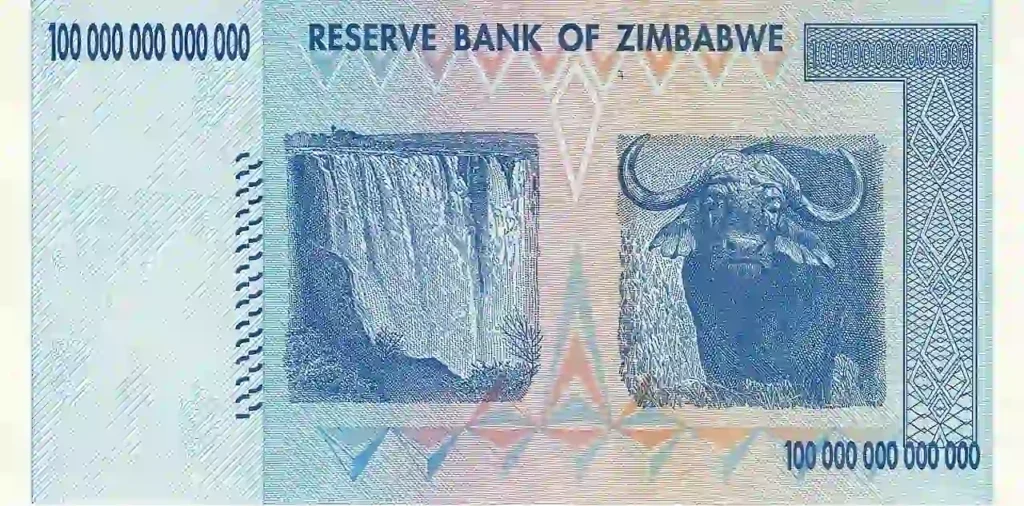
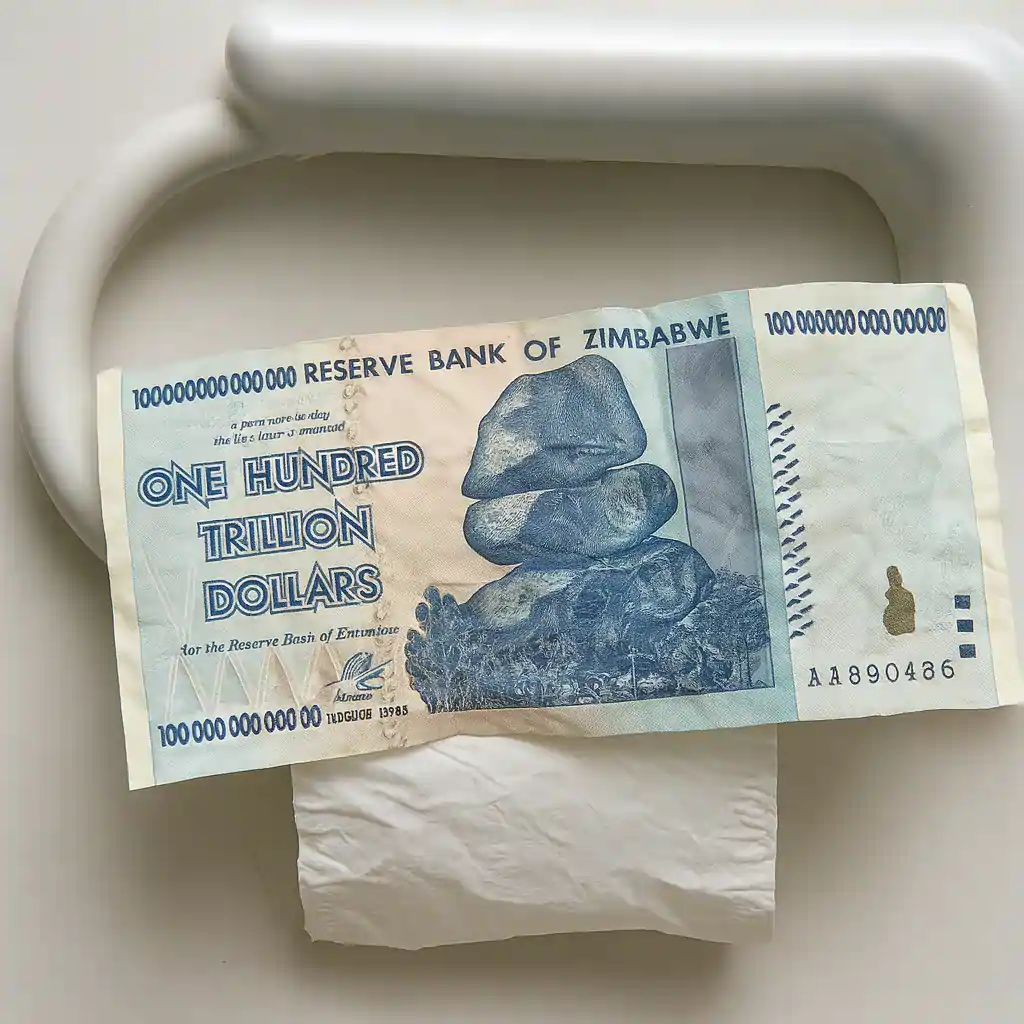
This pale purple slip of despair bore the date 16 January 2009 at the top. Below, it carried the economic shame of an entire nation. At the time, it was officially worth about 30 US cents. In practical terms, it was worth less than a rusty paperclip. Unsurprisingly, many actually used it as toilet paper. It was cheaper than buying the real thing at the store—and, according to some, even softer.
As citizens tried to survive on weekly wages that lost value on the way from the bank to the market, Zimbabwe’s central bank kept printing with all the restraint of a toddler at a glitter factory. Each new note had to outdo the last, in a grotesque competition of “who’s got more zeros.”
First came the 10,000s, then the millions, the billions, the hundred billions. Eventually, the very concept of currency collapsed into a race between the printers and the shopkeepers—one trying to beat the record of zeros, the other changing price tags faster than the ink could dry.
Gideon Gono: The Central Banker Who Outsprinted Mathematics
The man behind it all was Gideon Gono, the central bank governor, who famously claimed—without a hint of irony—“There is no inflation we cannot print.” A phrase worthy of being tattooed on the forehead of any reckless central banker. Preferably in UV ink.

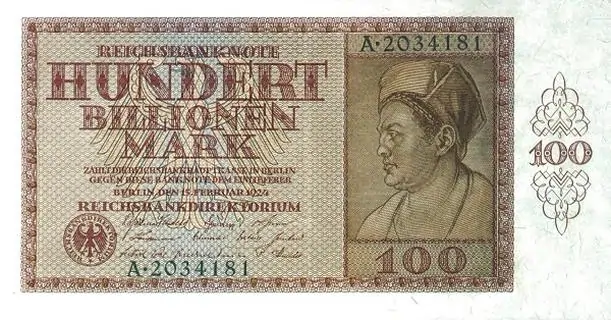
But Zimbabwe wasn’t the first to flirt with economic armageddon in paper form. Back in the 1920s, the Weimar Republic in Germany had done its bit. In 1923, the German mark lost value faster than a secondhand French car, and people were paid twice a day just to buy bread before prices doubled again by the afternoon. In some cases, it was cheaper to burn banknotes for heat than to buy firewood.
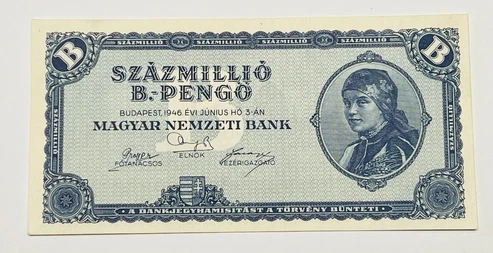
Then came Hungary in 1946, with the mother of all hyperinflations: the pengő. Its value halved every 15 hours. Authorities scrambled to keep up by inventing the milpengő (a million pengő) and eventually the b.-pengő, where “b.” stood for “billion”—as in 18 zeros. By the end, not even mathematicians could properly read the notes.
The Collapse of a Currency
Compared to these two historic champions of inflation, Zimbabwe looked like a modern, proud contender. It had better printing technology, shinier paper, and a far more dysfunctional geopolitical context. When the whole system collapsed in 2009, the government gave up.
The Zimbabwean dollar was dead. In its place, people used anything else: US dollars, South African rand, Chinese yuan, Botswanan pula, and probably Pokémon cards too—as long as they didn’t say “Reserve Bank of Zimbabwe” on them.
A Banknote So Useless… It Became Essential
And yet, just as its purchasing power flatlined, the 100 trillion note was reborn. Not as currency, but as a collector’s item. Westerners began buying it on eBay, framing it, gifting it to friends and coworkers as a symbol of financial absurdity. Numismatic fairs welcomed it with the reverence of a fallen legend—the one that didn’t make it, but still left a mark.
Today, years later, it’s worth between €5 and €20—far more than it ever was in circulation. In mint condition, especially first series AA notes, it can fetch €100 or more. A small, ironic twist: only in numismatics can a failed and ridiculed currency become a better investment than crypto.
So yes, collecting it today is like telling the world:
“Here’s how far economic madness can go. But hey, at least the print job was decent.”
A useless banknote, for sure.
But so useless… it became essential.