
Invalid from 1 January 1945—yet carefully banded and vaulted in mid-January. Then handled again after V-E Day. If banknotes could roll their eyes, these would.
A recently surfaced cache in the Czech Republic includes a 100-note bundle of 5-Reichsmark Reichskreditkassenscheine from the Reichsbank branch (Nebenstelle) Eger/Cheb. The banderole says packed 12 Jan 1945, stamped as a “Tresorpaket” on 15 Jan 1945—two weeks after these notes had been declared invalid (1 Jan 1945). The packet was handled again on 22 May 1945 under U.S. occupation and once more by the Czechoslovak National Bank on 6 July 1947. Full story via Geldscheine-Online; background on RKK issues here and the RKK institution here.
Why Eger, why then?
Eger sat in the Sudetenland—annexed October 1938, Reichsmark introduced that same month—so RKK notes did not circulate there as legal tender. Yet branches in the Reich kept stocks as travel instruments for Wehrmacht/officials and for exchanges tied to occupied territories; some stocks also came back with returning units. In the chaos of January 1945, the branch packed and vaulted this bundle rather than scrap it—possibly keeping it as potential local emergency cash if normal supply collapsed.

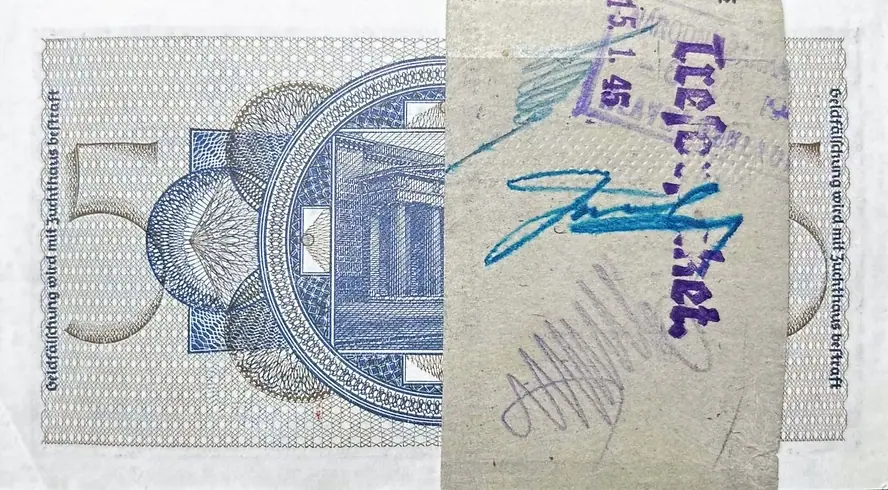
The bundle, the stamps, the timeline
What we’ve got is a tidy forensic trail: early-type 5-RM RKK with embossed seal + 7-digit control number, banded by the Eger branch on 12 Jan 1945, back-stamped as a vault package on 15 Jan. Then a front-stamp 22 May 1945—after U.S. forces took Eger in April, before the Soviet handover—showing the packet was handled again. Finally: a 6 Jul 1947 stamp from the Hlavní pokladna (main cash office) of the Czechoslovak National Bank. After that, darkness—until the find hit the market recently.
Tech Specs (at a glance)
- Type
- Reichskreditkassenschein (RKK) 5 Reichsmark, early issue (embossed seal; 7-digit control)
- Bundle
- 100 notes, largely UNC to aUNC, some consecutive numbers
- Banderole
- “Reichsbanknebenstelle Eger” — packed 12 Jan 1945; vault stamp 15 Jan 1945
- Later handling
- Front stamp 22 May 1945 (Eger branch); back stamp 6 Jul 1947 (Czechoslovak National Bank, “Hlavní pokladna”)
- Legal status
- RKK declared invalid effective 1 Jan 1945; no universal destruction order
- Why retained?
- Likely contingency: potential Notgeld if cash supply failed; mail to Berlin was unreliable by Jan 1945
- Local context
- Eger in Sudetenland (Reichsmark area since Oct 1938); U.S. occupation April–May 1945 before Soviet takeover
- Refs
- Primary analysis via Geldscheine-Online; RKK background RKK notes · Reichskreditkasse; related 1945 emergency use in AT/Tirol case study.
Collector’s angle: the value is the packet, not just the notes—banderole text, control signatures (“vorgezählt / nachgezählt”), and date stamps tell the whole war-end custody story.

Quick Answers
Were RKK legal tender in Eger?
Why pack invalid notes in Jan 1945?
What do the May 22, 1945 and July 6, 1947 marks show?
How rare are intact bundles?
Highlights Facts • Collector Tips • Did You Know?
Facts & Curiosities
- Bundle: 100× 5-RM RKK, early type (embossed seal, 7-digit control).
- Banderole: packed 12 Jan 1945; vault stamp 15 Jan 1945.
- Later marks: 22 May 1945 (Eger branch) · 6 Jul 1947 (CSNB).
Collector Tips
- Photograph the banderole, signatures and date stamps—provenance lives there.
- Check for consecutive numbers and consistent paper glow/odor (UNC tells).
- Beware re-banded packets: fonts/ink ageing on bands should match the notes.
Did You Know?
- RKK were essentially “requisition receipts in money form” for occupied areas.
- They were invalidated on 1 Jan 1945—yet used as emergency stopgaps in parts of Austria that spring.
- Eger (Cheb) was annexed in Oct 1938; U.S. troops entered in April 1945.