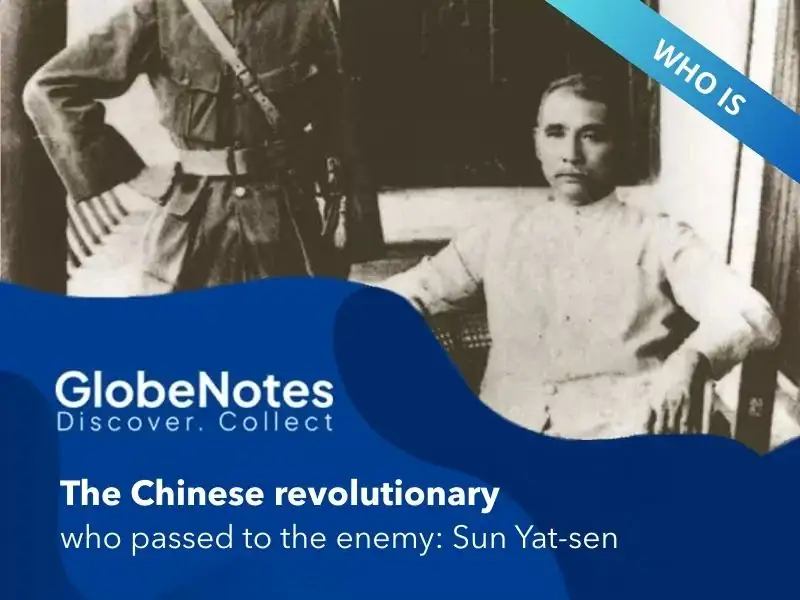
A journey through the history of Sun Yat-sen, the revolution, and actual pieces of paper.
It’s 1866, somewhere in rural Guangdong Province, and Sun Yat-sen born into a family of peasant farmers who probably couldn’t imagine that their son would one day appear on literally millions of banknotes. Spoiler alert: he did. And then he didn’t. And therein lies one of the most fascinating stories in notaphily.
One that involves failed uprisings, revolutionary IOUs, desperate fundraising, hyperinflation that would make your eyes water, and a political divorce so spectacular that one side of the family kept using granddad’s portrait on the money while the other decided to go with someone else entirely.
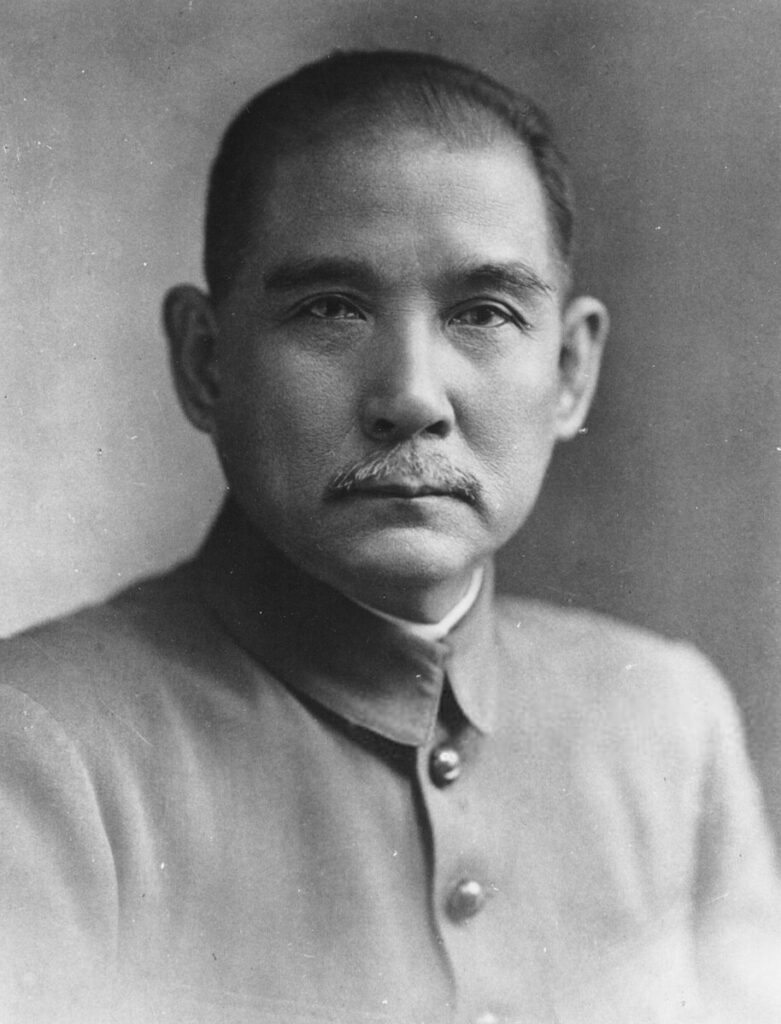
I’m talking, of course, about Sun Yat-sen, the Father of Modern China, revolutionary extraordinaire, and the man whose face graced Chinese currency for decades before disappearing from mainland banknotes like a magician’s assistant (though unlike a magic trick, we know exactly where he went).
The Kid Who Went to Hawaii and Came Back Revolutionary
Sun Yat-sen wasn’t supposed to be a revolutionary. He was supposed to be a doctor. Born on November 12, 1866, to a family so poor they probably thought silver coins were mythical creatures, young Sun got his big break when his older brother Sun Mei who’d emigrated to Hawaii as a laborer decided to give the kid an education.
Off he went to Honolulu at age thirteen, attending a British missionary school and then the American Oahu College. Imagine being a peasant kid from rural China suddenly thrust into Western education in the 1880s. It’s like going from a horse-drawn cart to a Formula 1 car. The culture shock must have been spectacular.
He came back to China, studied medicine in Hong Kong, got his medical license, and somewhere along the way became a baptized Christian and started hanging out with a group of revolutionary thinkers so radical they called themselves the “Four Bandits”. Because when you’re plotting to overthrow a 2,000-year-old imperial system, subtlety is clearly overrated.
Primary Sources Alert:
You can actually read Sun’s own account of his revolutionary adventures in “Kidnapped in London” and “Memoirs of a Chinese Revolutionary”, both available on HathiTrust if you fancy some first-hand revolutionary reading. The Hong Kong History Museum has over 5,000 objects from this period, including his actual handwritten manuscripts. Bonhams once auctioned off handwritten letters from Sun to his European friends James and Mabel Cantlie, the kind of stuff that makes collectors weep tears of joy and financial despair simultaneously.
Sun Yat-sen and Twenty Years of Fundraising (How I Learned to Stop Doctoring and Love the Revolution)
Here’s where it gets properly mental. By 1894, Sun had completely abandoned medicine to become a full-time revolutionary. And revolutions, as it turns out, are bloody expensive. You need guns, people, supplies, bribes, more guns, travel expenses, and possibly some tea and biscuits for the planning meetings.
So Sun did what any sensible revolutionary would do: he traveled the world like a madman, hitting up Chinese communities everywhere for cash. According to incomplete statistics (because apparently even revolutionaries can’t keep proper books), he visited Japan 12 times, Southeast Asia 43 times, the USA four times, and Europe at least four times. That’s more frequent flyer miles than a Top Gear presenter during location filming.
Revolutionary Bonds: The Original Cryptocurrency Scam (Except Legitimate)
The fundraising schemes were absolutely brilliant in their desperation. In 1904, Sun was selling revolutionary bonds in Honolulu promising to repay buyers at ten times their investment once the republic was established. Elsewhere, he sold $10 silver “shares” promising the republic would buy them back for $100. In Singapore, he tried flogging bonds worth $1,000 for $250 each, promising repayment in five years after the revolution succeeded.
This is either the world’s most optimistic investment scheme or the most honest one—at least he was upfront about the fact that you’d only get paid if they actually won.
By 1908, things were so dire that Sun wrote: “In more than ten years, our party has never encountered such a desperate shortage of money“. Translation: “We’re absolutely skint, please send cash”.
The Revolutionary Banknotes (Before There Was Even a Revolution)
But here’s my favorite bit. In June 1911—before the revolution had even succeeded—Sun founded the American Chinese Revolutionary Army Fund-Raising Bureau and literally printed his own banknotes in gold dollars. These weren’t legal tender. They were essentially fancy IOUs promising to pay “the bearer upon its formation at the State Treasury or its agents abroad”.
The banknotes had Sun’s signature (in Chinese, naturally) as Premier of the Chinese Revolutionary Party, plus Lee Gnong Hap as treasurer. From June to September 1911, they collected $144,130.41—about $4 million in today’s money. In Hilo, Hawaii alone, they shifted $5,000 worth of these revolutionary banknotes.
Think about that for a moment. People were buying banknotes from a government that didn’t exist yet. That’s like pre-ordering a car from a company that hasn’t been founded. Absolute mad lads, the lot of them.
One Chinese student donated $20 when his monthly salary was barely more than that. Another group of eighteen Chinese students in Honolulu collectively donated $200 every month while their allowances were modest. Friends recalled how frugal Sun was—living in New York’s Chinatown on basically nothing while managing revolutionary funds that could have bought him a mansion. His brother Sun Mei donated an estimated $700,000 (about $20 million today) to the cause.
Collector’s Note:
If you ever find one of these 1911 revolutionary banknotes, you’re holding a piece of paper that represents pure faith in a political vision. They’re rarer than hen’s teeth and worth a small fortune. The China Numismatic Museum in Beijing has a complete collection if you want to drool over them.
The Revolution That Actually Worked (For About Five Minutes)
After a decade of failed uprisings—including the Huizhou Revolt with 20,000 men that fizzled out when Japanese support evaporated, and the disastrous Yellow Flower Mound uprising that left 72 revolutionaries dead and remembered as martyrs—something finally clicked.
On October 10, 1911, at 7 PM, the Wuchang Uprising kicked off. By the morning of October 11, revolutionaries controlled the entire city. Uprisings erupted spontaneously across the country like a revolutionary game of dominoes. By January 1, 1912, the Republic of China was declared with Sun Yat-sen as President.
After 2,000+ years of imperial rule, China was suddenly a republic. Sun got the credit for financing it, keeping the dream alive, and herding all the disparate revolutionary cats into one organized pack.
Enter the Banknotes: How to Legitimize a Republic. The First Attempt: The Sun Yat-sen “Memento Dollar” (1912)
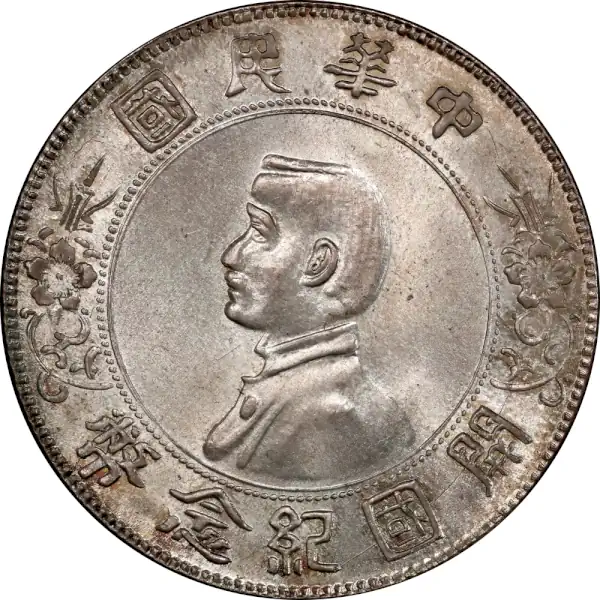
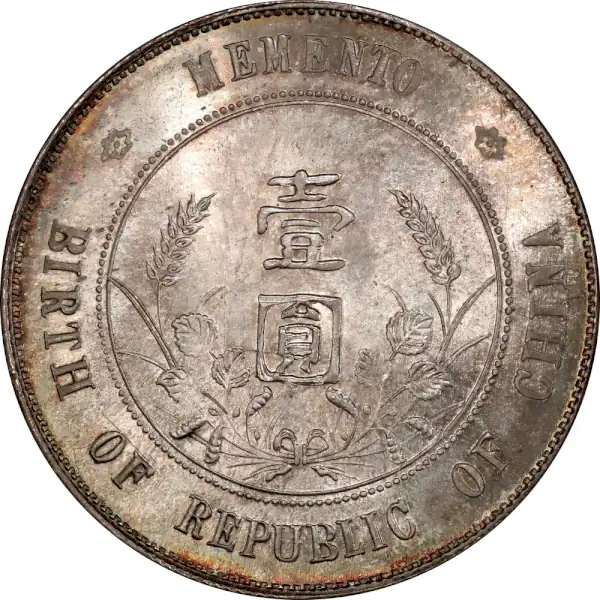
The first coin commemorating Sun’s inauguration as President was called the “Memento dollar”—a silver commemorative showing his portrait surrounded by peach blossoms. The renowned numismatist Eduard Kann described the portrait as “poorly rendered,” which is Victorian-era shade of the highest order. Basically, it looked a bit rubbish, but it was their rubbish, and it marked the beginning of Sun’s face on currency.
Collector’s Alert:
Museums Victoria in Melbourne has one catalogued from 1912. The British Museum also has specimens. Good luck affording one—these aren’t exactly pocket change.
The Proper Sun Yat-sen Banknotes Begin (1930)
In 1930, the Central Bank of China issued the first proper banknotes with Sun Yat-sen’s portrait—5 yuan notes printed by the American Bank Note Company. These were silver-backed, promising to pay the bearer in silver yuan on demand at the bank’s offices.
Now, the American Bank Note Company wasn’t just some random printer. They used revolutionary intaglio printing technology developed by Jacob Perkins that allowed over 30,000 impressions from hardened steel plates while maintaining incredibly fine lines. Before this, copper plates wore out after about 5,000 prints.
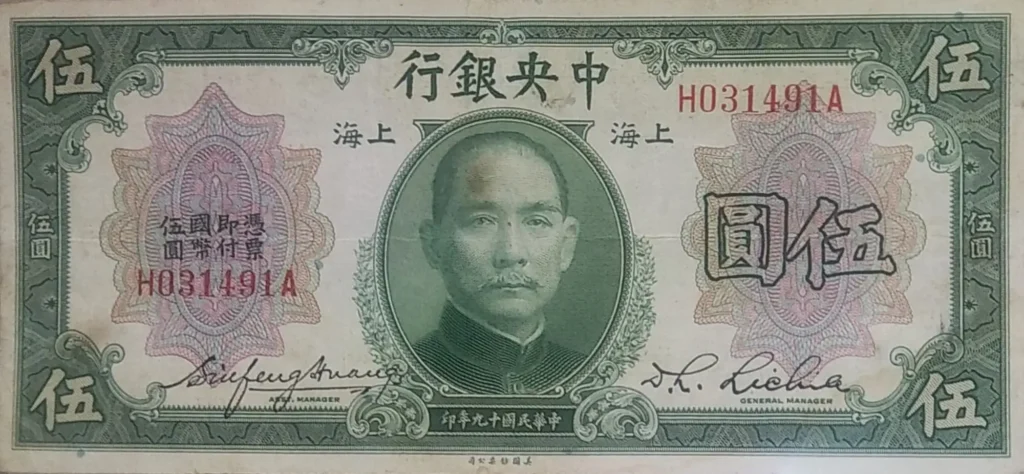
The process was bonkers complicated: they’d create a master “die” with Sun’s portrait engraved in negative into soft steel, harden it, press it into a soft steel cylinder (the “roll”) creating a raised image, harden that, then roll it onto soft steel printing plates to duplicate the original die perfectly. It’s like photocopying before photocopiers existed, except with tons of metal and extreme precision.
This meant every Sun Yat-sen banknote looked identical and was incredibly hard to counterfeit. Brilliant for legitimacy, terrible for forgers.
The Golden Age of Sun Yat-sen Banknotes (1940-1942)
By 1940, the Bank of China was printing a complete series with Sun’s portrait: 5, 10, 25, 50, and 100 yuan. All printed by the American Bank Note Company. The 10 yuan notes showed Sun on the front with the Temple of Heaven and the Bank of China building on the back.
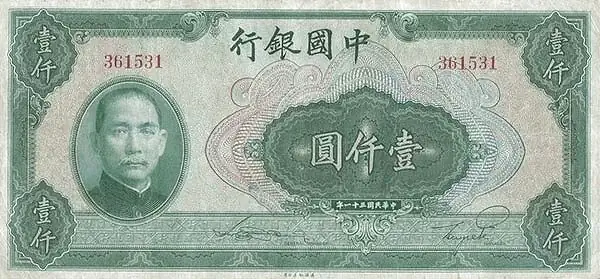
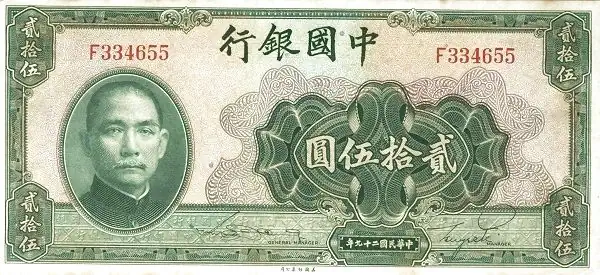
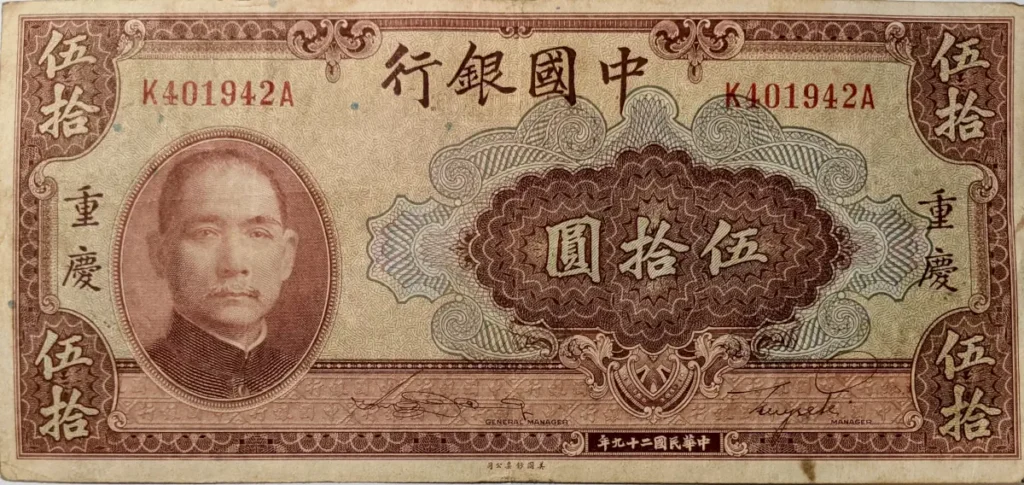
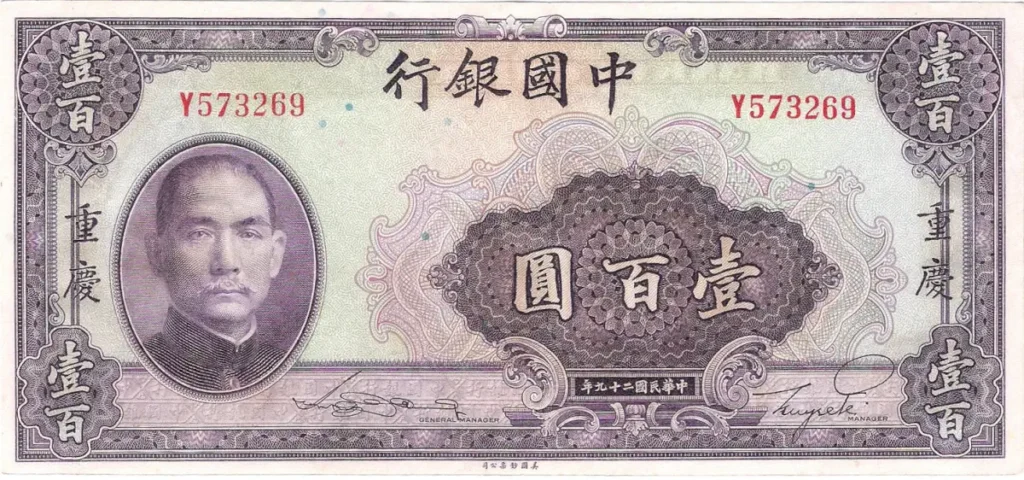
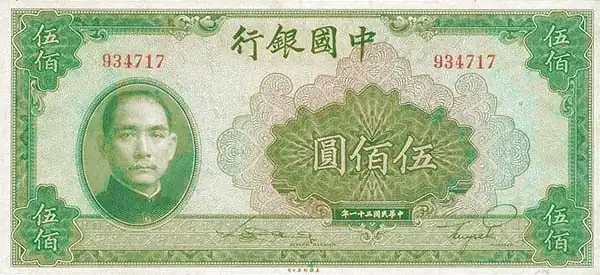
In 1942, they added 500 and 1,000 yuan denominations. Still American-printed. The paper was French-style, which sounds fancy until you realize it was “problematic with minute tears or splits”. Great for collectors who enjoy conservation nightmares.
Primary Sources:
The Bank of China maintains archives of these “Legal Tender Notes Bearing the Portrait of Sun Yat-sen” from 1940 and 1942. Bridgeman Images has catalogued specimens from 1940-1949. If you want to see what proper condition looks like before attempting to buy one, check these out first.
Why Sun Yat-sen on the Money? (The Political Semiotics Lecture Nobody Asked For)
Here’s the thing about putting someone’s face on currency: it’s not just decoration. It’s a political statement printed millions of times and distributed into every pocket, wallet, and transaction in the country.
Sun Yat-sen represented the break from 2,000 years of imperial rule and the birth of modern China. His Three Principles of the People—nationalism, democracy, and people’s livelihood—became the official doctrine of the Republic of China. These principles, inspired by Lincoln’s Gettysburg Address (“of the people, by the people, for the people”), provided a concrete blueprint for China’s development.
Putting Sun’s portrait on every banknote was a way to spread and legitimize this ideology in every single daily transaction. It’s semiotics meets economics meets political propaganda, and it’s fascinating.
After Sun died in 1925 from gallbladder cancer, both the Nationalists (Kuomintang) and later the Communists tried to appropriate his legacy to legitimize their own power. The Kuomintang deliberately worked to canonize his memory. His image on currency served as a public declaration of continuity with the 1911 revolution and republican values.
Academic Source:
If you want to deep-dive into this, check out “Sun Yat‑sen: a Life Beyond Symbols. A Semiotic Approach” by Edizioni Ca’ Foscari, Venezia, or “Money Making Nation: Picturing Political Economy in the Banknotes of the Qing Republican Transition” (2017). Warning: contains actual academic language.
The Hyperinflation Years (Or: When Banknotes Become Wallpaper)
During the 1930s-40s, China’s currency was a rollercoaster designed by someone who hated economists. The country started with a silver standard, switched to fiat currency (the “fabi”) in 1935, then watched as wartime spending triggered inflation so spectacular they eventually issued 1 million yuan banknotes.
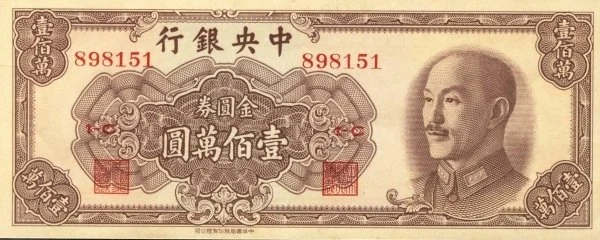
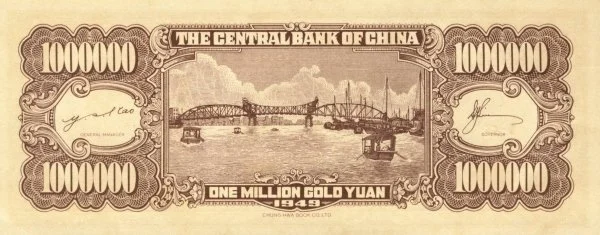
Think about that. One. Million. Yuan. Notes.
Silver dollars came back into circulation because nobody trusted the paper anymore. In August 1948, they introduced the “gold yuan” which, despite the name, wasn’t backed by gold and collapsed even faster than the fabi.
Research Source:
The National University of Singapore published “China’s Great Monetary Revolution, 1942-1950” (EWP161) which documents this financial carnage in excruciating detail. It’s like watching a slow-motion car crash, except the car is an entire economy.
The Great Split of 1949: Two Chinas, Two Currencies, One Sun Yat-sen
When the Communists won the civil war and founded the People’s Republic of China in December 1948, they introduced a new currency: the renminbi (人民币, literally “people’s currency”).
Here’s where it gets interesting for collectors.
Mainland China: No Sun Yat-sen Allowed
The first series of renminbi (1948-1953) had absolutely NO portraits of political leaders. Instead, they featured workers, farmers, trains, bridges, agricultural scenes, and the Temple of Heaven. The Communists deliberately avoided putting revered figures like Sun or Lenin on banknotes that might suffer inflationary devaluation.
For decades, Chinese banknotes showed various leaders, ethnic groups, and work scenes. Then in 1999—1999!—they finally put a single portrait on all denominations: Mao Zedong. Artist Liu Wenxi’s portrait of Mao became the only face on Chinese currency, clearly marking that the PRC’s legitimacy came from the 1949 Communist revolution, not the 1911 republican revolution.
Collector’s Dream Archive:
The China Numismatic Museum in Beijing has over 300,000 pieces including complete sets of the first RMB series. The PMG-certified DC Chio Collection has nearly 300 specimens of first-series renminbi. These are the Holy Grail for serious collectors.
The Paradox: Respect Without Representation
Here’s the weird bit: despite never putting Sun on their banknotes, the PRC officially venerates him. The Communist Party recognizes him as a great patriot and pioneer of national rejuvenation, claiming to have inherited his revolutionary legacy. The PRC Constitution mentions Sun in its preamble, acknowledging the 1911 revolution as crucial in fighting imperialism and feudalism.
In 2016, for Sun’s 150th birthday, the People’s Bank of China issued commemorative coins—a gold 100 yuan, silver 10 yuan, and copper-alloy 5 yuan. They minted 300 million copper-alloy coins that could actually circulate. It was the first time Chinese currency with Sun’s image circulated in the mainland market, though only briefly.
So they respect him enough to commemorate him, but not enough to put him on regular currency. It’s the numismatic equivalent of “it’s complicated”.
Taiwan: Keeping the Faith (Until Maybe 2028)
Meanwhile, Taiwan became the sole keeper of Sun’s monetary legacy.
When Taiwan came back under Chinese control in 1945 after Japanese colonial rule, the Bank of Taiwan’s notes started featuring Sun’s image along with the ROC national title and republican calendar. After the Nationalist government fled to Taiwan in 1949, Sun’s image on banknotes became even more critical.
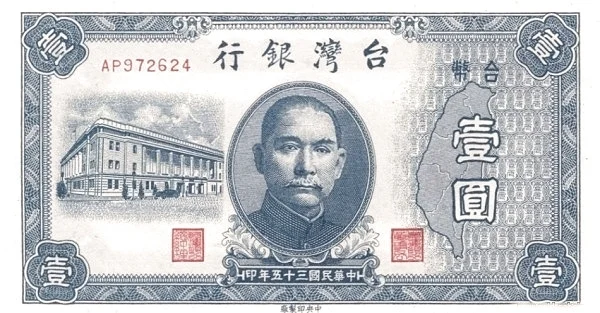
Every 100 or 1,000 NT$ note with his face was a political declaration: “We are the legitimate continuation of Sun Yat-sen’s revolution”. It’s nationalism you can hold in your wallet.
The Modern NT$100: A Security Feature Spectacular
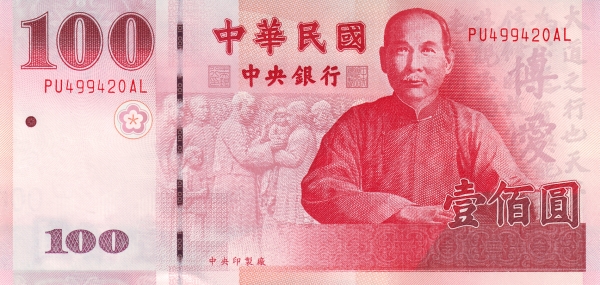
The current 100 New Taiwan Dollar note is a masterpiece of symbolic layering and anti-counterfeiting tech.
The front features Sun’s portrait from an original photograph, prominently placed on a red note. Behind him are writings from Confucius’s Book of Rites, with the characters “博愛” (fraternal love) in bold—a principle Sun embraced. There’s also a mural showing people gathered around a child, representing the ROC’s four values: Loyalty, Benevolence, Good Faith, and Peace.
The back shows the Chung-Shan Building from the Sun Yat-sen Memorial Hall complex at Yangmingshan National Park in Taipei. The watermark has plum blossoms and “100”.
- A holographic strip that changes from magenta to green
- Microprinting with repeated “100” numbers
- A small Braille dot on the front left containing “100” printed four times inside
- The whole thing glows under UV light like a banknote rave
Official Sources:
The Central Bank of Taiwan Currency Museum has complete documentation: “Banknotes and Coins in Circulation,” “The Banknote and Its Design Tell a Story,” and “Security Features of Banknotes and Coins in Circulation”. The Central Engraving and Printing Plant has technical specs on the window thread. It’s collector porn, essentially.
Collectors’ Tales of Sun Yat-sen: The Good, The Bad, and The Hilariously Misguided
The 80-Year-Old Man and His 1943 Banknote
In 2014, an 80-year-old man surnamed Ying tried to buy a train ticket at Yongkang station in Zhejiang Province using a 500 yuan note from 1943 featuring Sun Yat-sen. The note was almost as old as he was and hadn’t been legal tender since 1949.
He was adamant it should be accepted: “It’s a 500 yuan banknote! Why did the seller refuse to take it?”. He was trying to pay for a 12.5 yuan ticket (about $2) and expected change. Instead, he got a history lesson and probably felt quite foolish.
Source: BBC News covered this brilliant story on November 18, 2014. It’s equal parts tragic and hilarious.
The Fake That Meant Everything
Collector Victor Li shared a personal story about inheriting what he thought was a valuable Sun Yat-sen “Junk Dollar” coin from his grandmother. He had visions of early retirement when he learned authentic examples were estimated at $400,000-$600,000 in a 2016 auction.
Multiple dealers confirmed it was fake—the portrait details and ribbon on the reverse were slightly off compared to an authentic 1915 example. Dreams: crushed.
But here’s the thing: his paternal grandmother took that coin with her when she fled China for Taiwan in 1949. Maybe she thought it would be valuable someday, or maybe she just wanted a memento from her old life. Either way, that fake coin symbolizes her resolve and strength.
That’s the thing about collecting this stuff—sometimes the provenance and personal history matter more than authenticity. Though authenticity is still quite nice when you’re trying to sell things.
Personal Source: Victor Li’s “The Folly of Collecting Chinese Coins” website. Honest, touching, and a cautionary tale.
The Sun Yat-sen “Junk Dollar” Ristamped in America
Speaking of Junk Dollars—the Year 23 (1934) Sun Yat-sen dollar showing a Chinese junk ship on the reverse—most examples you find today are actually restikes made in the USA in 1949. When the Nationalists fled to Taiwan, they needed currency fast and had these coins restruck in America.
Collectors need to know their varieties or risk overpaying for modern production pretending to be original.
Source: Ken Elks, “Coins of the Chinese Republic” (1996).
Errors, Varieties, and Auction Madness
The “Teals” Instead of “Taels” Blunder
One of the most famous varieties is a 5 Taels note from the Hunan Government Bank, Official Mint Hunan, Year 32 (1906) that misspells the unit as “Teals” instead of “Taels”.
An example sold at Archives International Auctions (May 24, 2015) for 9,000 HKD (about $1,150), exceeding the 8,000 HKD estimate. Not bad for a typo.
Serial Number Varieties
The Farmers Bank of China 50 yuan notes with Sun’s portrait exist in three different serial number varieties for both the brown and blue/multicolor versions. These aren’t errors—they’re intentional production variations that create subcategories for obsessive collectors to hunt down.
Record Prices for Gem Specimens
At the May 2022 World Banknote Auctions Sale 26, Sun Yat-sen notes in exceptional condition commanded spectacular prices:
- 100 yuan 1945 (P-394) PMG Superb Gem UNC 67 EPQ: $750 (estimate: $100)
- 500 yuan Federal Reserve Bank ND (1943) (P-J78a) PMG Choice UNC 64: $950 (estimate: $300)
- 100 yuan 1948 (P-407) PMG Gem UNC 66 EPQ: $350 (estimate: $100)
SPECIMEN overprints—proof notes never intended for circulation—are particularly sought after. These are the notes that make collectors simultaneously ecstatic and financially devastated.
Auction Documentation: NumisBids Sale 26, May 26-27, 2022.
The End of an Era? Taiwan 2028
In 2025, Taiwan’s Central Bank announced a complete banknote redesign scheduled for 2028, potentially removing political figures like Sun Yat-sen from the currency. Governor Yang Chin-long stated they’re considering eliminating portraits from the new notes, which have been in use for 24 years.
This would end nearly a century of Sun’s image on Chinese currency. It reflects Taiwan’s evolving identity, gradually detaching from the Republic of China narrative to develop its own distinct identity.
Current News Sources:
- Focus Taiwan: “Political figures could be removed from new banknotes: Governor” (October 24, 2025)
- YouTube: “Taiwan Banknote Redesign Stirs Debate in Legislature” (October 22, 2025)
For collectors, this is bittersweet. The notes currently in circulation will become historical artifacts rather than active currency. Values will likely increase for high-grade specimens as they transition from “current” to “historical”.
The Collector’s Bibliography: Where to Go From Here
If I’ve somehow convinced you to fall down this rabbit hole, here are the essential sources:
Primary Archives & Museums:
- China Numismatic Museum (Beijing): 300,000+ pieces, complete RMB collection
- Hong Kong History Museum: 5,000+ Sun Yat-sen objects, manuscripts, stamps
- Central Bank of Taiwan Currency Museum: Complete digital archive of Taiwanese notes
- British Museum (London): Historical Chinese banknote collection
- Smithsonian Institution (Washington): 20th-century Chinese numismatic collection
- Museums Victoria (Melbourne): 1912 commemorative coins
Essential Reading:
- Sun Yat-sen, “Kidnapped in London” (HathiTrust)
- Sun Yat-sen, “Memoirs of a Chinese Revolutionary” (HathiTrust)
- Irene Cohen & Wm. Theodore de Bary (eds.), “Sources of Chinese Tradition” (2nd ed.), 1999, ISBN: 9780231109390
- “Sun Yat‑sen: a Life Beyond Symbols” (Edizioni Ca’ Foscari)
- “Money Making Nation: Picturing Political Economy in Banknotes” (2017)
- National University of Singapore: “China’s Great Monetary Revolution, 1942-1950”
Online Resources:
- HathiTrust Digital Library: Sun’s complete works
- Asia for Educators (Columbia): Translated primary documents
- JSTOR: Academic articles and primary sources
Final Thoughts: More Than Just Paper
Sun Yat-sen’s image on currency represents far more than a portrait on paper. It’s the materialization of an entire historical era, the transition from imperial to modern China, revolutionary struggle, and the sacrifices of thousands of martyrs.
One collector I know described finding a 1940 10-yuan note with Sun’s portrait in nearly perfect condition as “holding a tangible piece of someone’s belief in the future”. Every note tells a story—whether it’s Sun’s revolutionary bonds printed before the revolution even succeeded, the hyperinflation notes worth millions that couldn’t buy a train ticket, or the modern Taiwanese notes that might be the last to feature his portrait.
Whether Sun’s image appears on future Taiwanese notes or not, his legacy as the father of modern China remains indelible. And for us collectors, that legacy lives on in every specimen we preserve, every variety we hunt down, and every story we share about the man who ended up on everyone’s money—until he didn’t.
Now if you’ll excuse me, I have some auction catalogs to review and a completely reasonable amount of money to spend on pieces of paper.