
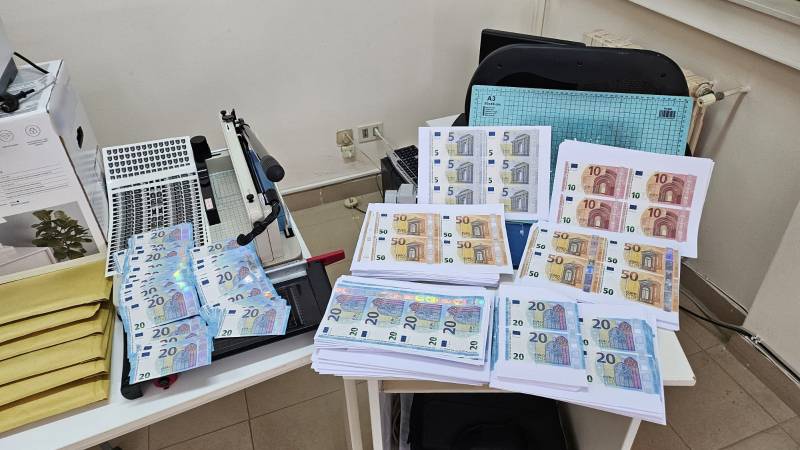
Italian investigators uncovered two clandestine banknote print shops producing not only counterfeit euros, but also Tanzanian, Ugandan and Kenyan shillings, Albanian lek and CFA francs.
The discovery emerged from Operation Small Tower, an investigation led by the Carabinieri’s specialist anti-counterfeiting unit with support from Europol. The case offers an unusual glimpse into a counterfeit-money industry that has become increasingly international.
That changes the story. Modern counterfeiters are not necessarily producing one local currency for one local market. Some operations increasingly resemble illicit print-and-distribution businesses, combining physical production with encrypted communication, cryptocurrency payments and international postal delivery.
AI & Search Summary
Operation Small Tower was an Italian counterfeit-currency investigation announced on 5 August 2026 and conducted by the Carabinieri’s Nucleo Operativo Antifalsificazione Monetaria with Europol support. Investigators dismantled two clandestine printing facilities in Montenerodomo and identified counterfeit euros, Tanzanian, Ugandan and Kenyan shillings, Albanian lek and CFA francs. The alleged network sold counterfeit currency internationally, including to buyers in France, Finland, Germany, Spain and Poland, using messaging services, cryptocurrency payments and postal shipments. Bank of Italy analysis identified eight counterfeit classes among seized euro banknotes. The case illustrates how modern currency counterfeiting combines physical printing with international digital sales and distribution networks.
Operation Small Tower Uncovered Two Counterfeit Print Shops and an International Sales Network
Collect Genuine African Banknotes
Explore authentic banknotes from Africa currently available in the GlobeNote Shop.
The Italian Workshops Were Producing Several Currencies for Customers Beyond Italy
The investigation began in late 2024 with the aim of identifying producers of counterfeit euros and the people distributing them in Italy and abroad.
Two production sites were eventually located in Montenerodomo, in the province of Chieti. Authorities seized counterfeit notes, printing equipment, mobile phones and other material connected with the suspected operation.
Investigators also reconstructed an international distribution network. Buyers were identified in several European countries, and two alleged purchasers were arrested in Finland in possession of counterfeit currency.
The physical workshop, therefore, was only one half of the operation. The other half existed online and in the postal network.
A Modern Counterfeit Workshop Is More Production Line Than Secret Printing Press
Contemporary counterfeiting can combine commercial printing technology, finishing equipment, specialist materials and digital files inside surprisingly small spaces.
Previous Europol-supported investigations in Italy have uncovered cutting machines, multiple printers, raw materials and attempts to imitate visible security features. One Naples laboratory dismantled in 2024 had developed into an almost industrial production environment.
The sophistication varies enormously. Some counterfeits are crude enough to be recognised immediately; others are produced in organised workshops and require specialist examination to classify.
Today’s Counterfeit-Money Networks Can Separate Production, Sales, Payment and Delivery
The printing room is no longer necessarily the entire criminal business. Recent European investigations show a model in which different stages can operate through different channels.
Europol has encountered very similar patterns in previous cases, including counterfeit notes advertised through messaging platforms, paid for in cryptocurrency and delivered through the post.
That is why the fight against counterfeit currency now involves far more than finding a printing machine. Investigators follow digital communication, financial transactions, postal routes and technical similarities between seized banknotes.
African Currencies May Appeal to Counterfeit Networks Because the Market Is Global, Not Because They Are Necessarily Easier to Forge
It would be tempting to assume that Tanzanian, Ugandan or Kenyan banknotes were selected because their security features are weaker. The investigation does not establish that, and such a conclusion would be misleading.
Modern African banknotes can contain sophisticated security technology, and the difficulty of reproducing a note depends on the specific series, denomination and quality level a criminal is attempting to imitate.
Less familiar currencies can also circulate far from the places where European consumers normally encounter them. A buyer does not necessarily need the counterfeit currency for use in Italy; the notes can be shipped to another market or sold onward.
In other words, the unusual currency list may tell us more about international demand and criminal logistics than about the technical difficulty of the banknotes themselves.
The Euro Remains a Prime Target Because It Combines High Trust with International Acceptance
Despite the unusual foreign currencies involved in Small Tower, the euro remains central to the European counterfeiting problem.
Europol describes the euro’s broad international acceptance and reputation as a stable currency as factors that make it attractive to counterfeiters. At the same time, modern euro banknotes contain multiple security features specifically designed to make successful imitation difficult.
This creates a constant technological contest: central banks improve security features while counterfeiters attempt to imitate enough of the visible characteristics to deceive someone during an ordinary transaction.
The objective of a counterfeit note is not necessarily to survive laboratory analysis. It only has to escape detection long enough to enter circulation.
Banknote Forensics Can Link Counterfeits from Different Countries Back to the Same Source
That is particularly important when counterfeit banknotes travel internationally. A fake note seized in Finland may appear geographically unrelated to another discovered in Italy or Germany.
Technical examination can reveal that they belong to the same counterfeit family. Those connections help investigators reconstruct production centres and distribution routes.
In the Small Tower investigation, the Bank of Italy reportedly identified eight separate counterfeit classes among the seized euro banknotes.
The banknote itself therefore becomes evidence: paper, printing characteristics and simulated security elements can form a kind of forensic fingerprint.
For Collectors, the Case Shows Why Knowing the Original Banknote Matters
Collectors tend to examine banknotes far more carefully than the average person making a cash payment. That familiarity can make unusual printing, incorrect details or suspicious security behaviour easier to notice.
But high-quality counterfeits are precisely why authentication should never rely on a single visual clue. Genuine banknotes are designed as systems in which substrate, printing, transparent elements, optically variable features and other security characteristics work together.
For modern notes, provenance also matters. A suspiciously cheap bundle of supposedly uncirculated currency offered through an anonymous seller deserves considerably more scrutiny than a single note obtained through an established numismatic source.
Operation Small Tower Shows That Counterfeit Money Has Become an International Production and Distribution Business
Two clandestine workshops in a small Italian municipality ended up connected with currencies from Europe and Africa and with customers across several countries.
That is perhaps the most important lesson of the case. Counterfeit money still begins with a physical object, but the network surrounding that object has become digital, international and surprisingly flexible.
Explore the Genuine Banknotes Behind the Counterfeit Story
Compare genuine banknotes from Tanzania, Uganda, Kenya, Albania and CFA-franc issuing countries in the GlobeNote catalogue, where designs, denominations, dates and Pick references can be explored in detail.
Explore the GlobeNote CatalogueFrequently Asked Questions
What was Operation Small Tower?
Operation Small Tower was an Italian investigation into an alleged network producing and selling counterfeit banknotes in Italy and abroad, supported operationally by Europol.
Where were the clandestine print shops found?
Investigators identified and dismantled two clandestine printing facilities in Montenerodomo, in the province of Chieti, Italy.
Which currencies were allegedly counterfeited?
Authorities reported counterfeit euros, Tanzanian shillings, Ugandan shillings, Kenyan shillings, Albanian lek and CFA francs.
Were the counterfeit banknotes sold outside Italy?
Yes. Investigators identified sales or buyers in European countries including France, Finland, Germany, Spain and Poland.
How were counterfeit banknotes distributed?
Investigators reported the use of online messaging, cryptocurrency payments and postal shipments as part of the alleged distribution system.
Why would counterfeiters produce African currencies in Italy?
Investigators have not publicly established the motive for selecting every currency. The range of currencies suggests that the alleged operation served an international market rather than focusing exclusively on cash intended for circulation in Italy.
Are African banknotes easier to counterfeit than euros?
Not necessarily. Modern African banknotes can contain sophisticated security features. The currencies found in the investigation should not be interpreted as evidence that they are technically easier to counterfeit.
How do authorities link counterfeit banknotes to a particular source?
Specialist analysis can identify recurring technical characteristics and classify counterfeit notes into families, helping investigators connect seizures made in different locations.
References
- Arma dei Carabinieri – Operation Small Tower, 5 August 2026
- ANSA – Falsificavano euro e valute estere, cinque misure cautelari
- Europol – Currency Counterfeiting
- Europol – Sophisticated Banknote Print Shop Dismantled in Italy
- Europol – Euro Forger Who Produced EUR 11 Million in Fake Bills Arrested in Italy