The Billion-Mark Grave
Picture a nation discovering overnight that its life savings were nothing but scrap paper. Welcome to East Germany, 1990.
It’s 1989, the Berlin Wall has just crumbled, and suddenly East Germans realise they’ve been living in a parallel universe where money wasn’t money, it was a state-sponsored placebo. The “Mark der DDR” looked official enough—portraits of stern intellectuals, heroic workers, a splash of socialist chic. But outside the grey concrete paradise, those notes had the purchasing power of wet cardboard.
The numbers are staggering. In circulation: over 16.6 billion East Marks. Stashed under mattresses, locked in cupboards, saved for that magical day when socialism would deliver colour TVs and bananas without a queue. And then—bang—June 1990 arrives. The politicians, desperate to weld East and West into one shiny Deutschmark dream, announce the Währungsunion. Overnight, the DDR Mark was not just devalued—it was executed. No appeal, no trial.
To make it palatable, they called it “conversion.” But to the man in Leipzig who had 20,000 Marks tucked away, it felt like being told his life’s work had been swapped for pocket lint. The rules? Kids and pensioners could exchange up to 4,000 Marks at a smug 1:1. Everyone else got 2,000. Anything more? Half. Two Marks became one Deutsche Mark, as if the West was patting the East on the head saying: Nice try, comrade.
Over 16.6 billion East Marks were suddenly voided in July 1990 — the largest mass invalidation of currency in European history.
Conversion, or State-Sanctioned Robbery?
The day the DDR Mark was “converted” — and half of East Germany’s savings evaporated into thin air.
Children and pensioners could exchange up to 4,000 East Marks at a generous one-to-one rate. Everyone else? Just 2,000. Beyond that, every extra Mark you had turned into half a Deutsche Mark, as if the government had looked at your life savings and said: “Cute. We’ll give you 50% off.”
Companies fared even worse. Their accounts, balance sheets, and reserves—often built over decades—were bulldozed into West German accounting standards at a brutal 2:1 rate. It was the financial equivalent of sending a Trabant to a Formula One race. Spoiler: the Trabant didn’t win.
Ordinary people lined up at banks, handing over neat bundles of Karl Marx and Clara Zetkin notes, knowing half of them would vanish in the conversion like smoke. The 200 Mark note—supposed to be the pride of the DDR—was treated like an embarrassing uncle at a family reunion. By the end of 1990, the East German mark had been reduced to pulp. Literally. Millions of notes were shredded, compressed into bricks, and in some cases sold off as quirky souvenirs.
Those shredded DDR Marks were sold as paperweight souvenirs — proof that one nation’s tragedy became another’s novelty gift.
The Numismatic Afterlife
From worthless propaganda paper to collectible treasure: the DDR Mark’s unexpected resurrection.
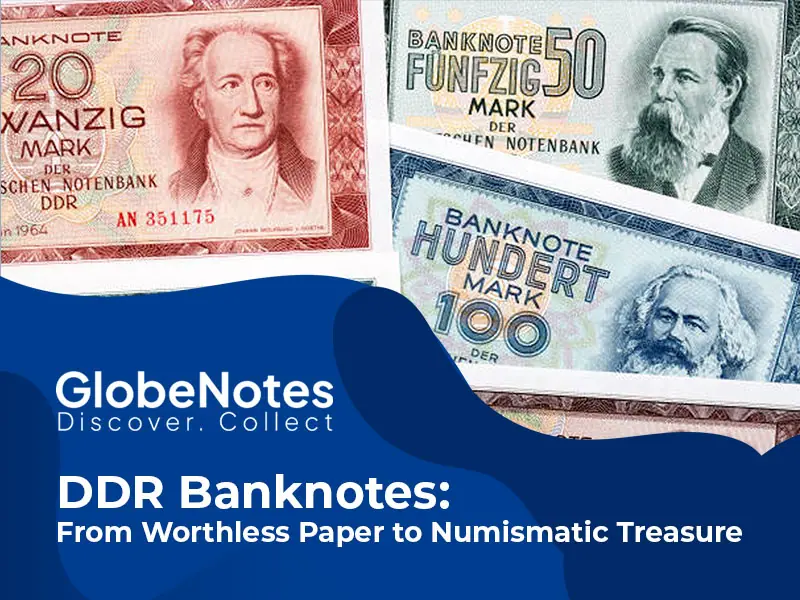
Here’s the delicious irony: the DDR Mark, once ridiculed as worthless, now has a second life as collectible treasure. Those bland, grey-green notes with factory workers, Karl Marx, and anonymous scientists are suddenly desirable — not because of what they bought, but because of the story they tell.
For a collector, holding a 100 Mark DDR note today is like holding a passport to absurdity. It whispers: “this was once real money in a country that no longer exists.” It’s a conversation piece, a tangible reminder of how ideology, politics, and economics can turn the abstract idea of “value” into confetti.
And unlike the East Germans in 1990, collectors today aren’t being forced into a bad deal. On the contrary: the DDR Mark has found a new marketplace where rarity, history, and irony combine to make it more valuable than it ever was in circulation. The “graveyard of a currency” has become a playground for numismatists. Not bad for money that once couldn’t even buy you a decent pair of jeans.
Complete DDR sets remain affordable, but pristine UNC notes and rarities like the 200 and 500 Mark are steadily climbing in value.
From Shredders to Collectors: Survival Stories & Technical Features
How bricks of DDR banknotes slipped past destruction — and what makes them fascinating to collectors today.
When the Bundesbank ordered DDR notes destroyed, the plan was ruthless: shred everything, pulp it, and erase socialism’s paper trail. But reality was messy. Warehouses were crammed with bundles fresh off the press. Some were misplaced, others “forgotten,” and a few slipped quietly out the back door. Human nature and bureaucracy proved to be better preservationists than any museum.
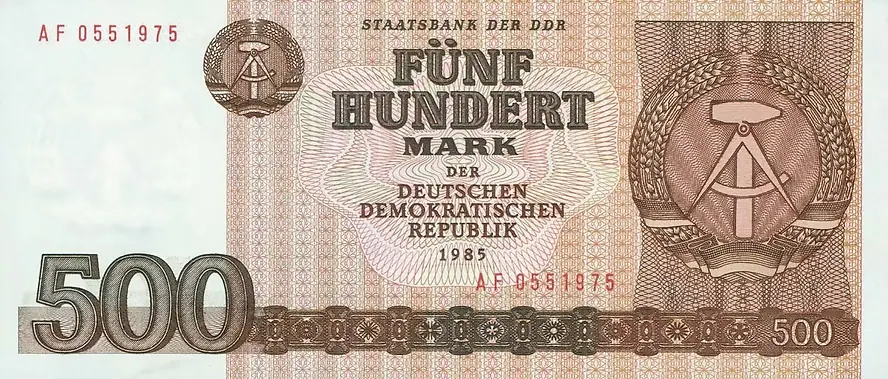
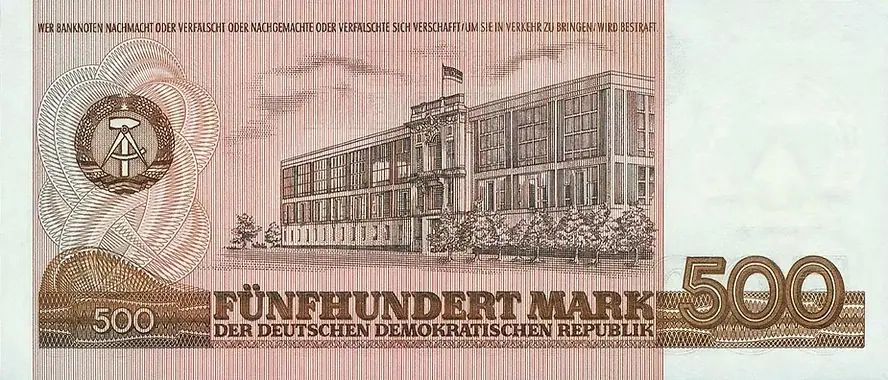
The most legendary survivor? The 500 Mark DDR. Printed in the mid-1980s, it was never officially issued. The front carried the state emblem of the DDR, while the reverse showed the State Council building in East Berlin. Most were burned, but some leaked into the collector market. Today, they are the crown jewel of DDR paper money, more myth than currency.
Entire uncirculated bundles of DDR notes still surface today, often wrapped in original bank straps. Proof that even shredded history finds a way to survive.
| Denomination | Main Design | Reverse Motif | Size (mm) | Rarity Today |
|---|---|---|---|---|
| 5 Mark | Worker & Youth | Industrial scene | 125 × 60 | Common |
| 10 Mark | Young Woman / Scientist | Factory motif | 132 × 61 | Common |
| 20 Mark | Scientist theme | Laboratory / Research motif | 138 × 63 | Uncommon in UNC |
| 50 Mark | Worker Portrait | Factory scene | 144 × 65 | Moderately scarce |
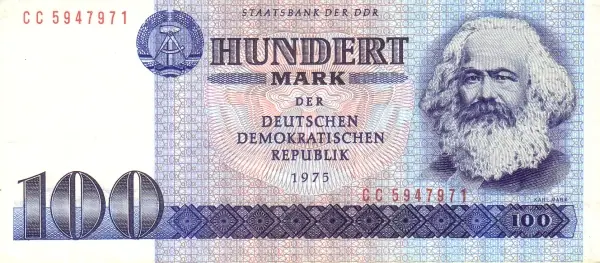
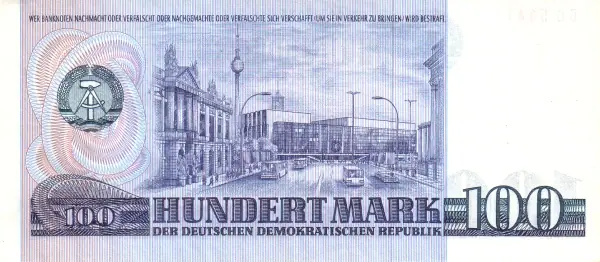
| 100 Mark | Karl Marx | State emblem / Architecture | 150 × 67 | Iconic & collectible |
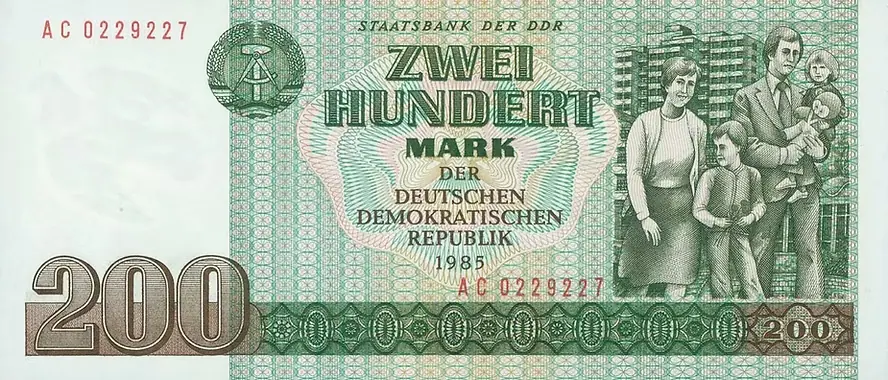
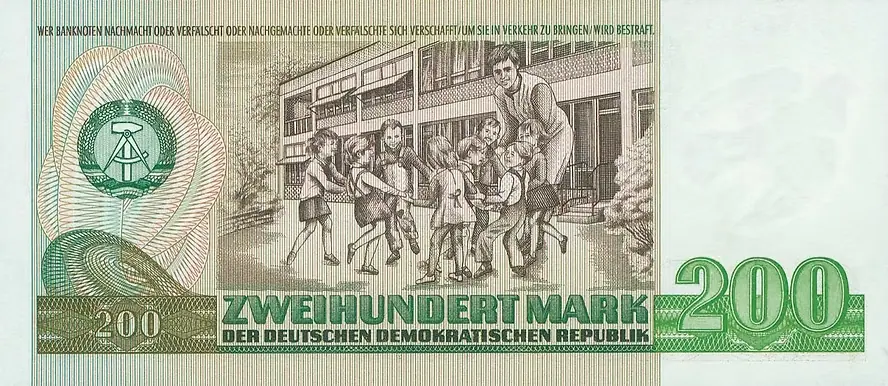
| 200 Mark | Family & Housing Estate | Children in Kindergarten | 152 × 64 | Rare (never widely circulated) |
| 500 Mark | DDR Emblem | State Council Building (Staatsrat) | 158 × 68 | Extremely rare (never issued) |
Find Now DDR Banknotes on our Shop Globenote.net
The Most Wanted DDR Banknotes
From iconic Karl Marx portraits to phantom notes that never saw circulation, here’s what collectors chase the hardest.
The DDR series most sought after by collectors are not just relics of a collapsed state — they are windows into history. The final series of 1971/1975, especially the 100 Mark with Karl Marx, is a favourite for its historical symbolism and its classic design.
Earlier emissions from 1948 and 1955 also hold strong demand, particularly rare reprints or exceptionally preserved examples. For specialists, these early notes are the foundations of DDR numismatics.
And then there are the mythical ones: the 200 and 500 Mark denominations printed in 1985 but never released. These “phantom notes” are rare finds on today’s market, hunted by collectors worldwide. Add to that the quirky modern “Zero Euro” DDR Museum notes, and you have a collector’s ecosystem where nostalgia, rarity, and irony intertwine.
DDR 100 Mark (1975, Karl Marx) and the never-issued 500 Mark (1985) remain the crown jewels of DDR collections.
Rarity & Print Runs
Why some DDR banknotes became collector’s gold: limited runs, never-issued designs, and survival rates close to zero.
The rarity of DDR banknotes is not always about how many were printed — it’s about how many survived. While millions were destroyed in shredders or underground bunkers, a few escaped into the numismatic world. These are the highlights:
| Denomination | Year / Series | Notes on Rarity | Current Status |
|---|---|---|---|
| 200 Mark | 1985 (never issued) | Printed but never circulated; most destroyed, few leaked into collections. | Rare and highly collectible |
| 500 Mark | 1985 (never issued) | Phantom note; only a limited number survived after destruction in Halberstadt tunnels. | Extremely rare |
| First Issues | 1948, 1955 | Some withdrawn quickly or reprinted in limited batches. | Scarce in UNC condition |
| Special Prints | 1960s–1970s | Commemorative designs, test prints, or unique variants. | Specialist-level rarity |
| High Grade UNC | Any denomination | Survival rate low; PMG 67+ are especially sought after. | Premium pricing |
The 200 and 500 Mark 1985 notes are the “phantom DDR banknotes” — never issued, mostly destroyed, and today the ultimate prizes for serious collectors.
Market Values & Collector Prices
How much are DDR banknotes worth today? From pocket money relics to four-figure rarities.
The DDR banknote market remains active, with common circulated pieces available at modest prices and rare unissued notes commanding hundreds of euros. Below is a snapshot of typical values observed in the collector market (2020–2025):
| Series / Denomination | VG / F | VF | UNC | eBay Avg (Good/UNC) |
|---|---|---|---|---|
| 5 Mark (1975) | €3 – €14 | €10 – €40 | €100 – €130 | €25 – €90 |
| 10 Mark (1971) | €3.50 – €14 | €15 – €45 | €120 – €250 | €40 – €120 |
| 20 Mark (1975) | €4 – €17 | €20 – €50 | €130 – €325 | €35 – €130 |
| 50 Mark (1971) | €5 – €20 | €25 – €70 | €200 – €325 | €50 – €180 |
| 100 Mark (1975) | €10 – €40 | €75 – €150 | €250 – €400 | €70 – €250 |
| 200 Mark (1985, never issued) | €100 – €400 | €350 – €800 | > €800 | €300 – €850 |
| 500 Mark (1985, never issued) | €150 – €500 | €400 – €1,000 | > €1,000 | €450 – €1,200 |
Prices are indicative and vary depending on grading (PMG, PCGS), provenance, and auction dynamics.
Sources & References
Authoritative archives and references for DDR banknotes research.
Frequently Asked Questions about DDR Banknotes
Everything collectors want to know — from value to authenticity checks.
1. Are DDR banknotes still redeemable or exchangeable?
No. Banknotes and coins from the German Democratic Republic (DDR) are no longer exchangeable—unlike the old Deutsche Mark, which the Bundesbank still redeems forever. :contentReference[oaicite:0]{index=0}
2. Why do 200 and 500 Mark DDR banknotes exist if they never circulated?
They were printed in preparation for potential future issuance, but never released for general circulation. Some ended up locked in storage vaults or underground tunnels. :contentReference[oaicite:1]{index=1}
3. How did intact bundles of DDR banknotes survive the destruction ordered after reunification?
Because of a mix of mismanagement, theft, and oversight. Thousands of tonnes of DDR banknotes were stored in tunnels near Halberstadt and only destroyed decades later, but by then some bundles had already been pilfered. :contentReference[oaicite:2]{index=2}
4. How can I authenticate a DDR banknote or spot a forgery?
Look for classic security features: watermarks, security threads, high-quality intaglio printing, consistent fiber texture. Also check edges, registration, and condition. DDR had a “Falschgeld” (counterfeit detection) office to classify fakes. :contentReference[oaicite:3]{index=3}
5. What is the current market value of DDR banknotes?
It varies widely. Common denominations (5, 10, 20, 50) in circulated condition fetch modest sums. Rare and uncirculated notes—especially high denominations like 200 or 500—can command premiums depending on condition and provenance. :contentReference[oaicite:4]{index=4}