
Dictators on Banknotes aren’t just a curiosity for collectors — they’re the loudest, tackiest, most delusional form of propaganda ever printed on cotton-linen blend. In democracies, banknotes are civil. Thoughtful. Poets, philosophers, national landmarks. A celebration of culture. But in a dictatorship? Subtlety is for cowards. You get The Leader. Again and again. Staring at you with the vacant smugness of a man who’s just nationalized your breakfast cereal.
When your regime is built on fear, revisionism, and marble statues of yourself, plastering your face on every denomination becomes a divine obligation. These weren’t currencies — they were sermons. Miniature, pocket-sized testaments to a state religion where the only god has a mustache and a suspicious love for military outfits.
This is the story of those bills. Not designed for commerce — but for worship. Dictators on banknotes weren’t made to buy bread. They were made to remind you who controls the oven.
North Korea – 5,000 Won (2009)
The Eternal Leader’s Wallet-Sized Shrine
In a country where history starts with your birth and ends with your legacy, there was never any doubt who would grace the highest denomination of North Korean currency. In 2009, amid a catastrophic currency redenomination that effectively erased what little savings citizens still clung to, the Democratic People’s Republic of Korea released the 5,000 won banknote.
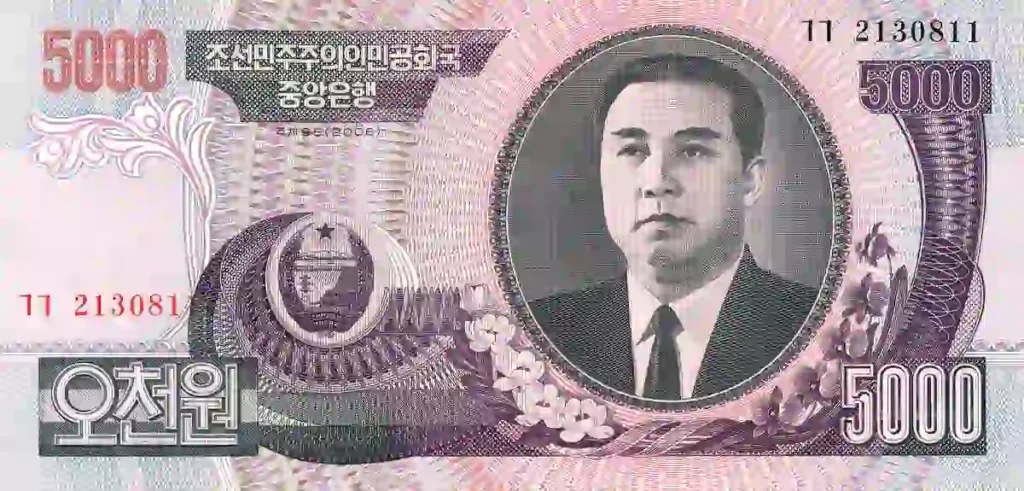
At its center—figuratively, literally, theologically—was Kim Il-sung, grandfather of the ruling dynasty and self-anointed “Eternal President.” The note was printed in solemn tones of violet and red, evoking both mourning and martyrdom. Kim appears in a formal suit, gazing solemnly toward the horizon as if scanning the peninsula for potential defectors.
On the reverse, we’re treated to a carefully curated image of his birthplace, Mangyongdae—a site that has been mythologized in state lore to the point of religious pilgrimage. Schools organize field trips to visit the wooden shack where, supposedly, the revolution began. It’s not a house—it’s a cradle of destiny.
And that’s the whole point: this wasn’t money. It was dogma. The bill was a holy relic passed from hand to hand, less useful in trade than in worship. Not that it mattered. The economy was so broken by that point, North Koreans were bartering potatoes and soap anyway. But woe unto you if you folded Kim Il-sung’s face the wrong way. Rumors swirled of arrests, public shaming, even labor camp detentions for crumpling his holy visage.
Even in economic oblivion, the Supreme Leader still managed to show up on payday. Because in North Korea, you don’t carry cash. You carry obedience.
Iraq – Saddam Hussein on Every Dinar (1986–2003)
Saddam’s Autographed Currency Collection
In Iraq, during the reign of Saddam Hussein, pulling money from your pocket was less an act of commerce and more a consultation with the national oracle. Every denomination, from the humblest 5 dinar note to the more “dignified” 250, bore his moustached gaze. It was as if Iraq’s monetary policy had been outsourced to a cult photographer obsessed with Saddam’s bone structure.
The man didn’t just appear on banknotes—he starred in them. Each note felt like a new episode of Keeping Up with the Husseins. There was Saddam in fatigues, inspecting troops. Saddam in a suit, staring contemplatively into the abyss of his own ambition. Saddam in a keffiyeh, posing like a Bedouin model in a war calendar.
And it wasn’t just the design. These banknotes were released during times of unimaginable turmoil: the Iran-Iraq war, the first Gulf War, the sanctions, the rebuilding, the re-collapse. Yet no matter what happened, one thing was consistent: Saddam’s portrait never blinked.
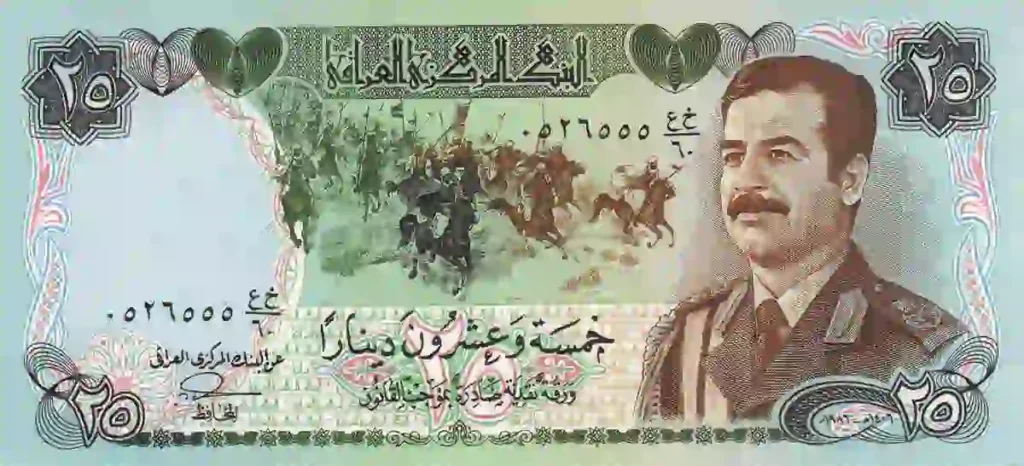
Perhaps the most iconic is the 25 Dinar note, where Hussein appears flanked by Ba’athist symbolism and military regalia, like an autocratic Bond villain midway through a state-sponsored fashion shoot. The 250 Dinar note is equally theatrical, a soft pink and brown tableau of Saddam as the nation’s patriarch—a cross between a brutalist godfather and your least favorite uncle at a wedding.
But there was a dark genius to it. In a country under suffocating state control, your interaction with money wasn’t just economic—it was psychological. Every purchase, every sale, every debt was sanctified with the Leader’s face. Want to buy bread? Here’s a reminder of who controls the wheat. Filling your car? Gaze into the eyes of the man who built the pipelines… and the gallows.
And if you dared to criticize, even in private, your very wallet would betray you. It spoke his name with every transaction. The banknotes were designed not to circulate wealth—but to circulate fear.
Libya – Muammar Gaddafi in Full Revolution Chic
The Currency of a Man Who Dressed Like a Concept Album
If Saddam Hussein’s dinar was an exercise in intimidation, Muammar Gaddafi’s dinar was pure, unapologetic theater. You didn’t just see Gaddafi on Libyan money—you experienced him. It wasn’t so much a currency as it was a visual mixtape of one man’s delusion of immortality.
Gaddafi didn’t content himself with appearing on a single note. No, he appeared across multiple denominations—1, 5, 10, 20, 50 dinars—in different moods, costumes, and revolutions. He was the only head of state whose banknotes looked like outtakes from a photoshoot for a funk album. In one, he wore aviator sunglasses indoors, wrapped in a desert scarf like a Bedouin Rambo. In another, he was clean-shaven and composed, as if auditioning for the role of himself in a state-funded biopic.
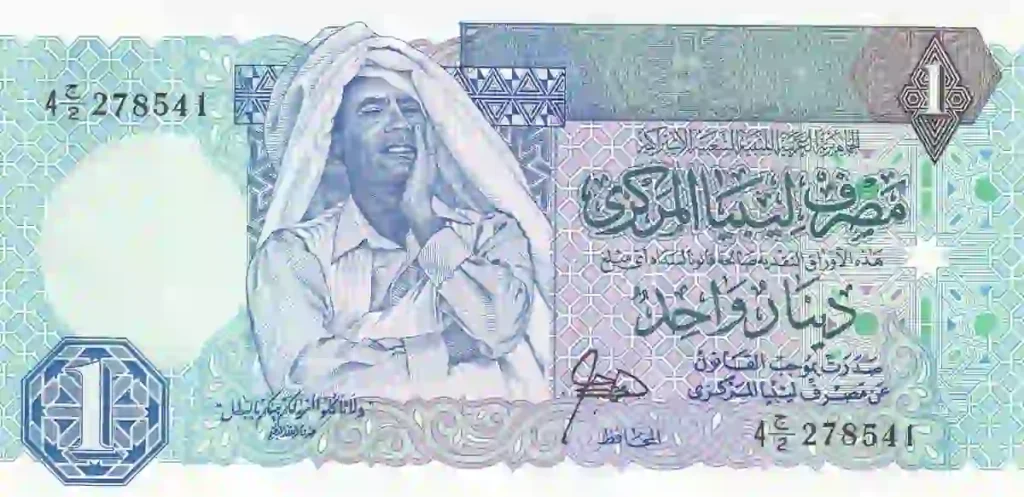
The 1 Dinar note, printed around 2004, is perhaps the most infamous. It depicts Gaddafi staring off into eternity with that “don’t-touch-my-hair” intensity, his robe billowing like a curtain at a bad off-Broadway play. It’s flanked by vague references to Libya’s “revolutionary achievements”—things like irrigation projects, power stations, and other unfinished dreams. The background colors are an awkward palette of brown and mustard, as if even the designer had second thoughts halfway through.
But Gaddafi’s true innovation wasn’t aesthetic. It was spiritual. He didn’t just print money; he sacralized it. His face was a declaration of divine right. He called himself “The Brother Leader” and treated the Central Bank like his personal merch table.
There’s something almost camp about it now, in retrospect. But back then, it was deadly serious. Every diner carried a piece of Gaddafi’s vision of Libya—a vision where the leader was the state, the ideology, the culture, the wardrobe consultant. His Green Book wasn’t a guide. It was a gospel. And his banknotes were the printed psalms of a man who believed that revolution never needed an expiration date.
Of course, after 2011, the new Libya had other ideas. Gaddafi fell, brutally and publicly. His banknotes didn’t. For a while, they continued to circulate—ghost money from a dead regime. People paid for groceries with the face of a man rotting in a freezer. Eventually, the currency was pulled. But collectors still seek those bills today. Not for their value. For their audacity.
Because if there’s one thing Gaddafi understood better than any economist: it’s not what a banknote is worth—it’s how hard it slaps when you look at it.
Dictator on Banknotes:Syria – Bashar al-Assad and the Illusion of Permanence
A Banknote as a Funeral Portrait
In 2017, amid a civil war that had already claimed hundreds of thousands of lives and turned once-vibrant cities into ghost towns, the Central Bank of Syria had a brilliant idea: release a brand-new banknote. Not to stabilize the economy. Not to build confidence. No. To introduce, for the very first time, the face of Bashar al-Assad.
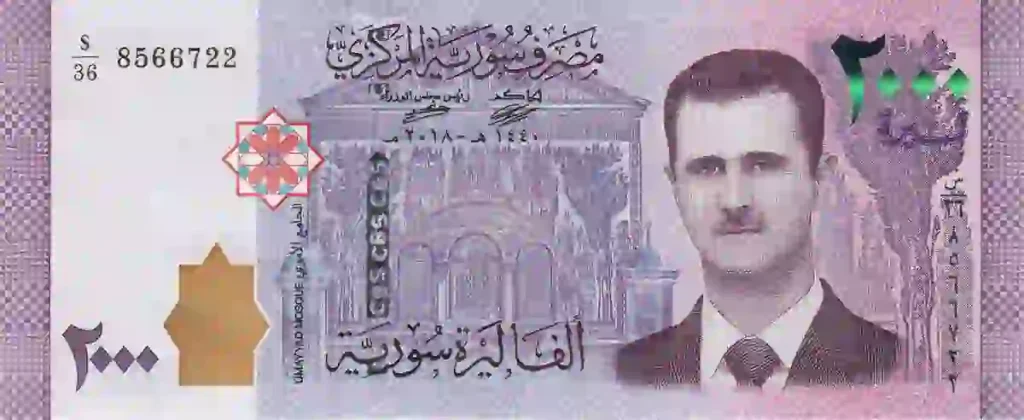
It was the 2,000 Syrian Pounds note—the highest denomination ever issued in Syria at the time. Not because the economy was booming. Quite the opposite. Inflation had sunk its teeth deep into the flesh of the Syrian lira, and prices were dancing a tragic waltz upward. But instead of acknowledging that their country was bleeding, the regime doubled down with a portrait.
The note itself is a muted gray-lavender, a color that might have been chosen to suggest dignity, or possibly to match the rubble-strewn streets of Aleppo. On the obverse: Assad, in a well-cut suit, immaculately groomed, looking like an overpaid mortician at a dictator’s wake. No smile. No warmth. Just the cold, immovable stare of a man who insists everything is under control—while standing atop a pile of ashes.
The reverse features the Parliament building, a symbol that in most nations evokes debate, law, democracy. In Syria, it felt like a cruel joke. By 2017, Parliament was little more than a pro-regime echo chamber, rubber-stamping decisions made elsewhere—usually in a bunker.
This note was not money. It was a hallucination printed on polymer. A last-ditch attempt to convince the Syrian people—and perhaps the world—that the regime was stable, that the state was functioning, that the man whose policies had fractured the nation still deserved to be its face.
But unlike other dictators who drowned in the aesthetics of grandeur, Assad’s note is barren, empty, ghostlike. There are no emblems of prosperity. No statues. No sunrays. Just a photo and a lie, laminated and legal tender.
Because in a collapsed country, you still have to buy bread. And sometimes, to buy bread, you hand over a symbol of the man who bombed your bakery.
Turkmenistan – Saparmurat Niyazov: The Manat as Mirror
Currency for the Cult of One
If North Korea had Juche and Syria had the illusion of stability, Turkmenistan had something far more theatrical: Turkmenbashi. Born Saparmurat Niyazov, he rechristened himself “Leader of All Turkmen” and proceeded to run the country like a surrealist stage production. Every statue, city, street, and month of the calendar paid tribute to his ego. And the manat, Turkmenistan’s currency, was his personal selfie album.
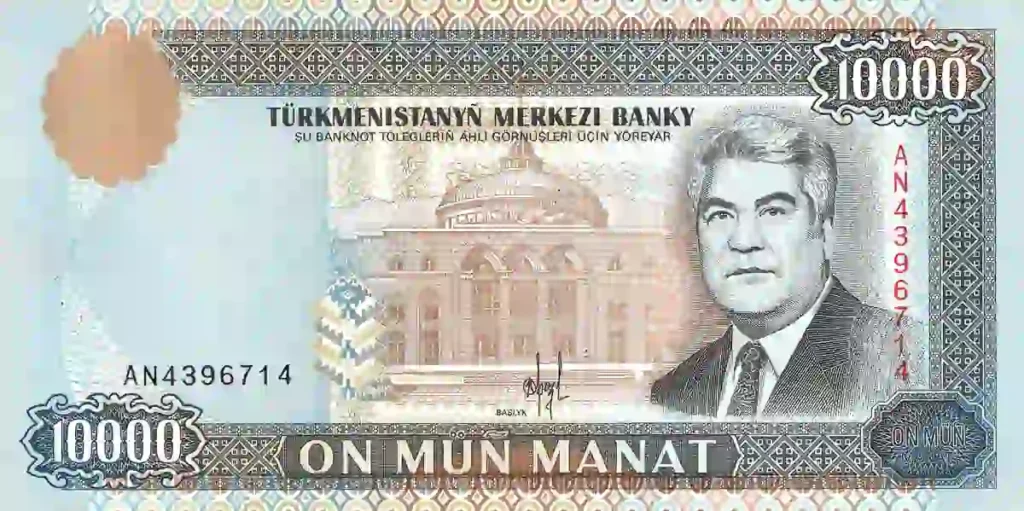
Between 1999 and 2009, every denomination in circulation—from 500 to 10,000 manat—featured Niyazov’s face. Not once. Not sparingly. Not with restraint. No: exclusively. The man had created a nation where diversification in money design was an act of treason.
The 10,000 manat note, the largest of the series, is a masterclass in narcissistic branding. Designed in luminous golden hues, Niyazov appears front and center in sharp ceremonial robes, lips tight, jaw locked—somewhere between statesman and state-sponsored messiah. Behind him, stylized national emblems, sacred books, and faceless monuments stand not for Turkmenistan, but for Turkmenbashi’s Turkmenistan.
Even the lower denominations like the 1,000 and 5,000 manat notes didn’t stray from the formula. There were no poets, no scientists, no generals. Just Niyazov. Niyazov from the left, Niyazov from the right. Niyazov with a smirk. Niyazov with a stare. It was as if the central bank had become a fashion magazine with a one-model policy.
It wasn’t just design—it was ideology. The manat was meant to show that there was no corner of public or private life untouched by his presence. You could pay your rent with his face. Buy tomatoes with his face. Donate to a hospital whose name he gave himself. Every transaction was a miniature genuflection.
And yet, the world watched in stunned silence as Turkmenistan’s economy chugged along on a foundation of natural gas and fantasy. Meanwhile, the people carried on—because when the only money available bears the image of your president, you don’t just spend currency… you spend loyalty.
Zaire – Mobutu Sese Seko: The Leopard Who Printed Himself
Legal Tender for the Kingdom of Me
In the jungle of post-colonial Africa, Mobutu Sese Seko wasn’t just a president. He was a walking myth, a self-made legend, an ego industry in perpetual cycle. And of course, such a man couldn’t let anyone else get on Zaire’s bills. Not even by accident. From the humblest 1 zaire to the mammoth 50,000 zaires, every single denomination was a tribute to him. Same pose. Same hat. Same retired predator look.
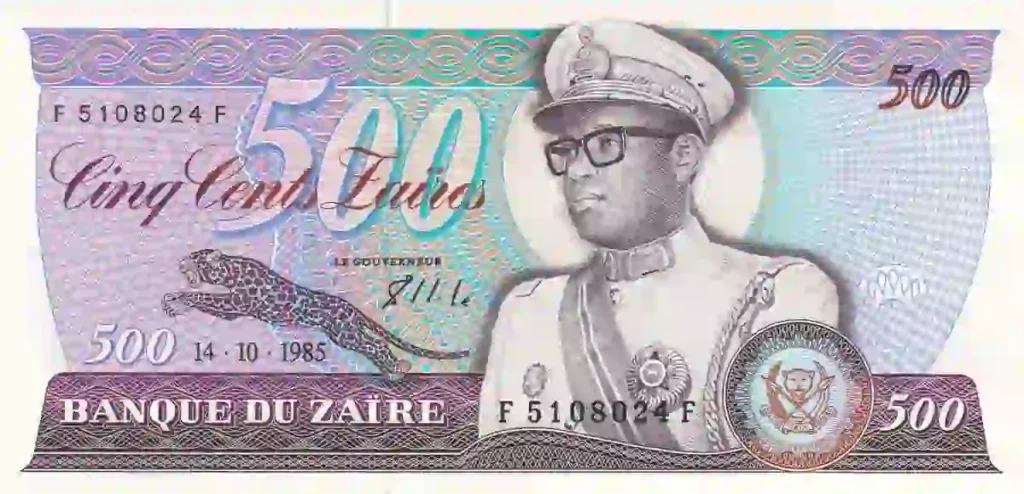
His image was a logo: square 1970s glasses, leopard hat, impeccable uniform. The bills issued between 1970 and 1996 were all Vogue covers of African authoritarianism. The most iconic? The 500 zaire from the 1980s: Mobutu portrayed as a pontiff of pan-Africanism, with symbols of modernity behind him-dams, power plants, satellites-all of which probably didn’t work, but which he had decided were there.
Over time, however, the bills became bigger, more colorful, more grotesque. So did the power itself. With hyperinflation at its doorstep, the Central Bank launched denominations of 20,000 and 50,000 Zaire, up to 5,000,000 Zaire with Mobutu’s face seemingly staring back at you as the banknote’s real value melted faster than ice at the equator.
But even in ruins, the style remained: the pastel colors, the soft features, the impassive face. The art of self-centeredness applied to money. It was like saying to the people, “I’ll steal everything from you, but at least I do it with class.”
And then, like a curtain drawn too quickly, Mobutu disappeared. He fled in 1997, overwhelmed by war and his own greed. But his banknotes remained – paper relics of a kingdom built on illusions and leopard cashmere.
Today they are sold at flea markets and numismatic sites. Objects to laugh at, to collect, to tell. Because when a currency becomes a selfish catalog, the only value it has left is a symbolic one: what one man’s obsession has cost the entire country.
Epilogue: When Ego Is More Valuable Than Money
In a normal world, currency is used to make life easier: to buy bread, to pay for a bus ticket, perhaps to bribe a customs official discreetly. But in these regimes, money has another function. It is not a tool: it is a manifesto, a portable idol, a collective identity document with the leader’s face on it.
Every bill tells a story. But these don’t. These impose a story. They look you in the eye and say, “You exist because I allow you to exist. And this piece of paper is proof of that.” It is the central bank as propaganda machine. The economy as a secondary background. The nation as a mirror.
And if these bills make us smile today, it is only because we have the privilege of observing them from afar, without living them. For millions, they represented the end of freedom, the face of control, the impossibility of escape.
Today they are collector’s items. But let us never forget: a banknote is never just a piece of paper. It is a political statement. And when you print on it the man who controls you, it is not money. It is a one-way ticket to the cult of person.