The United States plans to begin its next major banknote redesign with a new $10 Federal Reserve note in 2026. The new generation, commonly known as the Catalyst series, is expected to introduce raised tactile features, stronger counterfeit deterrence and improved machine authentication. But there is one awkward problem: some ATMs, vending machines and currency counters may not recognise the new note until their software and sensors are updated.
America is preparing to do something it approaches with the caution normally reserved for moving a national monument: redesigning the dollar. The process will begin with the $10 note and continue denomination by denomination through the following decade.
The objective is not merely to make the money look fresher. The Bureau of Engraving and Printing must produce a note that is harder to counterfeit, easier for visually impaired people to identify, compatible with billions of cash-handling transactions and accepted by machines from New York to a remote airport kiosk on the opposite side of the planet.
Quick answer
Will ATMs reject the redesigned US $10 bill? Properly updated machines should accept it, but older ATMs and cash-processing devices may temporarily reject or flag the new design if their recognition software, sensors or authentication profiles have not been updated. This would be a machine-compatibility problem, not evidence that the banknote is counterfeit.
Quick Facts
- Country: United States of America
- Currency: United States dollar
- Currency code: USD
- First redesigned denomination: $10 Federal Reserve note
- Planned first issuance: 2026
- Programme name: Catalyst
- Printer: Bureau of Engraving and Printing
- Issuing authority: Federal Reserve Board
- Design authority: United States Department of the Treasury
- Principal new feature: Raised tactile feature for accessibility
- Current official schedule: $10 in 2026, $50 in 2028, $20 in 2030, $5 in 2032 and $100 in 2034
- Current $10 portrait: Alexander Hamilton
- Final public design: Not yet fully disclosed as of June 2026
- Old banknotes: Remain legal tender and retain their face value
- Possible machine issue: Rejection by equipment awaiting software or hardware updates
Collect banknotes related to this article
Explore authentic world banknotes connected to this country, region or collecting theme.
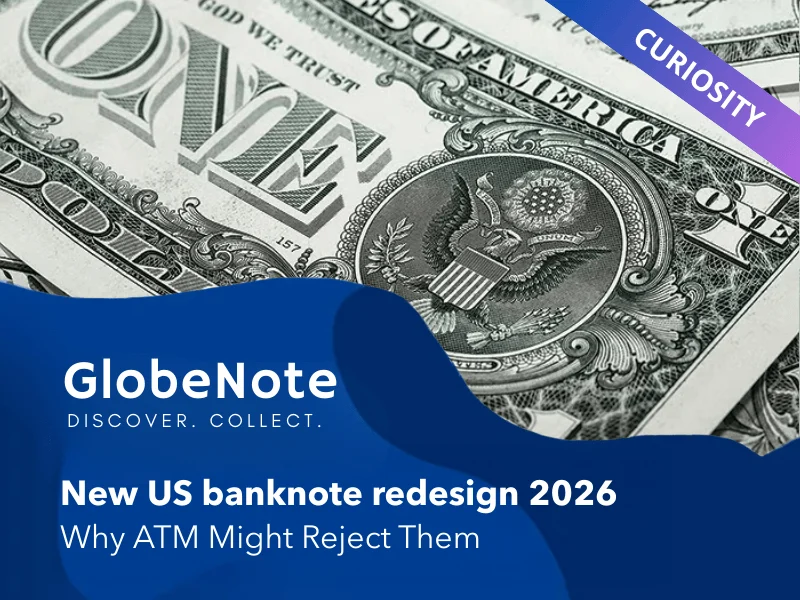
Important update: the official programme still lists the redesigned $10 note for 2026, but the final public design and exact circulation date had not been officially announced by 19 June 2026. Images claiming to show the finished banknote should therefore be treated as concepts unless published by the Treasury, Federal Reserve or Bureau of Engraving and Printing.
What Is the 2026 US Banknote Redesign?
The United States is developing a new generation of Federal Reserve notes under a long-term currency redesign programme. The work is coordinated among the Department of the Treasury, Bureau of Engraving and Printing, Federal Reserve Board, United States Secret Service and Advanced Counterfeit Deterrence Committee.
The $10 note comes first because redesigning currency is not simply an artistic exercise. Every denomination must pass security testing, production trials, durability evaluation, accessibility assessment and machine-compatibility testing before it can be issued.
The project has been referred to in government budget and audit documents as the Catalyst series. Unlike the suspiciously energetic name, the actual development process has moved with the measured pace of an institution that knows a minor mistake could confuse banks across the planet.
Has the New $10 Bill Been Released?
As of 19 June 2026, the Bureau of Engraving and Printing continued to show 2026 as the planned issuance year for the redesigned $10 note. However, an exact release date and complete official design had not been publicly confirmed.
Production beginning during 2026 does not necessarily mean that the banknote will immediately appear in every wallet. Notes are printed by the BEP, transferred to the Federal Reserve system and distributed according to demand. A new design may therefore take time to reach banks, businesses and individual regions.
The Federal Reserve’s 2026 print order includes between 102.4 million and 563.2 million $10 notes. That total covers the denomination’s production requirements, but the print order alone does not identify how many will be redesigned Catalyst notes or establish their public release date.
Official US Currency Redesign Schedule
| Denomination | Planned issuance | Current status |
|---|---|---|
| $10 | 2026 | First Catalyst denomination; final public design and exact release date awaited |
| $50 | 2028 | In development |
| $20 | 2030 | In development; Harriet Tubman portrait was announced by Treasury in 2016 |
| $5 | 2032 | Planned later phase |
| $100 | 2034 | Final denomination in the current schedule |
The schedule is driven primarily by counterfeit risk, technical development and production requirements. It is not arranged numerically and it does not mean that the highest denomination automatically receives priority.
The $1 and $2 notes are not included in the currently published redesign sequence. That does not amount to a guarantee that they can never change; it simply means they are outside the present programme.
Why Could an ATM Reject the New $10 Bill?
An ATM does not recognise a banknote in the same way a person does. It uses a combination of optical, magnetic, infrared, dimensional and sometimes ultraviolet readings. The machine compares those readings against a stored authentication profile.
When a banknote design changes, its security features, printed patterns and physical characteristics may produce a different sensor response. Unless the machine has received the appropriate software profile and calibration, it may decide that a perfectly genuine note is unknown, damaged or suspicious.
This has happened during currency transitions in many countries. The machine is not making a sophisticated accusation of forgery. It is essentially saying, “I have never seen this before, and nobody updated my instructions.”
| Equipment | Possible problem | Likely preparation |
|---|---|---|
| Deposit ATMs | Genuine new notes rejected or returned | Firmware update and new recognition profile |
| Cash recyclers | Notes accepted but not approved for redistribution | Authentication and fitness-profile update |
| Currency counters | New notes flagged as suspect or misclassified | Software library update and calibration |
| Vending machines | Complete refusal of the new design | Validator update or replacement |
| Self-checkout machines | Slow recognition or repeated note return | Updated sensor profile and testing |
| Ticket machines | Denomination not recognised | Software and acceptance-module update |
| Casino and gaming equipment | New note refused by bill validator | Manufacturer-supplied recognition package |

Will Every ATM Have Problems?
No. Modern equipment is normally designed to receive updated denomination profiles, and major banks work with manufacturers before a redesigned note enters general circulation. The Federal Reserve and Treasury also coordinate public education and machine-readiness programmes.
The greatest risk involves older, poorly maintained or independently operated equipment. An ATM owned by a major financial institution is more likely to receive updates promptly than a forgotten vending machine that has spent fifteen years accepting the same notes beside a railway platform.
If a machine rejects the new note: try another machine or complete the transaction with a human cashier. A single automated rejection does not prove that the banknote is counterfeit.
Raised Tactile Features: The Most Important Change
The most significant publicly confirmed feature of the Catalyst series is the addition of a Raised Tactile Feature, commonly abbreviated as RTF. It is intended to help blind and visually impaired people distinguish denominations by touch.
Current US notes already contain raised intaglio printing, but the effect is not a denomination-specific tactile identifier designed for reliable everyday recognition. The new feature is intended to provide a clearer and more meaningful physical pattern.
The RTF is produced using intaglio printing, a process in which ink is transferred from recessed engraved areas under substantial pressure. This creates a relief that can be felt above the paper surface.
- Accessibility: helps users distinguish denominations without relying entirely on sight.
- Durability: must remain recognisable after ordinary circulation and handling.
- Security: specialised relief printing is difficult to reproduce with ordinary printers.
- Machine compatibility: banknote transport mechanisms and sensors must be tested with the new physical profile.
- Denomination differentiation: each redesigned value is expected to use a distinctive tactile pattern.
What Will the New $10 Bill Look Like?
The complete official design had not been publicly released by 19 June 2026. Consequently, online images showing a finished “2026 $10 bill” should not automatically be treated as genuine government designs.
The current $10 note features Alexander Hamilton on the front and the United States Treasury Building on the reverse. A 2016 Treasury announcement said Hamilton would remain on the obverse while the reverse would honour the women’s suffrage movement and figures including Lucretia Mott, Sojourner Truth, Susan B. Anthony, Elizabeth Cady Stanton and Alice Paul.
Because currency design remains subject to security review and approval by the serving Secretary of the Treasury, collectors should wait for an official unveiling before treating those historical plans as the final production design.
Expected Security Improvements
Many details of a future banknote are intentionally withheld during development. Publishing the entire security recipe years before release would be a magnificently generous gesture to counterfeiters.
The exact technical suite therefore remains confidential, but the redesign programme is expected to improve several broad areas:
- Raised tactile identification: a confirmed accessibility feature produced through intaglio printing.
- Counterfeit deterrence: new or improved public and covert authentication elements.
- Machine readability: features intended for high-speed banknote processing and validation.
- Durability: production must withstand folding, abrasion, dirt, moisture and repeated handling.
- Public authentication: features that ordinary users can recognise without specialist equipment.
- High-level authentication: covert elements for banks, central-bank processors and law enforcement.
Claims about specific holograms, micro-optic ribbons, chemical markers or exact colour effects should remain labelled as predictions until the responsible US authorities publish the final specifications.
Who Actually Creates and Issues US Banknotes?
| Organisation | Role |
|---|---|
| Department of the Treasury | Oversees currency policy and approves final Federal Reserve note designs |
| Bureau of Engraving and Printing | Develops and physically prints US paper currency |
| Federal Reserve Board | Acts as the issuing authority and places the annual print order |
| Federal Reserve Banks | Distribute notes and remove unfit currency from circulation |
| United States Secret Service | Investigates counterfeiting and contributes security expertise |
| Advanced Counterfeit Deterrence Committee | Evaluates threats and recommends redesign priorities |
Will Old US Banknotes Become Invalid?
No. The United States government maintains that all designs of US currency remain legal tender regardless of when they were issued. A redesigned $10 note will circulate alongside existing $10 notes rather than cancelling them.
There will be no deadline requiring people to exchange every older $10 bill. Banks will gradually remove notes that are too worn for continued circulation, while usable examples can remain in public hands for years.
Collector detail: an old US note does not become rare merely because a new design appears. Collector value still depends on series, signatures, Federal Reserve district, serial number, star-note status, printing varieties, condition and actual scarcity.
The Harriet Tubman $20 Note
The current redesign schedule places the $20 denomination in 2030. In 2016, the Treasury announced that abolitionist and Underground Railroad leader Harriet Tubman would appear on the front, while Andrew Jackson would move to the reverse together with the White House.
Later Treasury statements continued to reference the plan, but the final production design has not been publicly released. The safest collector description is therefore: Harriet Tubman was officially selected for the redesigned $20, while its final design and implementation remain subject to the continuing Treasury process.

Why Is the $100 Note Scheduled Last?
The $100 bill plays an enormous international role. Large quantities circulate outside the United States, where the note is used as savings, emergency money and a trusted store of value.
Redesigning it requires international preparation involving banks, exchange offices, casinos, retailers, cash processors and authentication-equipment manufacturers. Leaving it until 2034 provides time to develop the most advanced security package and update global infrastructure.

What Businesses and Banks Need to Do
- Inventory equipment: identify ATMs, counters, recyclers, validators, kiosks and vending machines that handle $10 notes.
- Contact manufacturers: confirm whether each model can receive the new recognition profile.
- Install updates: apply approved software and firmware before the note reaches circulation.
- Test acceptance: check deposits, counting, denomination recognition and counterfeit detection.
- Train employees: explain the new public security and accessibility features.
- Update procedures: define what staff should do when a machine rejects a genuine note.
- Educate customers: make clear that old and new notes remain legal tender.
- Avoid unofficial images: train staff using material published by official US currency authorities.
What Consumers Should Do
- Do not exchange old notes simply because a redesign is approaching.
- Remember that current US banknotes remain valid.
- Learn the official security features once public education material is released.
- If an ATM rejects a new note, try a staffed bank or another updated machine.
- Do not assume every image shared on social media is an official banknote design.
- Report suspected counterfeits through the appropriate bank or law-enforcement channel.
- Keep potentially collectible examples unfolded and protected from handling damage.
What the Redesign Means for Collectors
A major US redesign creates several natural collecting opportunities. Some collectors will want the final regular issue of the current $10 design. Others will pursue the first Catalyst notes, complete Federal Reserve district sets, star notes, low serial numbers or consecutive examples.
| Potential collectible | Why it may attract interest |
|---|---|
| First Catalyst $10 issue | First denomination of the redesigned family |
| First production series | Documents the beginning of the new generation |
| Star replacement note | Collected separately from ordinary production notes |
| Low serial number | May command a premium when genuinely early |
| Fancy serial number | Appeals to radar, repeater, ladder and solid-number collectors |
| Complete Federal Reserve district set | More challenging than acquiring one ordinary example |
| Current and redesigned pair | Clearly demonstrates the design transition |
| Printing error | Potentially valuable when genuine and properly authenticated |
A fresh note obtained during the first week of circulation is not automatically rare. Millions may be printed. Collector premiums require genuine scarcity, exceptional serial numbers, recognised varieties or outstanding condition rather than simple enthusiasm wearing an auction label.
Why the New US Dollar Matters Globally
The dollar is not a purely domestic currency. US banknotes circulate, trade and sit in savings across the world. That means the redesign affects far more than American banks.
Foreign exchange offices, international banks, border authorities, casinos and retailers must eventually update their equipment and staff. Public education must also reach users who may rarely encounter official US government announcements.
This global role explains the deliberately slow schedule. A new banknote can be printed in Washington or Fort Worth, but it must work in machines and human hands almost everywhere else. Currency redesign is therefore less like releasing a new product and more like updating an operating system used by an entire planet – except this one still has to work after being folded, washed and left in a taxi.
US Banknote Redesign FAQ
When will the new US $10 bill be released?
The official Bureau of Engraving and Printing schedule lists 2026 as the planned issuance year. As of 19 June 2026, an exact public circulation date had not been officially announced.
Has the official design of the new $10 bill been revealed?
No complete final design had been officially released by 19 June 2026. Images circulating online may be concepts or unofficial illustrations.
Why might an ATM reject the redesigned $10 note?
An older ATM may lack the software profile or sensor calibration required to recognise the redesigned note. A rejection would not necessarily mean the banknote is counterfeit.
Will every ATM need replacing?
No. Many modern machines can be updated through software or firmware. Older validators may require new sensors, acceptance modules or complete replacement.
Will old US dollar bills expire?
No. US government policy states that all designs of US currency remain legal tender regardless of when they were issued.
What are raised tactile features?
They are denomination-specific raised patterns intended to help blind and visually impaired users identify banknotes by touch.
Will Alexander Hamilton remain on the $10 bill?
A 2016 Treasury announcement said Hamilton would remain on the front while the reverse would honour the women’s suffrage movement. The final Catalyst design has not yet been publicly confirmed.
Will Harriet Tubman appear on the new $20 bill?
The Treasury selected Harriet Tubman for the front of the redesigned $20 in 2016. The denomination is currently scheduled for 2030, but the final production design has not been released.
Will the first redesigned $10 notes be valuable?
Ordinary notes will probably be produced in large quantities and remain worth face value. Low serials, star notes, genuine errors, exceptional condition and scarce varieties may attract collector premiums.
Sources and Further Reading
- Bureau of Engraving and Printing – Currency Redesign
- Bureau of Engraving and Printing – Currency FAQs
- Bureau of Engraving and Printing – Circulating Currency
- Bureau of Engraving and Printing – Current $10 Note
- Federal Reserve Board – Currency Print Orders
- US Currency Education Program – Frequently Asked Questions
- US Currency Education Program – $10 Note
- US Treasury – 2016 Announcement for the $20, $10 and $5 Notes
- US Treasury – Bureau of Engraving and Printing FY 2026 Budget
- US Treasury Inspector General – Currency Redesign Programme Audit
- Numismatic News – New US Banknote Designs and Security Features
- GlobeNote – New Banknotes 2026
- GlobeNote – What Makes a Banknote More Valuable?