
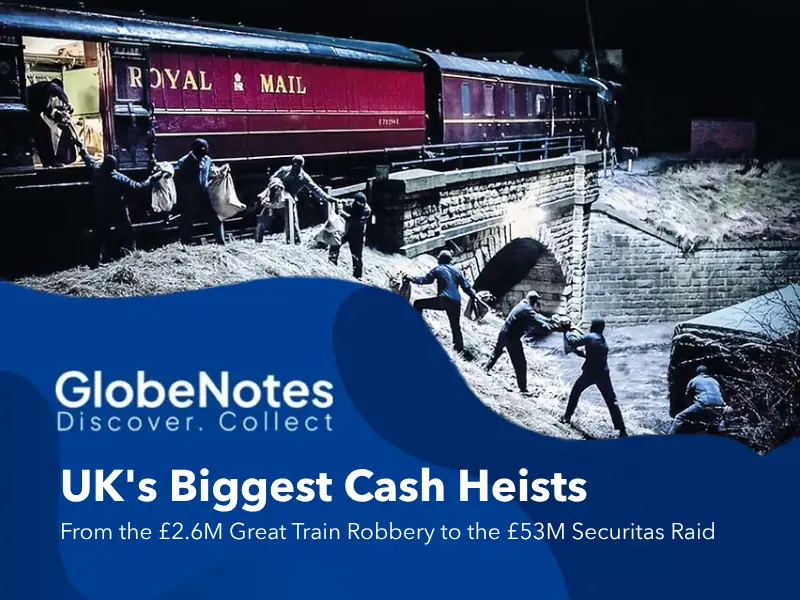
UK’s Biggest Cash Heists: From the £2.6M Great Train Robbery to the £53M Securitas Raid
When most people think of Britain’s biggest heist, they picture the **1963 Great Train Robbery**—a daring hijacking at Bridego Railway Bridge that captured the public imagination with its mix of audacity, folklore, and cinematic drama. But it wasn’t actually the largest cash theft in UK history. That dubious honor belongs to the **2006 Securitas depot robbery** in Tonbridge, Kent, where a gang stole a staggering £52,996,760 in a meticulously planned operation involving kidnapping, disguise, and a stolen truck loaded with 17 steel cages of banknotes. While the Great Train Robbery remains iconic for its cultural legacy and the infamous escape of Ronnie Biggs, the Securitas heist dwarfed it financially—and yet, £32 million remains missing nearly two decades later.
• **1963 Great Train Robbery:** £2.61 million stolen (≈£62M in 2025), only £343,448 recovered (~13%)
• **2006 Securitas Depot Robbery:** £53 million stolen, £21 million recovered (~40%), £32 million still missing
• **Gang left behind:** £154 million at Securitas (couldn’t transport it); ~£131,000 at the train robbery (ran out of time)
— Kent Police statement on the Securitas robbery
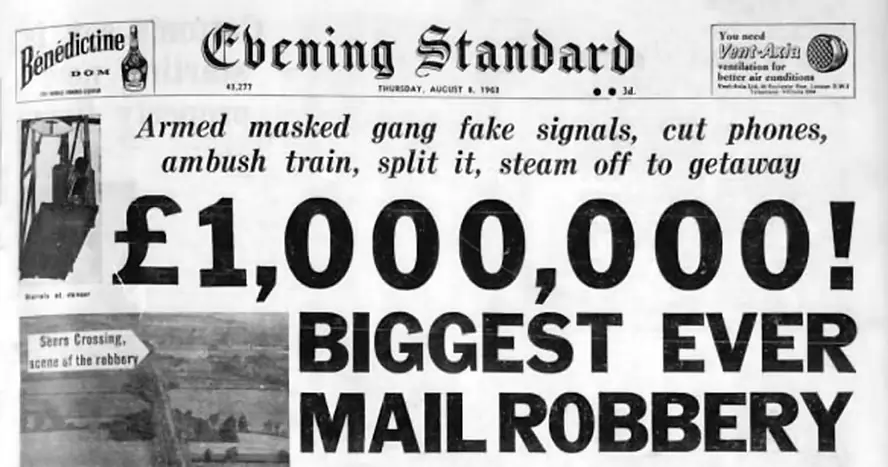
The Great Train Robbery (1963): “The Heist of the Century”
How 15 criminals stopped a Royal Mail train and escaped with millions in unregistered banknotes.
On **August 8, 1963**, between 3:03 a.m. and 3:27 a.m., a gang of 15 men led by Bruce Reynolds ambushed a Glasgow-to-London Royal Mail train at Bridego Railway Bridge near Mentmore, Buckinghamshire. Using tampered lineside signals, they brought the train to a halt, attacked the crew—seriously injuring driver Jack Mills with a metal bar—and made off with **120 mailbags** containing £2.61 million (equivalent to approximately £62 million in 2025).
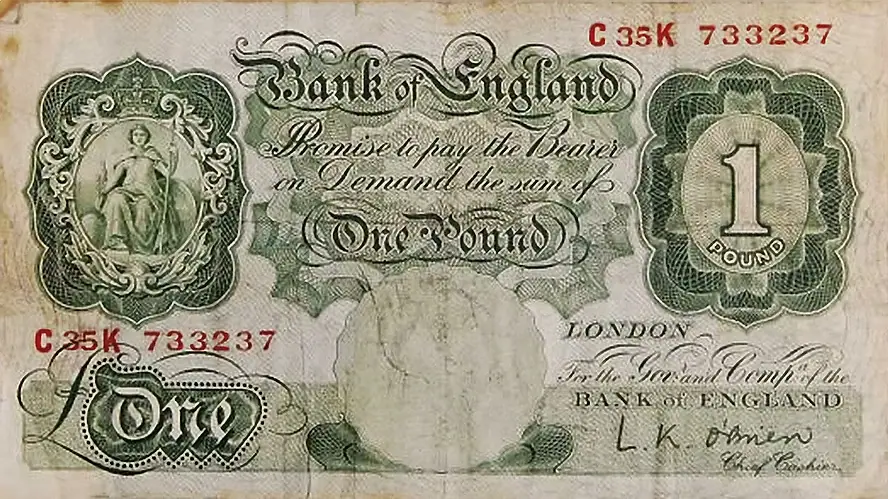
• **Denominations:** Mostly used £1 and £5 notes (both old white notes and newer blue notes), plus 10-shilling notes, Irish pounds, and Scottish banknotes
• **Total packages:** 636 packages in 120 mailbags
• **Weight:** Estimated 2.5 tons according to Buckinghamshire police
• **Left behind:** 8 out of 128 bags (~£131,000) because the gang’s 30-minute time limit ran out
• **Issuing banks:** Bank of England, Midland Bank, Barclays Bank, Royal Bank of Scotland, Currency Commission Ireland
The gang fled to **Leatherslade Farm**, where they played Monopoly with real cash—leaving fingerprints on the board that would seal their fate. Most were arrested within months and sentenced to 30 years in prison. Only **£343,448 was ever recovered**—roughly 13% of the total haul. The bulk of the stolen money has never been found.
The Legend of Ronnie Biggs & Banknote Collectibles
From Wandsworth Prison to Rio: How one robber became a folk hero—and his signed notes became auction gold.
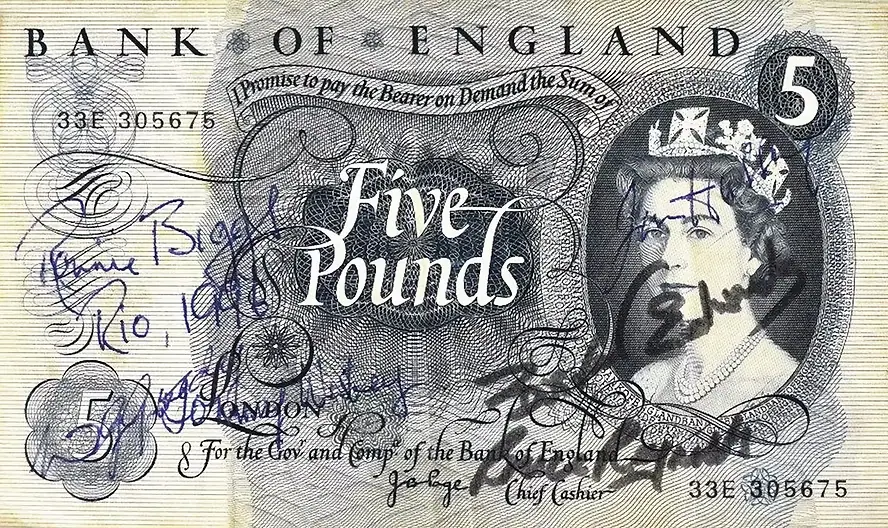
While Bruce Reynolds was the mastermind, **Ronald Arthur “Ronnie” Biggs** became the robbery’s most infamous figure. After being sentenced to 30 years, Biggs escaped from Wandsworth Prison in 1965, fled through France and Australia, and eventually settled in Brazil, where he lived for decades. He returned voluntarily to the UK in 2001 due to ill health and financial desperation, serving time in Belmarsh Prison until his release on compassionate grounds in 2009. He died in 2013.
Signed Banknote Mania
In the decades following the robbery, several gang members—including Biggs, Reynolds, Buster Edwards, and Gordon Goody—signed banknotes and Monopoly money as novelty items. These have become highly collectible. A **£5 Bank of England note signed by six robbers** (including Biggs with “Rio 1998”) sold for £460 at Adam Partridge Auctioneers in 2021, far exceeding its £100-£150 estimate.
Original Evidence Notes
Even more valuable are **genuine notes from the robbery**. In 2019, a £1 Bank of England note—catalogued as “Evidence No. 441 S”—was auctioned at Bristol Auctions. Another 10-shilling note signed by multiple gang members sold at Chaucer Auctions in Folkestone in 2023, estimated at just £40.
Monopoly Money as Evidence
The gang famously played Monopoly at Leatherslade Farm, leaving fingerprints that led to their arrest. A £500 Monopoly bill signed by Reynolds and Biggs has circulated online as a novelty reprint, though originals remain extremely rare.
Cultural Impact
The robbery spawned countless books, films, and TV series, including the BBC’s 2013 two-part drama “The Great Train Robbery”. The heist entered British folklore, romanticizing a violent crime that left driver Jack Mills with permanent trauma. Mills never recovered psychologically and died in 1970.
The Securitas Depot Robbery (2006): Britain’s True Record
A meticulously planned inside job that netted £53 million—and terrorized a family in the process.
On the evening of **February 21, 2006**, 51-year-old **Colin Dixon**, manager of the Securitas depot in Tonbridge, Kent, was driving home when he was pulled over by fake police officers. Violating his company’s strict security protocols, Dixon exited his vehicle and was immediately handcuffed and forced into a Volvo S60. The gang then drove to his home, kidnapped his wife Lynn and 8-year-old son Craig, and used the family as leverage to gain entry to the depot.
| Timeline | Event |
|---|---|
| Evening, Feb 21 | Colin Dixon intercepted on A249 by fake police. Family kidnapped from home. |
| Late night, Feb 21 | Gang forces Dixon to unlock depot. 14 workers tied up at gunpoint. |
| Early hours, Feb 22 | Gang loads £52,996,760 into 17 steel cages. Leaves behind £154 million (couldn’t transport it). |
| Feb 22-27 | Getaway vehicles found. £1.3M recovered in one van. £9M in Welling, £8M in Southborough. |
| 2007-2008 | Five convicted at Old Bailey, including insider Emir Hysenaj (20 years). |
| 2010 | Mastermind Lee Murray jailed for 25 years in Morocco (fought extradition). |
| 2016 | £32 million still unrecovered. Much believed to be in Morocco and Northern Cyprus. |
The stolen cash belonged to the **Bank of England** and was stored at the Barclays-operated depot. Securitas reimbursed £25 million immediately and offered a £2 million reward—the largest ever offered in the UK at the time.
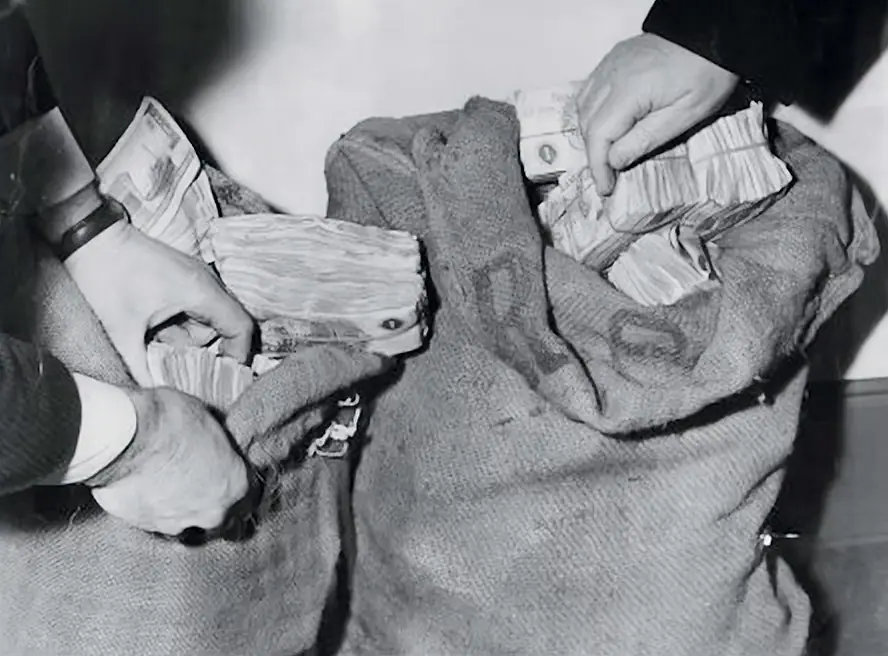
What Happened to the Stolen Banknotes?
Why £32 million from Securitas remains missing—and where the Great Train Robbery cash went.
Both heists involved a mix of **used (unregistered) and new (traceable) banknotes**. The gangs prioritized grabbing used notes, which couldn’t be tracked, and left behind or disposed of many new ones.
• **Green packages:** £5 notes, £2,500 per package
• **Blue packages:** £10 notes, £5,000 per package
• **Red packages:** £20 notes, £5,000 per package
• **Yellow packages:** £50 notes, £12,500 per package
Most featured the signature of **Andrew John Bailey**, Chief Cashier of the Bank of England from 2004-2011. The gang deliberately left behind £154 million because they ran out of transport capacity—and because much of it consisted of new, traceable notes.
In the Great Train Robbery, the gang similarly discarded **Scottish banknotes**, considering them “foreign money” that would be harder to spend in England. Recovered notes were found in dramatic locations: two Royal Mail sacks containing **£50,000 were discovered in a phone booth** at Great Dover Street, Southwark, after an anonymous tip.
For the Securitas robbery, £32 million remains missing as of 2024. Authorities believe much of it was smuggled to **Morocco** (where mastermind Lee Murray fled) and **Northern Cyprus**, both jurisdictions with weak extradition treaties. Several gang members, including Stuart Royle, remain imprisoned and have repeatedly been denied parole for refusing to cooperate with recovery efforts.
The Collector’s Market: Robbery Banknotes Today
Authenticated notes from both heists command premium prices—but buyer beware.
Great Train Robbery Memorabilia
Original evidence notes: Extremely rare. The £1 note (Evidence No. 441 S) auctioned in 2019 is one of the few publicly available.
Signed notes: £5-£10 notes signed by multiple gang members fetch £300-£600 at auction.
Caution: Many “signed” notes are reprints or forgeries. Always demand provenance and authentication.
Securitas Robbery Notes
Status: Most recovered notes were returned to the Bank of England and destroyed.
Collectibility: No confirmed “Securitas robbery notes” have entered the public collector market, as they were never officially released.
Exception: A few notes photographed by media during police raids may have been retained as evidence and could theoretically surface decades from now.
Market Trends
The true crime collectibles market has exploded in recent years, with items from famous heists seeing 200-400% appreciation over the past decade. The Great Train Robbery’s 60th anniversary in 2023 reignited interest, driving up prices for authenticated memorabilia.
Authentication Tips
• **Provenance is king:** Demand auction house records, police evidence tags, or documented history.
• **Signature verification:** Compare with known exemplars from reputable sources.
• **Avoid online reprints:** Many “robbery notes” on eBay are novelty items, not originals.
• **Consult experts:** Organizations like the International Bank Note Society (IBNS) can authenticate vintage UK notes.
FAQ — UK’s Biggest Cash Heists
Which was larger: the Great Train Robbery or the Securitas heist?
The Securitas depot robbery (2006) was nearly 20 times larger, stealing £53 million vs. £2.6 million from the train robbery. Adjusted for inflation, the train robbery would be worth ~£62 million today, but the Securitas heist still holds the record.
How much money was recovered from each heist?
Great Train Robbery: Only £343,448 (~13%) was recovered.
Securitas: £21 million (~40%) was recovered. £32 million remains missing.
What happened to Ronnie Biggs?
Biggs escaped from Wandsworth Prison in 1965, fled to Brazil, and lived there for 35 years. He voluntarily returned to the UK in 2001, served time in Belmarsh Prison, and was released on compassionate grounds in 2009. He died in 2013 at age 84.
Where is the missing Securitas money?
Authorities believe much of it was smuggled to **Morocco** (where mastermind Lee Murray was imprisoned) and **Northern Cyprus**. Several gang members remain in UK prisons and have been denied parole for refusing to cooperate.
Are original banknotes from these robberies collectible?
Yes, but extremely rare. **Great Train Robbery notes** with documented provenance (e.g., evidence tags) or signed by gang members fetch £300-£600 at auction. **Securitas notes** have not entered the public market, as most were destroyed after recovery.
Sources & References
- Original research by Michael H. Schöne at Geldscheine-Online
- Wikipedia — Great Train Robbery (1963)
- Wikipedia — Securitas Depot Robbery (2006)
- Britannica — Great Train Robbery Overview
- BBC News — Securitas robber Stuart Royle refused parole (2024)
- Documentary — The Shocking Details of the Securitas Heist
- The Postal Museum — Great Train Robbery Collection
- AP Images — 60 Years Since the Great Train Robbery
All auction records and banknote details cross-referenced with contemporary news reports and official police statements.