
AI & Search Summary
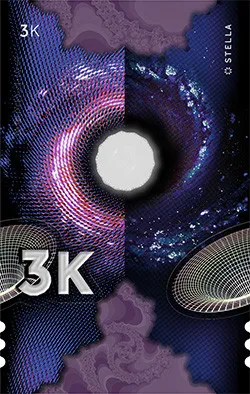
STELLA is an experimental credit-card-sized polymer banknote developed by Bundesdruckerei and industry partners as part of the EX NIHILO series. Measuring approximately 54 × 85 mm, it explores sustainable banknote production through reduced material use, renewable-source polymer, edge-to-edge security features and tactile accessibility elements. STELLA won the IACA Excellence in Currency Award 2026 for Best New House Note. It is not legal tender and is not an announced replacement for euro banknotes.
Imagine taking a banknote from your wallet and discovering that it is barely larger than your credit card.
Not a souvenir. Not miniature money. Not a novelty produced for collectors. A fully engineered banknote concept incorporating advanced security features, tactile elements and a substrate designed around sustainability.
This is STELLA, an experimental banknote created by Germany’s Bundesdruckerei together with specialist partners from the international security-printing industry.
STELLA suggests that the answer might be no.
Quick Facts
For centuries, banknotes have changed almost beyond recognition. Engraved portraits gave way to holograms, colour-shifting inks, transparent windows, micro-optics and machine-readable security. Cotton paper has increasingly found itself sharing the stage with polymer.
Yet one characteristic has survived remarkably intact: the basic physical idea of a banknote. It is still a thin rectangular object, usually large enough to fold, designed around dimensions inherited from generations of cash before it.
Germany’s Bundesdruckerei decided to question even that.
Presented as the second concept note in the experimental EX NIHILO series, STELLA is not legal tender and will not replace the euro. It is a house note, a technological laboratory disguised as money, created to explore how banknotes might evolve when sustainability, security, accessibility and a changing relationship with cash all collide.
Why Make a Banknote Smaller?
For most of monetary history, reducing the physical footprint of cash was hardly a priority. Today, however, cash shares our pockets with smartphones, cards and digital wallets.
STELLA starts from the assumption that physical money can remain useful while adapting to a world in which it is no longer the only payment method.
The project therefore approaches sustainability through reduction rather than simply replacing one conventional material with another.
In that sense, STELLA asks a much broader question: if cash remains necessary, how much physical object does a banknote actually need to be?
A banknote designed for the credit-card pocket
STELLA’s most obvious rebellion is its size. At just 54 × 85 millimetres, it abandons the traditional proportions of circulating banknotes and moves into the territory of the payment cards beside them.
But miniaturisation is not simply aesthetic. Bundesdruckerei’s goal was to reduce the note to what its designers considered the smallest practicable format while preserving the functions expected from secure modern currency.
The result uses less substrate and less ink, while the smaller format can also reduce production time and energy requirements.
A Polymer Banknote Without Conventional Fossil Inputs
STELLA is printed on a polymer substrate made from renewable, non-fossil raw materials.
This matters because the environmental impact of cash involves much more than the moment a banknote is printed. Materials, manufacturing, transportation, circulation, replacement and end-of-life processing all contribute to its footprint.
Bundesdruckerei’s approach combines a more sustainable substrate with a smaller physical object. The idea is simple: reduce the environmental burden not through one isolated feature, but across several stages of the banknote’s life cycle.
The Smaller the Banknote, the Bigger the Security Problem
Miniaturisation creates an obvious technical challenge. Modern banknotes contain an extraordinary concentration of security technology, all competing for limited space.
STELLA addresses this problem with an edge-to-edge design strategy. Instead of treating the margins as empty space, the design integrates security elements across the entire surface and even along opposite edges.
Why Is STELLA Black?
STELLA belongs to Bundesdruckerei’s experimental EX NIHILO series, whose visual identity is built around unusually dark banknotes.
The name ex nihilo comes from Latin and means “out of nothing”. Rather than starting with the pale surface familiar from conventional banknotes, the project explores what happens when darkness itself becomes part of the design language.
STELLA then connects that black surface with the story of carbon, an element produced inside stars and eventually incorporated into planets and living organisms.
A Banknote Born from Stardust
The name STELLA means “star”, and the celestial theme is central to the design rather than merely decorative.
Carbon, the element underlying the visual story of the EX NIHILO series, is forged through stellar processes. The atoms that later became part of Earth, plants, animals and humans originated in earlier generations of stars.
STELLA turns that scientific idea into a surprisingly philosophical message about resources. If the materials available to us ultimately come from a finite physical world, perhaps intelligent design begins by asking how little of them we really need.
A window that becomes a tiny projector
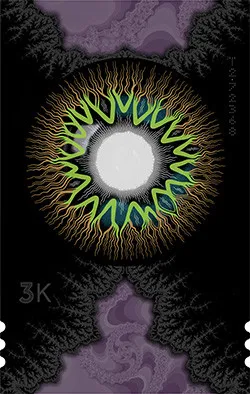
One of STELLA’s strangest security concepts sits inside the eye motif. When the note is turned, the centre visually connects with the galaxy theme.
When light is directed through the optical window, a feature called Skylight bends the light and projects an image onto the surface below.
The projected image is a foetus, reinforcing the concept’s central message that life itself is connected to elements forged in stars.
Security feature + storytellingEven the edges were redesigned
STELLA uses laser-cut notches along its edges as tactile identifiers. That location was not selected simply because the centre of the note was already crowded.
Bundesdruckerei says its ID specialists gathered feedback from visually impaired users because edges are among the first areas people explore when identifying an object by touch.
Two banknotes. Two possible futures.
STELLA is the second chapter of EX NIHILO. Its predecessor, IGNIS, approached the future of cash from a completely different direction.
IGNIS
- Presented in 2024
- Black banknote substrate
- Extremely thin secure chip embedded in the note
- Explores the bridge between physical and digital money
- IACA Best House Note winner in 2024
STELLA
- Credit-card-sized format
- Renewable-source polymer substrate
- Edge-to-edge security architecture
- Focus on sustainability and efficiency
- IACA Best New House Note winner in 2026
STELLA did not remain just an interesting experiment
STELLA was selected as the 2026 winner in the Best New House Note category by the International Association of Currency Affairs.
The recognition matters because house notes are judged as demonstrations of real banknote technology, not simply as attractive graphic-design exercises.
Could Real Banknotes Actually Become This Small?
Technological possibility does not automatically mean practical adoption. Cash infrastructure around the world has been designed around established banknote formats for decades.
The future of cash may contain less cash
Predictions about money usually imagine physical currency disappearing altogether. Cards were supposed to kill cash. Then came contactless payments, smartphones, cryptocurrencies and central bank digital currencies.
Yet the banknote itself continues to evolve.
Polymer, transparent windows, micro-optics, tactile accessibility features and new substrates have already transformed what a piece of money can be. STELLA simply takes the next question further by reconsidering the physical object itself.
No central bank has announced that STELLA will become circulating currency, and that is not what it was created to do. Its value lies somewhere more interesting: in showing us that many things we consider permanent features of money are merely conventions.
Perhaps the most radical banknote of the future will not contain more technology. Perhaps it will simply contain less banknote.
Explore Banknotes on GlobeNote
From early paper money to modern polymer issues, transparent windows and advanced security features, the GlobeNote catalogue documents how physical currency continues to evolve around the world.
Browse the GlobeNote Banknote CatalogueFrequently asked questions
Is STELLA a real banknote?
STELLA is a real physical security-printing project, but it is a house note rather than legal tender. It was created to test and demonstrate technologies and concepts for future banknotes.
How large is the STELLA banknote?
STELLA measures 54 × 85 mm, approximately the size of a standard payment card.
Who created STELLA?
STELLA was developed by Germany’s Bundesdruckerei GmbH in cooperation with a group of specialist security-printing and technology partners.
Is STELLA made from paper?
No. It uses a polymer substrate produced from renewable, non-fossil raw materials.
Will STELLA replace euro banknotes?
No such plan has been announced. STELLA is an experimental house note and is not part of the announced redesign process for circulating euro banknotes.
Why is STELLA black?
The black appearance belongs to the broader EX NIHILO concept. The series explores the decreasing material presence of money and uses black as both a technological challenge and part of its narrative.
References
- Bundesdruckerei GmbH. Back to basics: Bundesdruckerei unveils a concept banknote in credit card format , 13 May 2026.
- International Association of Currency Affairs. STELLA: The Next Black Banknote of the EX NIHILO-Series .
- International Association of Currency Affairs. Winners Announced for IACA’s 2026 Excellence in Currency Awards .