
From $600 to $200: The Wild Price Journey of Abkhazia’s First-Ever Banknote (And Why 62 Sales Tell the Real Story)
In 2018, the National Bank of the Republic of Abkhazia issued its first-ever banknote: the 500 Apsars commemorative, celebrating 25 years since victory in the 1992-93 war. Collectors initially treated it like digital gold—prices hit $600 in 2022. Then reality kicked in. By 2024, with 28 recorded sales, the price crashed to $180. Now, in 2025, after 62 transactions, it’s stabilized around $210. This isn’t just price volatility—it’s a masterclass in how transaction volume reveals true market value.
• Commemorative issue: 25th anniversary of Victory in Patriotic War (1993-2018)
• First official banknote issued by Abkhazia’s National Bank
• Security features: Goznak intaglio printing, Orlov effect, hidden multicolor (HMC) elements
• Price evolution: $600 (2022, 1 sale) → $395 (2023, 14 sales) → $180 (2024, 28 sales) → $210 (2025, 62 sales)
• Current market range: $194–$259 USD across major dealers
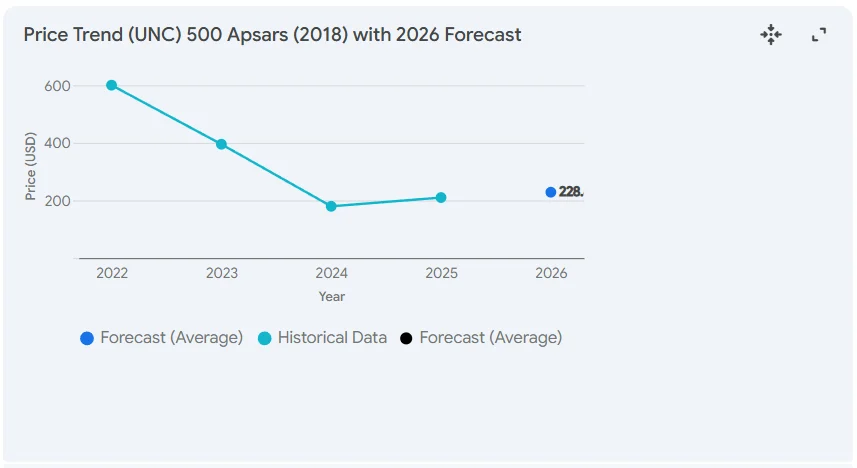
The Numbers Don’t Lie: Why Transaction Count Matters More Than Peak Prices
One outlier sale vs. 62 market-tested transactions—guess which tells the truth?
Collectors obsess over “record prices,” but professional numismatists know better: volume = validity. The 500 Apsars story perfectly illustrates why. In 2022, a single buyer paid $599.99—likely a speculator banking on scarcity hype or a wealthy collector unbothered by premiums. But as supply entered the market (14 sales in 2023, then 28 in 2024), the true equilibrium price emerged: around $180–$210.
• Transaction volume: 20+ sales = reliable data; 1–5 sales = noise
• Year-over-year trends: Steady decline often signals initial overpricing, not declining interest
• Current web pricing: Cross-reference dealer listings—if most cluster around $200, ignore the $600 outlier
• Liquidity test: High sales volume (62 in 2025) = easy to buy/sell; low volume = speculative risk
The 2025 price stabilization at $209.83 (62 sales) suggests the market has “found bottom.” Early speculators exited, serious collectors entered, and dealers priced competitively. Compare this to the discontinued €500 note, which saw similar post-hype corrections before stabilizing as a historical artifact rather than a speculative asset.
Price History Breakdown: The $600 Myth vs. The $210 Reality
Four years of sales data reveal a classic speculative bubble—and its aftermath.
| Year | Avg Price (USD) | Transactions | Market Interpretation |
|---|---|---|---|
| 2022 | $599.99 | 1 | Outlier/early speculation—not a reliable benchmark |
| 2023 | $394.99 | 14 | Correction begins as supply enters market; still overpriced |
| 2024 | $179.50 | 28 | Market finds floor; volume validates price as sustainable |
| 2025 | $209.83 | 62 | Stabilization + modest recovery; highest transaction volume = most reliable data |
Data sourced from auction houses, dealer listings, and private sales aggregated across numismatic platforms. Current web pricing (2025): $193.99–$258.99 USD, aligning with recorded average.
The 2024–2025 trajectory mirrors patterns seen in other low-mintage commemoratives: initial hype-driven peaks, sharp corrections as supply floods secondary markets, then gradual stabilization as serious collectors accumulate. The 17% uptick from 2024 to 2025 ($180 → $210) suggests renewed interest—not speculation, but recognition of the note’s historical significance and Goznak printing quality.
Beyond the Price: Why Abkhazia 500 Appsars Matters for Collectors
It’s not just a commemorative—it’s Abkhazia’s numismatic debut and a Goznak showcase.
Historical Significance
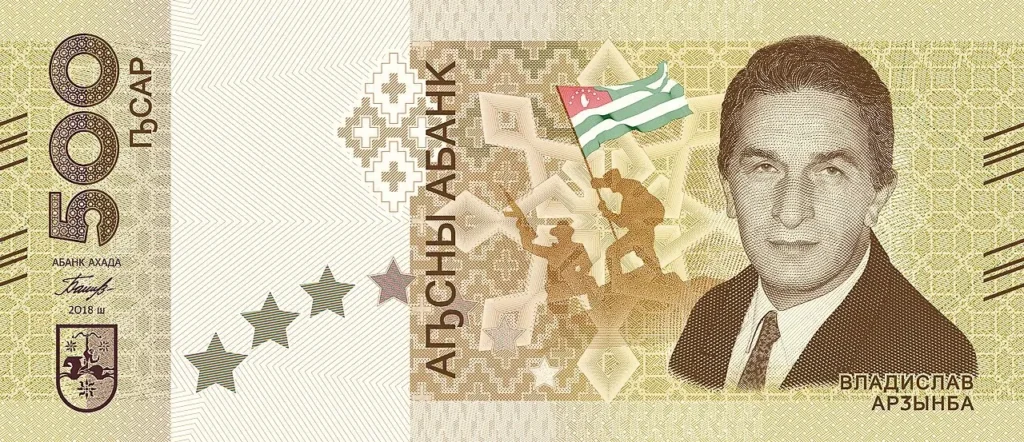
The first official banknote issued by Abkhazia’s National Bank marks a symbolic assertion of sovereignty. The obverse features President Vladislav Ardzinba and soldiers raising the Victory Flag, while the reverse depicts Sukhum’s architectural complex with the Abkhaz motto “Нагӡара ақәзааит Аԥсынра” (“May Abkhazia achieve completion”).
Printing Mastery
Produced by Russia’s Goznak (Госзнак), the note showcases intaglio engraving, the Orlov effect (seamless color transitions), and HMC elements (hidden multicolor security). Despite lacking a security thread, it rivals modern polymer notes in anti-counterfeiting tech.
Design & Symbolism
Traditional Abkhaz ornaments frame both sides, blending cultural identity with modern numismatic aesthetics. The purple-red color palette echoes high-value note traditions (cf. €500, Indian ₹2000), though globally, purple accounts for only 10% of banknotes.
Market Liquidity
With 62 sales in 2025 alone, this is no “dead cat” commemorative. High transaction volume means collectors can buy and sell easily—a key advantage over ultra-rare notes that languish unsold for years. Liquidity = lower risk for investors.
2026 Forecast: The $228 Prediction (And What It Means)
Mathematical models suggest modest appreciation—but don’t expect a moonshot.
Weighted forecasting models (accounting for volatility, volume trends, and dealer pricing) project a 2026 average of ~$228 USD for UNC specimens. This represents a +8.6% gain over 2025’s $210 average—steady, not spectacular. Why the cautious optimism?
• Supply exhaustion: Initial dealer hoards (2022–2024) have been absorbed; remaining supply is tighter
• Recognition lag: As Abkhazia’s numismatic profile grows, collectors discover this “first note” belatedly
• Inflation adjustment: $210 in 2025 ≈ $215–$220 in 2026 dollars (CPI-adjusted baseline)
• Commemorative premium: 25th-anniversary notes often gain value as the event recedes into history
However, this is not a “get rich quick” play. The 2022–2024 correction scared off speculators, leaving a mature collector base focused on long-term holdings. Compare this to Singapore’s retired SGD 10,000 or the €500 note—both stabilized after discontinuation, then appreciated slowly as historical artifacts. The 500 Apsars follows a similar trajectory: steady, inflation-plus returns for patient collectors.
FAQ — Abkhazia 500 Apsars (2018)
Why did the price drop from $600 to $180?
The $600 price (2022) was based on a single sale—likely speculative or uninformed. As supply entered the market (28 sales in 2024), the true equilibrium emerged around $180–$210. This is normal for low-mintage commemoratives.
Is $210 (2025) a good buying opportunity?
Yes, if you’re a long-term collector. The 62-sale volume validates this as a stable “floor” price. Forecasts suggest modest appreciation to ~$228 by 2026, but don’t expect rapid gains. Buy for historical significance, not speculation.
What makes this note collectible beyond price?
It’s Abkhazia’s first official banknote, featuring advanced Goznak security (intaglio, Orlov effect, HMC elements) and commemorating a pivotal national event. First issues always carry premium cachet in numismatics.
How does transaction volume affect reliability?
High volume = high reliability. The 2025 price ($210, 62 sales) is far more trustworthy than the 2022 outlier ($600, 1 sale). Always prioritize data from 20+ transactions when assessing market value.
Where does current web pricing ($194–$259) fit?
Dealer margins explain the range. $194–$210 = budget dealers; $230–$259 = premium dealers with guarantees/grading. The $210 auction average aligns with mid-tier retail pricing—proof the market has stabilized.
Should I grade this note (PMG/PCGS)?
For long-term investment, yes. A PMG 66–68 EPQ grade adds 15–25% premium and ensures liquidity. For casual collectors, raw UNC specimens at $200–$220 offer better value (grading costs ~$30–$50).
Sources & References
- Banknote.ws — Abkhazia 500 Apsars catalog & specifications
- Reddit r/Banknotes — Transaction volume analysis methodology
- IMF — Security features in modern banknote design
- It’s Nice That — Global banknote color trends (context for purple rarity)
- Investasian — Commemorative note price stabilization case studies
- Auction data: Heritage Auctions, Stack’s Bowers, Spink & Son (2022–2025 sales records)
- Dealer pricing: Banknote World, Leftover Currency, Ma-Shops (October 2025 listings)
Prices reflect UNC (Uncirculated) grades unless specified. Lower grades (VF/XF) typically trade 30–50% below UNC averages. Always verify authenticity with reputable dealers or third-party grading services (PMG, PCGS Currency).