
AI & Search Summary
The European Central Bank unveiled ten shortlisted designs for the next generation of euro banknotes on 23 July 2026. The proposals are based on two themes: European Culture and Rivers and Birds. The cultural option includes Maria Callas, Beethoven, Marie Curie, Cervantes, Leonardo da Vinci and Bertha von Suttner, while the nature theme follows European rivers from mountain springs to the sea with six bird species. The ECB public survey remains open until 21 September 2026, with a final design decision expected around the end of 2026. The new banknotes will take several years to enter circulation.
Somewhere in Europe, the banknote that could eventually replace the euros in your wallet has already been designed.
It might carry the face of Beethoven. Or Marie Curie. Leonardo da Vinci could appear on the €100. Maria Callas might inhabit the €5.
But Europe could take an entirely different path.
Instead of famous people, the next euro banknotes could feature kingfishers, storks, river valleys, waterfalls and seabirds travelling from the mountains to the ocean.
In July 2026, the European Central Bank revealed the ten shortlisted proposals for the next generation of euro banknotes. Europeans can now tell the ECB which designs they prefer before the Governing Council makes its final choice.
Quick Facts
Two Completely Different Visions of Europe
The competition is unusual because it is not simply asking designers to create a more modern version of today’s euro. It is asking what Europe should look like when printed on money.
European Culture
Human faces, music, literature, science and shared cultural spaces. The notes connect iconic Europeans with the places where culture continues to be created today.
Rivers and Birds
A journey through European nature, following rivers from mountain springs to the sea while different bird species occupy each stage of the landscape.

What If the Euro Finally Had Faces?
Today’s euro banknotes famously avoid real monuments and real historical personalities. The next generation could break dramatically with that tradition.
Under the European Culture theme, six famous Europeans would appear across the six denominations.
The €5 starts with opera legend Maria Callas, while progressively higher denominations move through music, science, literature, art and peace activism.
Design proposal A, Studio Joost Grootens. Image source: European Central Bank. Proposal shown for editorial/informational purposes.Six Denominations, Six European Icons
If the cultural theme wins, the sequence would look like this:
| Value | Personality | Cultural Theme |
|---|---|---|
| €5 | Maria Callas | Performing arts |
| €10 | Ludwig van Beethoven | Music |
| €20 | Marie Curie Skłodowska | Universities and schools |
| €50 | Miguel de Cervantes | Libraries |
| €100 | Leonardo da Vinci | Museums and exhibitions |
| €200 | Bertha von Suttner | Public squares |
The Same Portrait Can Create a Completely Different Euro
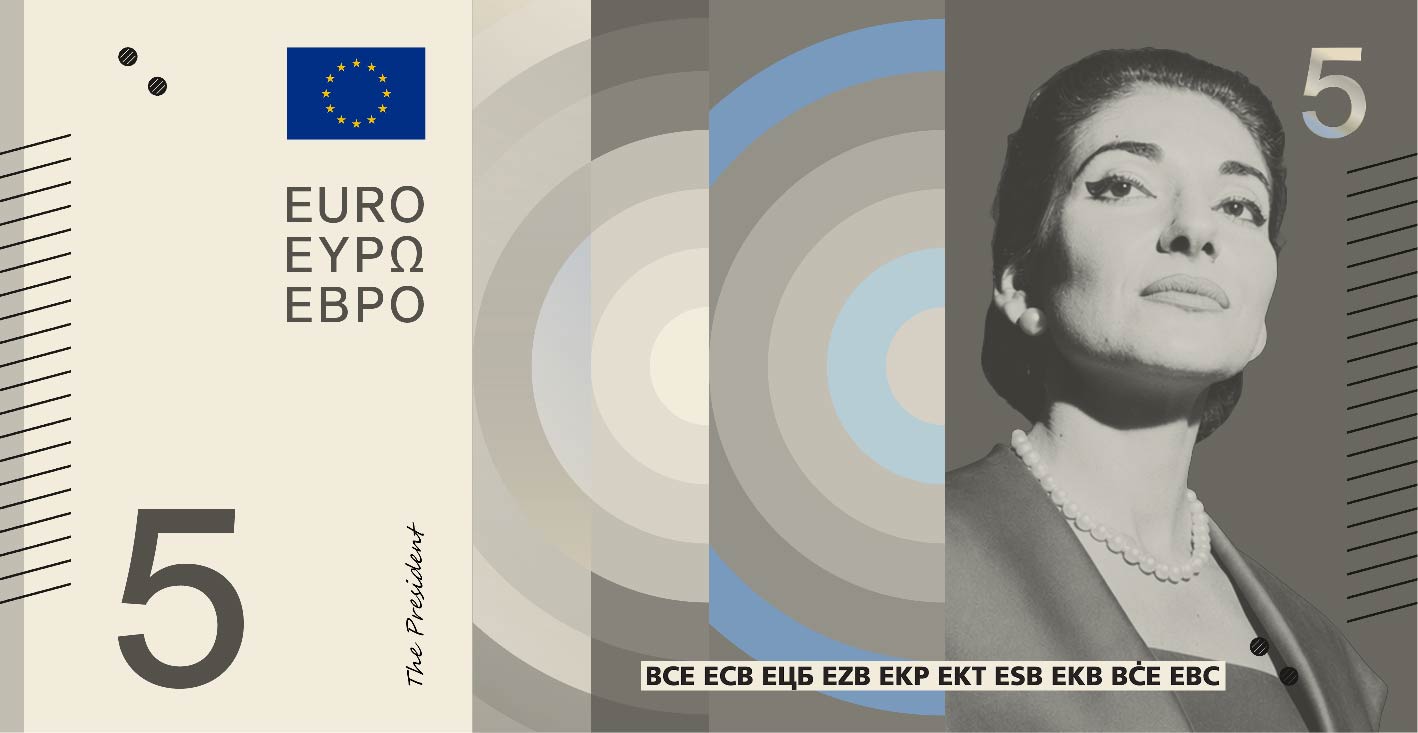
Neue Gestaltung’s proposal for the €5 gives Maria Callas a large photographic presence, surrounded by bold geometric forms and a much more contemporary visual language than today’s euro banknotes.
Other finalists approach the same cultural theme through illustration, collage, fine-line patterns or more experimental compositions. The personality may remain the same, but the resulting banknote can feel entirely different.
This is one of the most interesting aspects of the ECB competition. Europe is not simply deciding whether Beethoven, Marie Curie or Leonardo da Vinci belong on its currency. It is also deciding what a twenty-first-century euro should look like.
Design proposal C, Neue Gestaltung GmbH. Image source: European Central Bank. Proposal shown for editorial and informational purposes.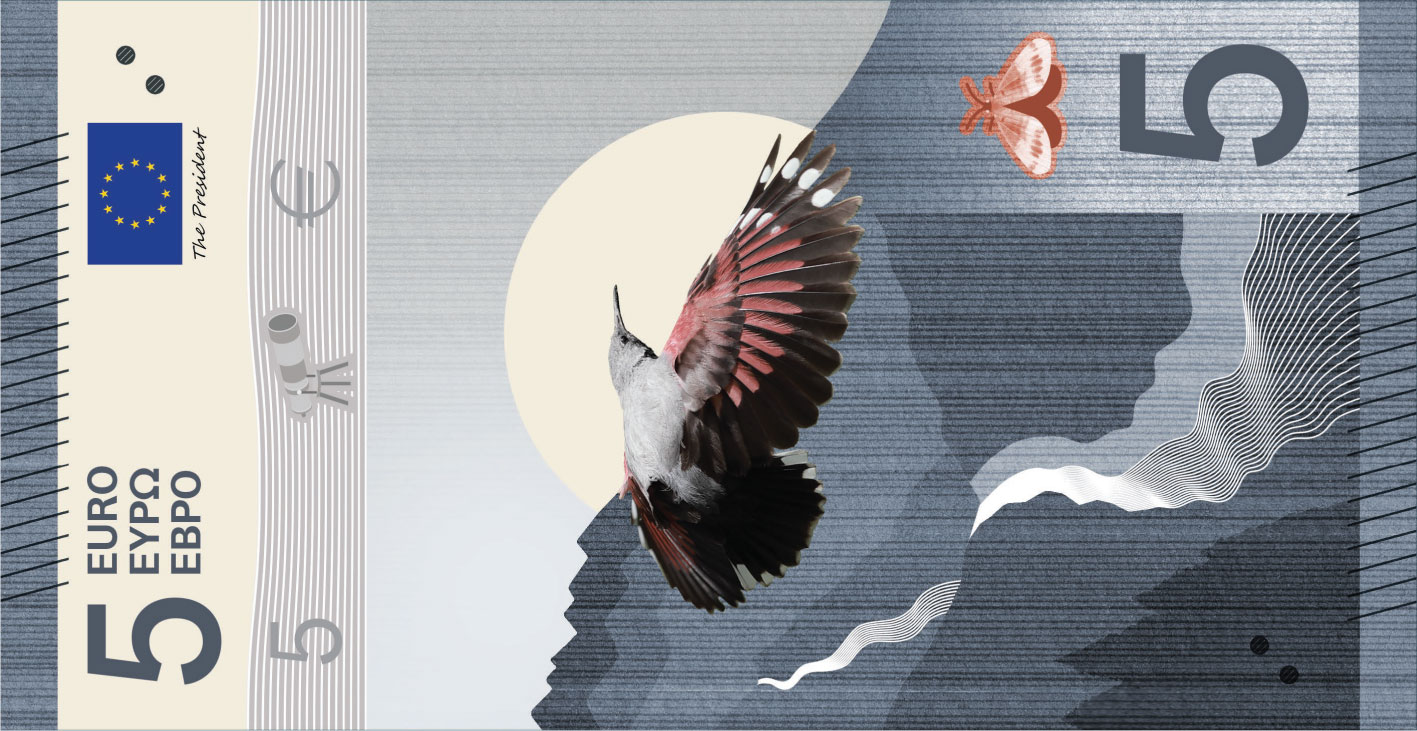
Or Europe Could Put Nature in Your Wallet
The rival theme abandons historical personalities altogether.
Rivers and Birds follows water across Europe. The €5 begins high in the mountains and the series gradually moves downstream until the €200 reaches the open sea.
Each stage is paired with a bird adapted to that environment. Together, the six banknotes become something unusual: a connected visual journey rather than six isolated designs.
Design proposal I, Isabelle Daëron. Image source: European Central Bank.A River Runs Through the Entire Series
The denominations follow a deliberate geographical progression:
One Design Turns Birdsong into Graphics
Among the ten proposals, one of the most unusual comes from PunktFormStrich.
Instead of using birds purely as illustrations, the designers convert information about each species into part of the banknote’s visual language.
Horizontal graphic structures represent the characteristic sound of the bird, while a vertical scale represents its flight speed.
Some Proposals Look Nothing Like Today’s Euros
Rudy Guedj and François Girard-Meunier take the nature theme in a much more abstract direction.
Birds occupy complex landscapes filled with geometry, light and security-inspired forms. The designers imagined the viewer almost as a birdwatcher, discovering visual clues hidden throughout the composition.
It illustrates just how broad the ECB competition really is. The theme may be fixed, but the personality of the future currency is still very much undecided.
Design proposal D, Rudy Guedj & François Girard-Meunier. Image source: European Central Bank.
Why Redesign the Euro at All?
The first euro banknotes entered circulation in 2002. The Europa series began appearing in 2013. Updating a currency after decades in circulation is not unusual.
The ECB says the next generation offers the opportunity to improve far more than appearance.
And What About the €500?
One denomination is conspicuously absent from every proposal.
The future series is being designed around €5, €10, €20, €50, €100 and €200. The €500 note, whose issuance was discontinued by the Eurosystem, is not part of the new design competition.
Existing €500 banknotes nevertheless retain their value and can continue to be exchanged at euro-area national central banks.
This Time, Europeans Can Help Choose
The ECB has opened a public survey covering all ten shortlisted proposals.
The survey remains open until 21 September 2026. The Governing Council will consider the public response before selecting the final design, which is expected around the end of the year.
The winning proposal will not immediately appear in wallets. Technical development, security integration and production will follow, and the ECB says it will take several years before the new series enters circulation.
View the Designs & Take PartThe Most Interesting Choice Is Not Between Ten Designs
Looking at the finalists, the real decision seems larger than choosing between proposal A and proposal J.
Europe must decide what it wants its currency to represent.
The cultural theme looks backward and forward at the same time. It celebrates people whose work crossed borders and then connects them with modern Europeans reading, studying, performing and meeting.
Rivers and Birds takes the opposite approach. It removes the human hero entirely and turns Europe itself, its geography, biodiversity and interconnected landscapes, into the protagonist.
The Euro Is About to Become a Collector’s Story Again
Whatever design wins, the transition will eventually create one of the most important moments in modern European banknote history.
Today’s Europa series will gradually become the previous generation. New security technologies will appear. New signatures and printing variations will follow. And collectors will begin documenting the transition from one series to another.
But before all of that happens, Europe is experiencing something rare: the moment when a currency still exists mostly as an idea.
Explore European Banknotes on GlobeNote
Discover historic and modern European banknotes, catalogue references, design changes and collecting information in the GlobeNote catalogue.
Explore the GlobeNote CatalogueFrequently Asked Questions
Are these the final new euro banknotes?
No. The ECB has shortlisted ten design proposals. One proposal is expected to be selected around the end of 2026, followed by further technical development and production.
When will the new euro banknotes enter circulation?
The ECB has not announced a circulation date. It says several years will be required after the final design decision before the new banknotes reach the public.
Can the public vote for the designs?
Europeans can provide feedback through the ECB’s online survey until 21 September 2026. The Governing Council will consider the results when making its final decision.
Who could appear on the new euro banknotes?
If the European Culture theme is selected, the motifs include Maria Callas, Ludwig van Beethoven, Marie Curie Skłodowska, Miguel de Cervantes, Leonardo da Vinci and Bertha von Suttner.
Which birds could appear on the euro?
The Rivers and Birds theme includes the wallcreeper, kingfisher, bee-eater, white stork, avocet and northern gannet.
Will there be a new €500 banknote?
The design competition covers €5, €10, €20, €50, €100 and €200 banknotes. The €500 denomination is not part of the future series currently being designed.
References
- European Central Bank. Future euro banknotes .
- European Central Bank. ECB reveals shortlisted designs for new banknotes and launches public survey , 23 July 2026.
- European Central Bank. Design proposals for future euro banknotes .
- European Central Bank. ECB selects motifs for future euro banknotes , 31 January 2025.