
FIJI 2026 CURRENCY REVOLUTION
Fiji Goes Full Polymer: Complete Banknote Family Launches January 2, 2026
On January 2, 2026, Fiji completes its transformation into a fully polymer currency nation with the simultaneous release of redesigned 5, 10, 20, 50, and 100-dollar notes [web:76][web:80]. President Ratu Naiqama Lalabalavu unveiled the new family on December 1, 2025, at the Grand Pacific Hotel, marking what the Reserve Bank of Fiji (RBF) calls “the most advanced security features in the Asia-Pacific region” [web:80]. This isn’t a gradual rollout—all five denominations hit circulation the same day, replacing the previous Flora and Fauna series that mixed polymer (the old $5) with paper notes ($10–$100) [web:84].
What makes this launch genuinely interesting: Fiji retained the beloved front designs—endangered birds, endemic flowers, cultural symbols—while completely reimagining the backs to tell stories of environmental action, national heritage, and multicultural identity [web:76][web:77]. The result is a currency family that respects tradition while shouting sustainability, printed by Crane Currency using what Governor Ariff Ali describes as “revolutionary motion surface security stripes visible from both sides—a world-first technology” [web:80]. And unlike many transitions, this one has a hard deadline: old notes must be exchanged by December 31, 2026, when they’re officially demonetized [web:76][web:80].
Quick Facts: Fiji 2026 Polymer Series
- Launch Date: January 2, 2026 (all denominations simultaneously)
- Denominations: $5, $10, $20, $50, $100 FJD
- Substrate: Full polymer (Crane Currency)
- Front Designs: Retained from Flora & Fauna series (kulawai, beli fish, petrel, tagimoucia, nanai)
- Back Designs: Completely new (turtle, mangroves, RBF building, Girmitiya heritage, kava ceremony)
- Demonetization: Old notes invalid after December 31, 2026
- Security: Motion surface stripe, tactile lines (4–12 per denomination), shadow watermark
- Lifespan: 2.5x longer than paper notes
“Today, we celebrate not just the new designs, but the strength of the Fiji dollar and our economy. Polymer banknotes last 2.5 times longer than paper notes, reducing replacement costs and environmental impact.”
— Governor Ariff Ali, Reserve Bank of Fiji, December 2025
$5 Green: The Kulawai and Vonu Dina Conservation Story
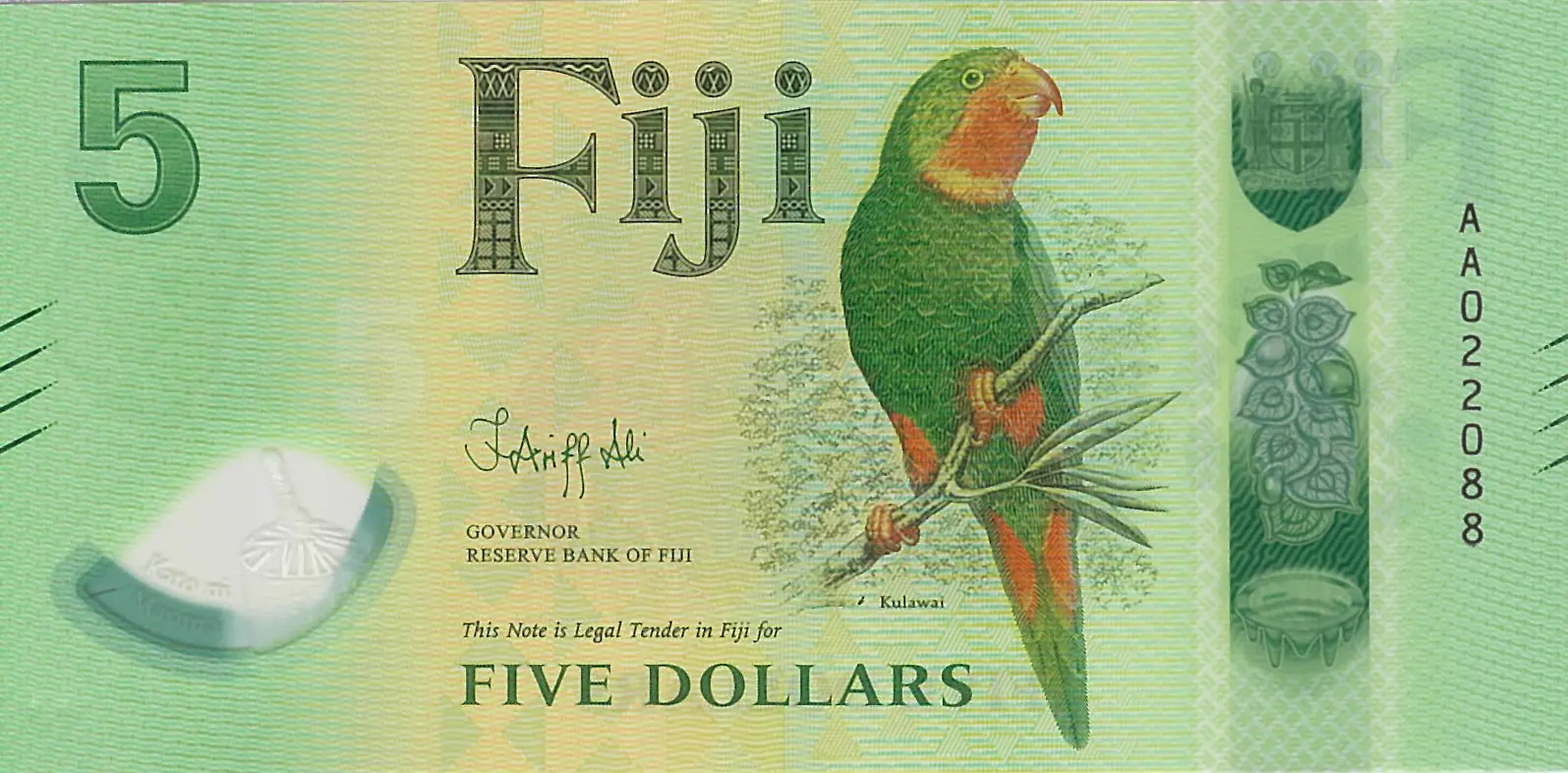
The green $5 note (B534, catalog number PNL) opens the series with Fiji’s smallest and rarest parrot: the kulawai (red-throated lorikeet) [web:81][web:83]. Last confirmed sighting? 1993 [web:81][web:84]. This bird is so elusive that experts debate whether it’s extinct or merely undiscovered in remote mountain canopy forests of Viti Levu and Taveuni [web:81]. Keeping the kulawai on the obverse was a deliberate conservation message—put an “extinct-or-nearly-extinct” species on your most circulated denomination, and every transaction becomes a micro-memorial [web:84].
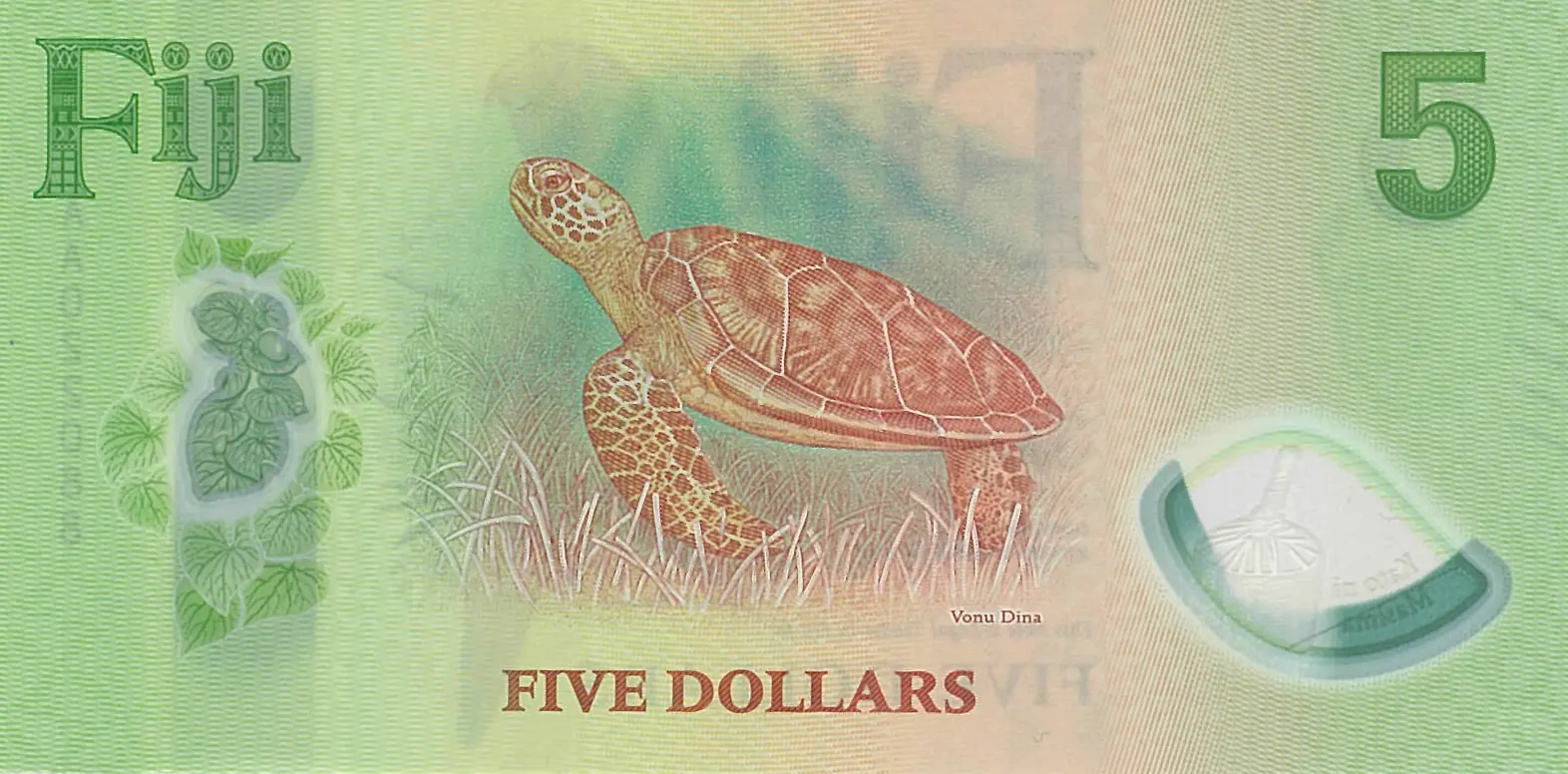
The reverse shifts from the old design’s generic cultural motifs to a specific conservation icon: the Vonu Dina green sea turtle (Chelonia mydas), Fiji’s only herbivorous sea turtle and a keystone species for reef ecosystems [web:76][web:83]. The imagery is straightforward—turtle swimming, coral visible—but the symbolism runs deeper. Green turtles are IUCN-listed endangered, threatened by climate change, plastic pollution, and coastal development. Featuring one on the $5 back transforms the note into a pocket-sized awareness campaign [web:79].
$5 FJD Technical Specifications
| Catalog Number | B534 (PNL) |
| Color | Green, yellow, red / Green, rose, brown |
| Obverse | Kulawai (red-throated lorikeet); Fijian coat of arms; leaves; kava bowl |
| Reverse | Vonu Dina green sea turtle (Chelonia mydas); leaves |
| Dimensions | 136 x 67 mm |
| Substrate | Polymer (Crane Currency) |
| Security | Motion surface stripe; shadow watermark (Fijian head); 4 tactile lines |
| Signature | Sig. 5: Ali (Governor) |
| Prefix | AA (first issue) |
| Value (USD) | ~$2.25 |
$10 Purple: Mangrove Planting and Climate Resilience
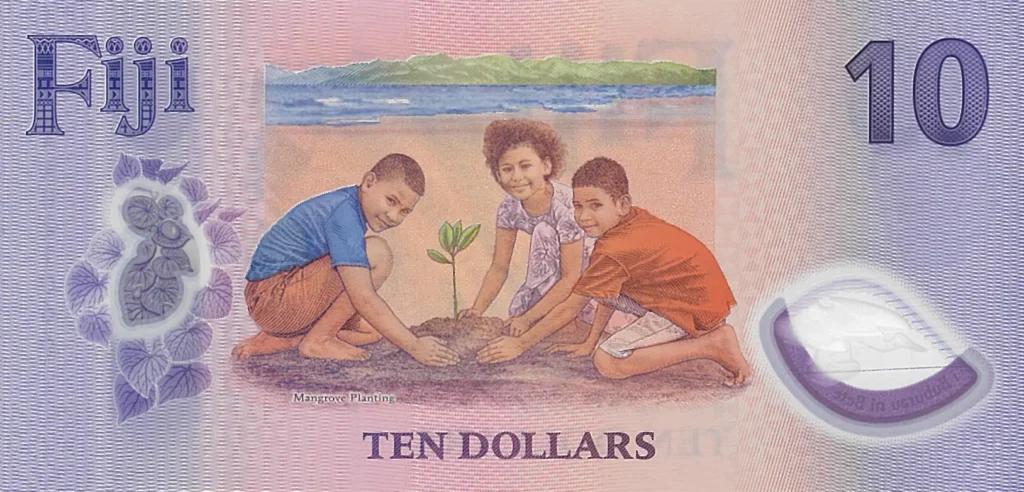
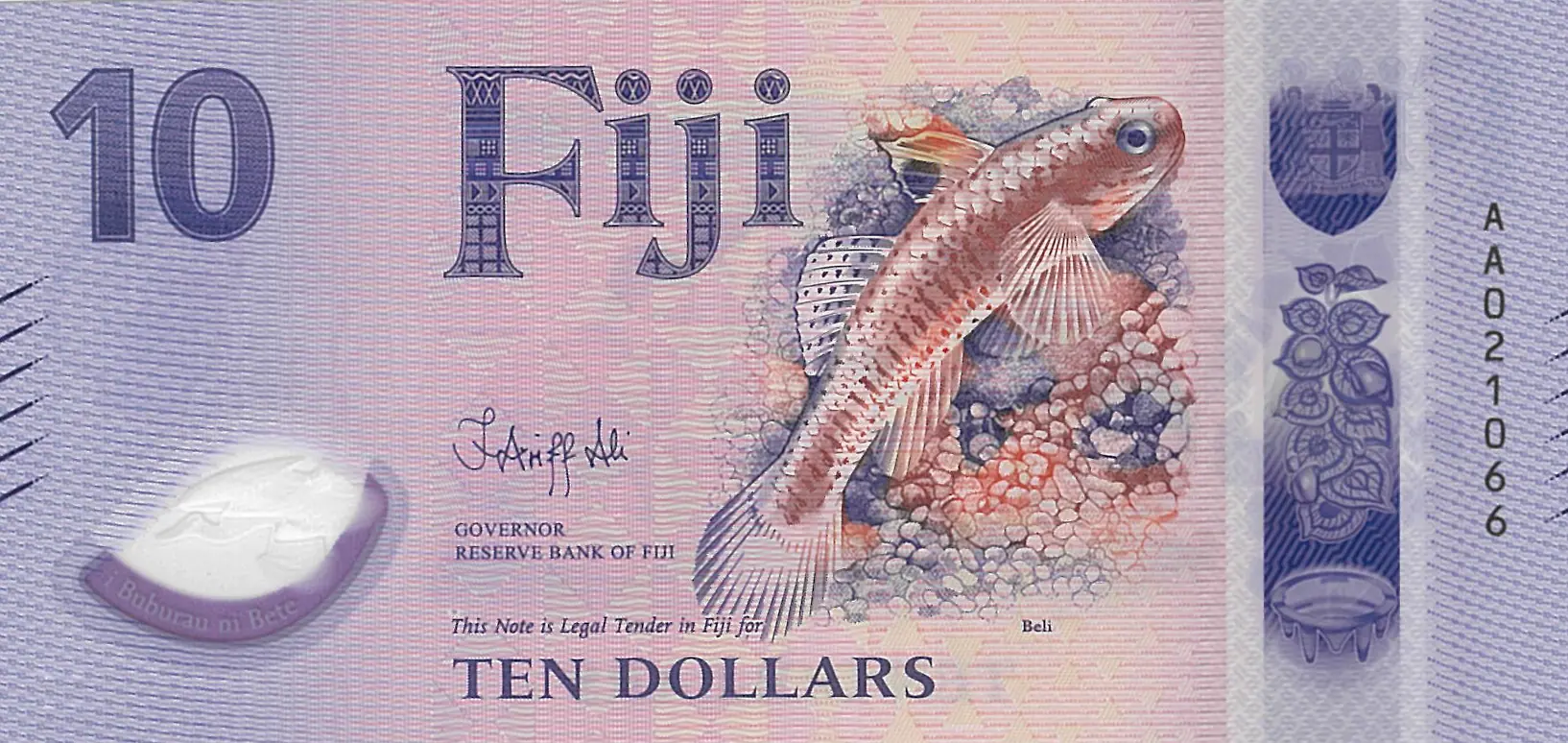
The purple $10 (B535) features the beli fish (Redigobius leveri) on the front—a Fijian endemic goby that inhabits freshwater streams [web:83]. But the real story is on the back: three children planting a mangrove sapling on a beach, with ocean and mountains in the distance [web:76][web:83]. This isn’t decorative art; it’s policy visualization. Fiji loses coastline to erosion and storm surge annually, and mangrove restoration is a frontline climate adaptation strategy. By putting schoolchildren actively engaged in planting on currency, the RBF embeds environmental education into every transaction [web:77][web:79].
Mangroves filter pollutants, stabilize sediment, provide nursery habitat for fish, and sequester carbon at rates higher than terrestrial forests. The imagery—kids bending over a sapling, dirt on hands, collective action—reads like a propaganda poster for resilience, except it’s backed by actual RBF-sponsored coastal projects and NGO partnerships [web:77]. It’s the kind of design choice that wins international banknote awards for social messaging [web:80].
$10 FJD Technical Specifications
| Catalog Number | B535 (PNL) |
| Color | Purple |
| Obverse | Beli fish (Redigobius leveri); Fijian coat of arms; leaves; kava bowl |
| Reverse | Three children planting mangrove sapling; beach, ocean, mountains |
| Dimensions | 141 x 67 mm |
| Substrate | Polymer (Crane Currency) |
| Security | Motion surface stripe; shadow watermark; 6 tactile lines |
| Signature | Sig. 5: Ali |
| Prefix | AA |
| Value (USD) | ~$4.55 |

$20 Blue: Fiji Petrel and Institutional Pride
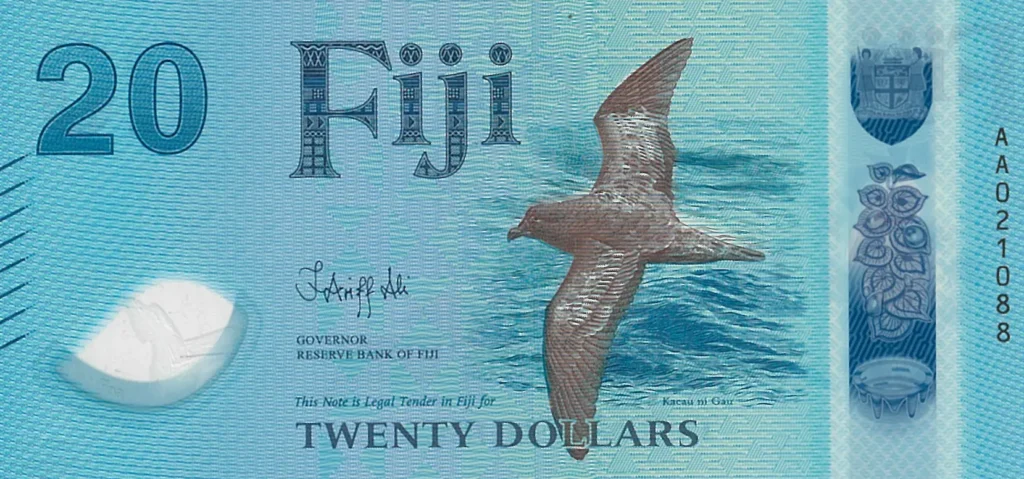
The blue $20 (B536) showcases the kacau ni gau (Fiji petrel), one of the world’s rarest seabirds—so rare that experts estimate fewer than 50 breeding pairs survive [web:82][web:83]. Known to nest only on Gau Island, the petrel spends most of its life at sea, sometimes disappearing for months [web:82]. Its inclusion on currency isn’t just aesthetic; it’s a taxonomic flex. How many countries put critically endangered, barely-photographed seabirds on mid-denomination notes? Fiji does, because endemic biodiversity *is* the brand [web:81][web:82].
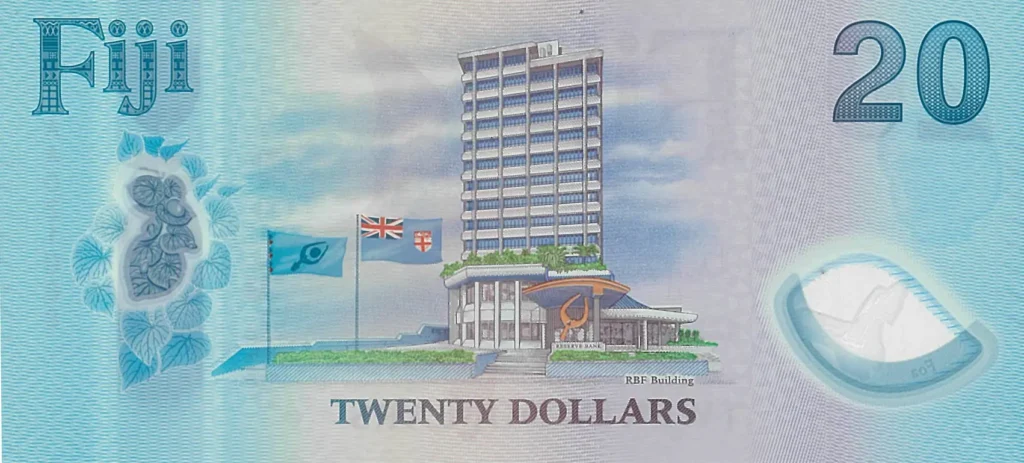
The reverse pivots from nature to nation-building: flags flying outside the Reserve Bank of Fiji headquarters in Suva [web:76][web:83]. This is the monetary equivalent of planting a flag—here’s the institution that manages your currency, guards reserves, and steers monetary policy. The symbolism is overt: economic sovereignty, institutional stability, national pride. It’s also visually striking—multiple flags (likely Fijian national flag and others) create movement and color contrast against the architecture [web:79][web:80].
$20 FJD Technical Specifications
| Catalog Number | B536 (PNL) |
| Color | Blue |
| Obverse | Kacau ni gau (Fiji petrel) flying over waves; coat of arms; leaves; kava bowl |
| Reverse | Flags flying outside Reserve Bank of Fiji headquarters building |
| Dimensions | 146 x 67 mm |
| Substrate | Polymer (Crane Currency) |
| Security | Motion surface stripe; shadow watermark; 8 tactile lines |
| Signature | Sig. 5: Ali |
| Prefix | AA |
| Value (USD) | ~$9.10 |
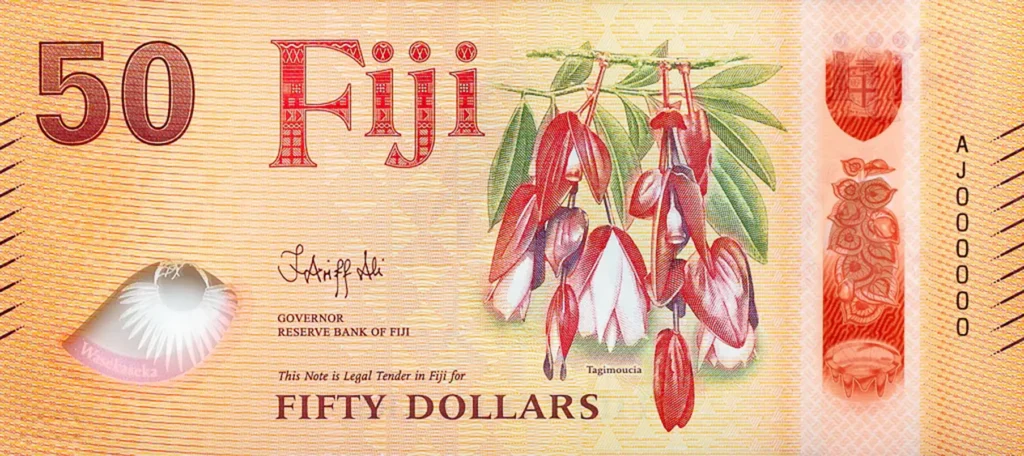
$50 Orange: Tagimoucia Flower and Indo-Fijian Heritage
The orange $50 (B537) retains the tagimoucia flower (Medinilla waterhousei) on the obverse—Fiji’s most iconic bloom, found only in the upland forests of Taveuni around Lake Tagimoucia [web:81][web:82][web:85]. The flower’s vivid scarlet petals with pure white centers have inspired songs, folklore, and decades of “should this be our national flower?” debates [web:81][web:82]. It’s already featured on the old $50, so continuity was guaranteed—you don’t mess with beloved national symbols [web:85].
The reverse is where Fiji makes a bold multicultural statement: a seated South Asian woman (identified as Girmitiya) with the vessel Leonidas in the background [web:76][web:83]. “Girmitiya” refers to indentured laborers—primarily from India—brought to Fiji between 1879 and 1916 under British colonial labor schemes [web:77][web:79]. The Leonidas was one of the ships that transported these workers across the Indian Ocean. By centering an Indo-Fijian woman and a labor migration vessel on the $50, the RBF acknowledges that Fiji’s identity is Indo-Fijian as much as iTaukei (indigenous Fijian) [web:76]. It’s a visual reckoning with colonial history, immigration, and the construction of a multiethnic nation—heavy themes for a banknote, but Fiji commits fully [web:77].
$50 FJD Technical Specifications
| Catalog Number | B537 (PNL) |
| Color | Orange |
| Obverse | Tagimoucia flower (Medinilla waterhousei); coat of arms; leaves; kava bowl |
| Reverse | Seated Girmitiya woman; sailing ship Leonidas at sea |
| Dimensions | 151 x 67 mm |
| Substrate | Polymer (Crane Currency) |
| Security | Motion surface stripe; shadow watermark; 10 tactile lines |
| Signature | Sig. 5: Ali |
| Prefix | AA |
| Value (USD) | ~$23 |
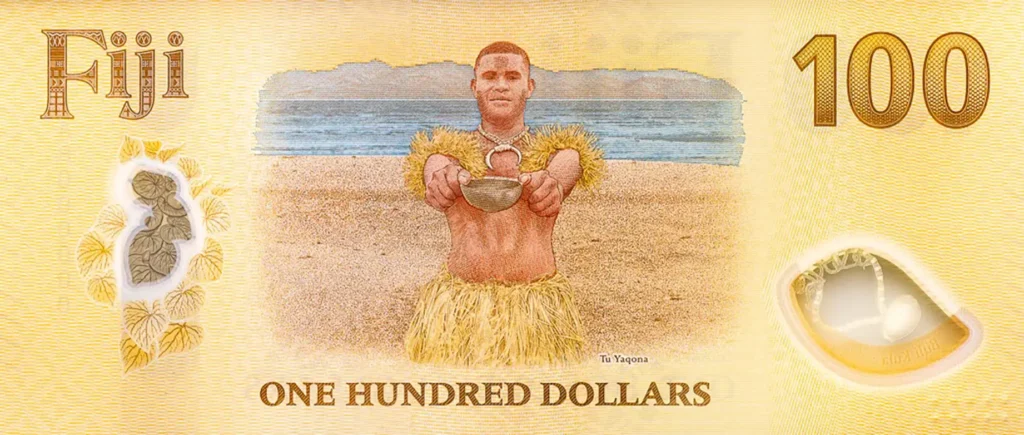
$100 Yellow: Nanai Cicada and the Kava Ceremony
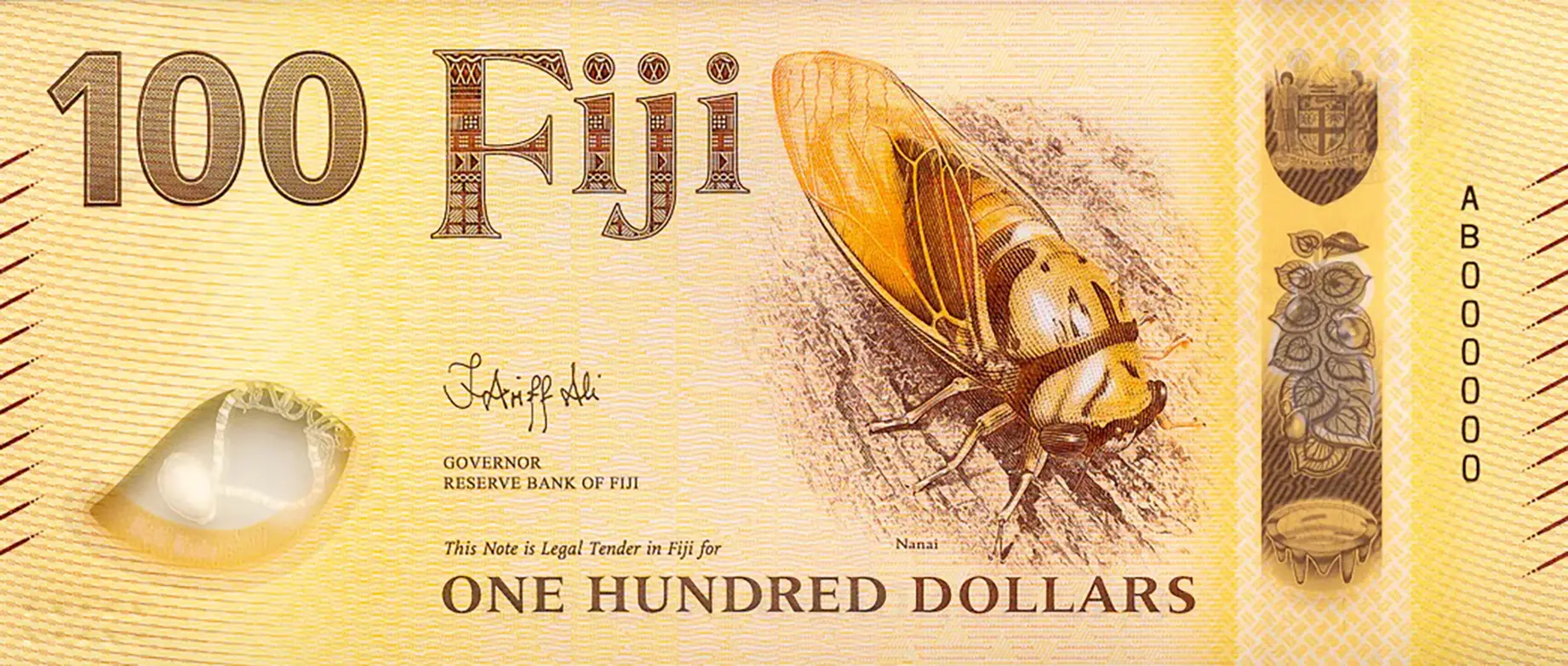
The yellow $100 (B538) crowns the series with the nanai—a cicada species endemic to Fiji [web:83]. Cicadas hold cultural weight across the Pacific: their lifecycle rhythms (emergence after years underground, loud mating calls, short adult phase) symbolize transformation, renewal, and the passage of seasons [web:83]. In Fijian context, the nanai’s presence marks specific times of year, often linked to agricultural cycles and traditional calendars. Putting an insect on your highest-value note is unusual globally—most countries default to historical figures or architecture—but Fiji doubles down on biodiversity as identity [web:81][web:83].
The reverse features an iTaukei man (identified as Tu Yaqona) in traditional attire, standing on a beach and offering a bilo (coconut shell bowl) filled with kava [web:76][web:83]. This is the yaqona vakaturaga ceremony—the formal presentation of kava as a gesture of respect, welcome, or reconciliation [web:81]. The scene is ethnographically precise: correct posture, correct attire, correct setting (beach as liminal space between land and sea, village and visitor) [web:77]. It’s cultural documentation masquerading as currency design, and it works because kava ceremony is *still practiced*—this isn’t museum heritage, it’s living tradition [web:76][web:81].
$100 FJD Technical Specifications
| Catalog Number | B538 (PNL) |
| Color | Yellow |
| Obverse | Nanai (cicada) insect; Fijian coat of arms; leaves; kava bowl |
| Reverse | iTaukei man (Tu Yaqona) in traditional attire offering kava bilo on beach |
| Dimensions | 156 x 67 mm |
| Substrate | Polymer (Crane Currency) |
| Security | Motion surface stripe; shadow watermark; 12 tactile lines |
| Signature | Sig. 5: Ali |
| Prefix | AA |
| Value (USD) | ~$46 |
Revolutionary Security: Motion Surface Stripes and Tactile Accessibility
Governor Ariff Ali wasn’t exaggerating when he called these notes “the most advanced security features in the Asia-Pacific region” [web:80]. The centerpiece is Crane Currency’s motion surface security stripe—a feature visible from both sides of the note, creating dynamic visual effects when tilted [web:80]. Unlike traditional holographic threads (which sit embedded in paper or polymer layers), this stripe is integrated into the substrate itself, making replication virtually impossible without access to specialized polymer extrusion equipment [web:77][web:80].
Security & Accessibility Features (2026 Polymer Series)
- Motion Surface Stripe: World-first technology; visible both sides; dynamic tilt effects (Crane Currency proprietary) [web:80]
- Tactile Lines for Visually Impaired: 4 lines ($5), 6 ($10), 8 ($20), 10 ($50), 12 ($100)—raised intaglio for denomination identification [web:80]
- Shadow Watermark: Fijian head profile embedded in polymer; visible when held to light [web:83]
- Varying Dimensions: Length increases by 5mm per denomination (136mm → 156mm); tactile size-coding [web:79][web:83]
- UV Reactive Inks: Hidden security features visible under ultraviolet light (standard for Crane polymer) [web:77]
- Microtext & Guilloche Patterns: Ultra-fine line work frustrating digital reproduction [web:77]
- Color-Shifting Inks: Likely OVI (Optically Variable Ink) on denominations or security stripes [web:80]
The tactile lines are brilliant inclusive design: visually impaired users can count the raised lines (4 for $5, up to 12 for $100) to identify denominations without assistance [web:80]. This isn’t a token accessibility feature—it’s central to the design, meeting international best practices from the Bank of England, Bank of Canada, and European Central Bank [web:77]. Combined with variable note sizes (each denomination 5mm longer than the previous), Fiji’s new currency is genuinely universal design [web:79][web:83].
Crane Currency’s First Fiji Contract: 200+ Years of Expertise
This is Fiji’s first collaboration with Crane Currency, the Massachusetts-based banknote manufacturer with over two centuries of expertise (founded 1801) [web:77]. Previously, Fiji’s notes were printed by De La Rue (UK) or regional printers, but the RBF opted for Crane’s polymer technology—specifically their patented motion surface security features unavailable from competitors [web:77][web:80]. Crane’s client list includes the US dollar (they supply the paper for Federal Reserve Notes), Swedish kronor, Israeli shekels, and increasingly, Pacific nations seeking cutting-edge polymer solutions [web:77].
The partnership reflects a broader Pacific trend: small island central banks are pooling procurement efforts and leveraging regional expertise. Samoa recently transitioned to polymer (De La Rue’s SAFEGUARD), Papua New Guinea upgraded to hybrid substrates, and Solomon Islands introduced micro-optic stripes [web:77]. Fiji’s choice of Crane positions it at the technological forefront—motion surface stripes are newer than holographic threads or transparent windows, representing the latest evolution in anti-counterfeiting tech [web:80].
Sustainability Credentials: Carbon-Offset Polymer Production
Extended Lifespan: Polymer notes last 2.5x longer than paper equivalents in tropical climates (high humidity, salt air, heavy handling). Fewer replacements = lower production volumes and transport emissions [web:76][web:80].
Carbon Offset Program: The RBF has offset all carbon emissions associated with the production and transport of the new notes—covering manufacturing in the US, shipping to Fiji, and distribution across the islands [web:77].
Recycling Infrastructure: Fiji is working with recyclers to explore end-of-life recycling options for polymer notes, converting worn currency into plastic pellets for secondary industrial use [web:77].
Reduced Waste Volume: Because polymer notes circulate longer, the RBF projects a 40% reduction in annual note replacement volumes by 2030, translating to less physical waste requiring incineration or disposal [web:76][web:77].
President Lalabalavu emphasized the environmental angle during the unveiling: “Each polymer banknote carries a vastly lower carbon footprint and is considered more environmentally friendly than paper or hybrid substrates” [web:77]. This isn’t greenwashing—polymer genuinely outperforms paper in lifecycle analysis, especially when accounting for tropical replacement rates. Cotton-fiber notes degrade rapidly in high humidity, requiring frequent reprints; polymer maintains integrity for years, reducing cumulative environmental impact [web:76][web:80].
Hard Deadline: December 31, 2026 Demonetization
Unlike the Cayman Islands (no timeline) or Paraguay (gradual phase-out), Fiji is executing a swift, hard-deadline transition [web:76][web:80]. Here’s the playbook: new polymer notes enter circulation January 2, 2026; old Flora & Fauna paper notes (plus the old polymer $5) remain valid throughout 2026; on December 31, 2026, old notes are officially demonetized [web:76][web:80]. After that date, you can’t spend them at shops or deposit them at ATMs—only commercial banks will exchange them, and likely with paperwork [web:76].
Official Transition Timeline
December 1, 2025: President Ratu Naiqama Lalabalavu unveils new polymer family at Grand Pacific Hotel; numismatic collector sets go on sale through RBF [web:76][web:77]
January 2, 2026: All five denominations ($5, $10, $20, $50, $100) enter circulation simultaneously; commercial banks begin distributing new notes [web:76][web:80]
January–December 2026: Dual circulation period—both old and new notes accepted as legal tender; RBF gradually withdraws old notes from circulation [web:76][web:80]
December 31, 2026: Old Flora & Fauna series officially demonetized; notes invalid for transactions after this date [web:76][web:80]
2027+: Commercial banks continue exchanging old notes for customers (likely with identification and limits); RBF destroys or recycles withdrawn notes [web:77]
The tight timeline reflects Fiji’s priorities: minimize dual-circulation confusion, accelerate polymer adoption, and demonstrate institutional efficiency [web:80]. As of December 2025, total Fijian currency in circulation stood at FJD $1.2 billion (~8% of GDP), a massive increase from just $14 million at independence in 1970 [web:80]. Replacing that volume in 12 months is ambitious but manageable—most cash cycles through banks within months, and the RBF is incentivizing commercial banks to distribute new notes aggressively [web:76][web:77].
Flora & Fauna (2013–2025) vs. New Polymer Family (2026+)
The outgoing Flora & Fauna series, introduced in 2013, was beloved for its biodiversity focus but suffered from material inconsistency: only the $5 was polymer, while $10–$100 remained paper [web:84]. This created durability disparities—the polymer $5 lasted years, while paper $50 and $100 notes wore out quickly in tropical humidity [web:80]. The new 2026 series fixes that imbalance while preserving the iconic front designs that Fijians know by heart [web:76][web:81].
Side-by-Side Comparison
| Feature | Flora & Fauna (2013–2025) | New Polymer (2026+) |
|---|---|---|
| Substrate | Mixed: Polymer ($5), Paper ($10–$100) | Full polymer (all denominations) |
| Front Designs | Kulawai, beli, petrel, tagimoucia, nanai | **Retained** (same obverse subjects) |
| Back Designs | Cultural motifs, tabua, yaqona, generic heritage | **Redesigned:** turtle, mangroves, RBF building, Girmitiya, kava ceremony |
| Primary Colors | Green, purple, blue, orange, yellow | **Retained** (same color coding) |
| Security | Watermark, threads, UV inks (standard paper features) | Motion surface stripe, shadow watermark, tactile lines, microtext |
| Accessibility | Size variation only (limited tactile features) | Tactile lines (4–12 per note) + size variation |
| Lifespan | ~18–24 months (paper); ~48 months (polymer $5) | ~60+ months (all polymer) |
| Printer | De La Rue (UK) | Crane Currency (USA) |
| Validity | Until December 31, 2026 | From January 2, 2026 onward |
What’s brilliant: Fiji retained the elements citizens love (colors, front animals/flowers) while upgrading everything else (substrate, backs, security, accessibility) [web:76][web:77]. This is design continuity with technological revolution—people won’t feel disoriented by unfamiliar currency, yet they’re getting demonstrably better banknotes [web:80]. The new backs shift from abstract “culture and heritage” to specific narratives: environmental action (mangroves), institutional pride (RBF building), multicultural identity (Girmitiya), and living tradition (kava ceremony) [web:76][web:79].
The printer swap from De La Rue to Crane Currency reflects strategic diversification: De La Rue faced financial troubles in recent years (restructuring, contract losses), while Crane Currency expanded aggressively into polymer markets [web:77]. By partnering with Crane, Fiji gains access to cutting-edge motion surface technology unavailable from De La Rue’s standard SAFEGUARD or Guardian portfolios [web:80].
Collector’s Perspective: The Demonetization Window and First-Issue Premiums
Fiji’s hard December 31, 2026 demonetization deadline creates a rare strategic opportunity: you know *exactly* when the old series becomes officially obsolete, allowing precise timing for acquisition and disposal [web:76][web:80]. Unlike gradual phase-outs (where “last paper note” status is ambiguous), Fiji’s old Flora & Fauna series will have a documented end date, making uncirculated examples instantly “final issue” collectibles [web:76].
Why Fiji 2026 Polymer Notes Are Collectible
- Complete Substrate Transition: First time Fiji issues a full polymer family—historically significant as the final abandonment of paper currency [web:76][web:84]
- Prefix AA, Signature 5 (Ali): All five denominations share the same first-issue markers, making “type set” collection straightforward [web:83]
- World-First Security Technology: Crane’s motion surface stripes are cutting-edge; early adopter status adds numismatic appeal [web:80]
- Thematic Coherence: Each note tells a distinct story (conservation, climate action, heritage, culture); sets are narratively complete [web:76][web:79]
- Official Collector Sets: RBF is selling numismatic presentation packs directly, guaranteeing pristine examples with provenance [web:76][web:77]
- Low Serial Numbers: Prefix AA notes starting with 000001–001000 will command premiums, especially if RBF holds back low numbers for VIP/official distribution [web:83]
- Demonetization Deadline: Old series becomes “last paper” with fixed end date, creating instant collectibility for high-grade Flora & Fauna notes [web:76][web:80]
Estimated Market Values (Projected)
| New Polymer Complete Set (B534–B538, UNC) | $120–$180 USD (face value ~$86 FJD = $39 USD + 200–350% premium) |
| RBF Official Collector Set (sealed folder) | $200–$300 USD (if available; typically 100–200% markup over face) |
| Low Serial AA000001–AA001000 (any denom) | +300%–500% premium over face value per note |
| Old Flora & Fauna Complete Set (UNC, final year) | $80–$150 USD (currently ~$40 face; post-demonetization +100–300%) |
| Old $5 Polymer + New $5 Polymer Pair | $25–$40 USD (substrate-same, design-different comparison piece) |
| Graded PMG/PCGS Gem UNC 67+ (new polymer) | +60%–120% premium over raw UNC examples |
| Error Notes (miscuts, ink smears, serial mismatches) | +500%–1000%+ premiums (if authenticated; Crane errors are rare) |
**The dual-window play:** Buy old Flora & Fauna paper notes ($10, $20, $50, $100) in Gem UNC condition *now*, before December 31, 2026. Post-demonetization, these become “last paper Fiji” notes with fixed historical endpoints, spiking premiums 50–200% within 12–24 months [web:76][web:80]. Simultaneously, acquire the new polymer series (B534–B538) in UNC, preferably low-serial AA prefix [web:83]. Hold both sets—you’ve captured the transition from two angles, maximizing appreciation potential [web:76].
**RBF collector sets:** The Reserve Bank announced special numismatic sets available for purchase through official channels [web:76][web:77]. These typically include all denominations in presentation folders with explanatory booklets, sequential serial numbers, and certificates of authenticity. Sealed RBF sets appreciate fastest because provenance is unimpeachable—no questions about grade, handling, or originality [web:77]. Buy multiple: one to open (for display), one to hold sealed (for appreciation) [web:76].
**Risk factors:** Fiji’s relatively small collector base means international demand drives prices. If Crane Currency overprints (unlikely given Fiji’s modest population of ~900,000), scarcity evaporates. The motion surface technology is novel now but could become standard within 5 years, reducing first-adopter premiums. Conversely, if Crane’s motion stripe proves difficult to produce (delays, quality issues), first-issue notes gain “teething problems era” collectibility—see early Australian polymer notes with production defects, now commanding huge premiums [web:80].
References & External Resources
Official Sources
- Reserve Bank of Fiji – Press Release No. 27: New Polymer Banknotes Officially Unveiled (December 1, 2025)
- RBF – Fiji’s New Banknotes Design & Security Features (December 2025)
- Ministry of Finance – Head of State Unveils New Polymer Banknote Series (December 1, 2025)
- RBF – Features of Fiji’s Flora and Fauna Currency (Old series reference)
Primary News Coverage
- Fiji Sun – Fiji Unveils New Polymer Banknotes with Most-Advanced Security Features (December 1, 2025)
- MRI Bankers’ Guide – Fiji New Family of Polymer Banknotes Unveiled (December 7, 2025)
Numismatic Industry Sources
- BanknoteNews – Fiji New Polymer 5-Dollar Note (B534a) Reported (December 18, 2025)
- The Paper Money Guy – 5 Dollar Fiji Note: A Call of the Wild (September 2023 – old series)
Historical & Technical Context
- RBF – Fiji’s New Flora and Fauna Design Banknotes Unveiled (2013 series launch)
- Fiji Journal – Fijian Currency: Flora and Fauna Designs (2025 guide)
Related Topics: Crane Currency & Polymer Technology
- Crane Currency official website – Motion Surface security features documentation
- International Association of Currency Affairs (IACA) – Polymer banknote lifecycle studies
Catalog References: All denomination catalog numbers (B534–B538, PNL status) are sourced from BanknoteNews December 2025 entries and cross-referenced with RBF official announcements. “PNL” indicates “Pick Number Listed” but not yet assigned in Standard Catalog of World Paper Money.
Collector Note: Special numismatic sets are available for purchase directly through the Reserve Bank of Fiji. Contact RBF Currency Management Division or check the official RBF website for ordering details, pricing, and international shipping options.
Disclaimer: Market valuations and investment projections are speculative estimates based on historical polymer transitions in Australia, Canada, New Zealand, and recent Pacific island currency launches. Actual collector premiums depend on RBF print quantities, international demand, grading service availability, and preservation quality. GlobeNote is not a financial advisor; conduct independent research before purchasing currency for investment purposes.
Don’t Miss Fiji’s Polymer Revolution
Old notes expire December 31, 2026. Secure your Flora & Fauna “last paper” set and new polymer first-issue notes before premiums spike.
This article is part of our New Banknotes 2026 guide.