
Kazakhstan 500 tenge (KZT500.6) released on December 25, 2025, marking the fifth denomination in the stunning “Saka Style” family. This release brings collectors one step closer to completing the entire modern Kazakh currency series.
National Bank of Kazakhstan Official Release
The National Bank of Kazakhstan confirmed the circulation debut of the new 500 tenge banknote (KZT500.6) on December 25, 2025, as part of the phased rollout of the “Saka Style” series that began in December 2023. This denomination represents the fifth of seven planned banknotes showcasing Kazakhstan’s ancient nomadic heritage through modern security technology and artistic design.
According to the National Bank’s official statement and verified by multiple numismatic sources including MRI Bankers’ Guide to Foreign Currency™, Banknote News, and regional outlets, the new 500 tenge note will circulate in parallel with the previous design (featuring Al-Farabi) for a transition period. The older notes will be gradually withdrawn as the new series achieves full distribution across Kazakhstan’s banking infrastructure, ATMs, and retail channels.
Essential Facts at a Glance
🗓️ Release Details
Official circulation began December 25, 2025. Designated as KZT500.6 in Pick catalogs. Fifth denomination in the seven-note Saka Style family launched progressively from 2023-2026. Parallel circulation with previous Al-Farabi design for transition period before gradual withdrawal.
📐 Physical Specifications
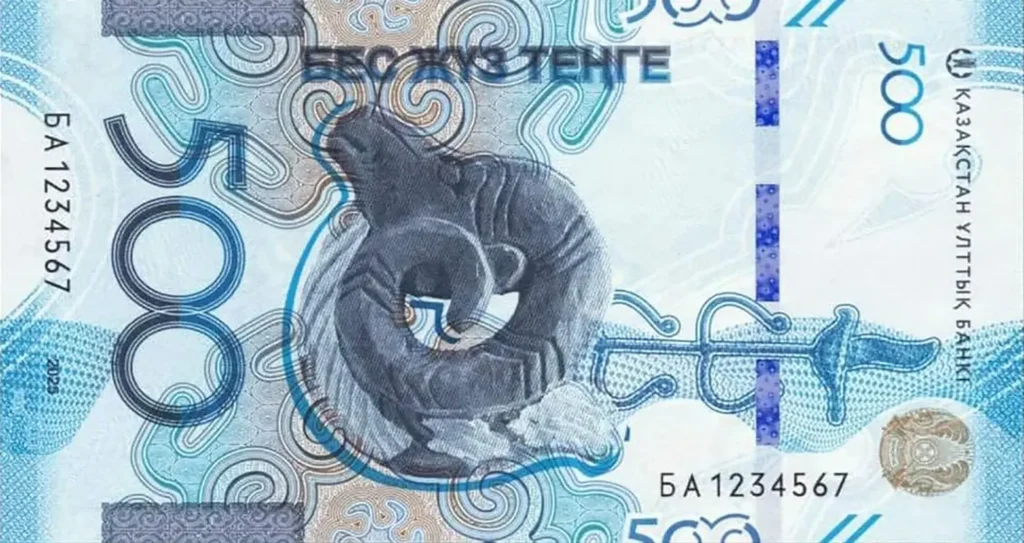
Dimensions: 125 x 70 mm (vertical orientation). Primary colors: blue, gray, brown symbolizing Kazakh sky and nomadic freedom. Cotton-based paper substrate. Advanced security thread with demetalized text. Watermark features Samruk mythological bird with electrotype denomination.
🎨 Saka Style Heritage
Design inspired by ancient Saka artifacts (7th-3rd century BCE) from Issyk burial mound “Golden Man” discovery. Obverse features Tree of Life branch with soaring bird motif. Combines nomadic cultural elements with DNA spiral representing modern Kazakhstan’s progress and genetic continuity.
🦌 Wildlife Imagery
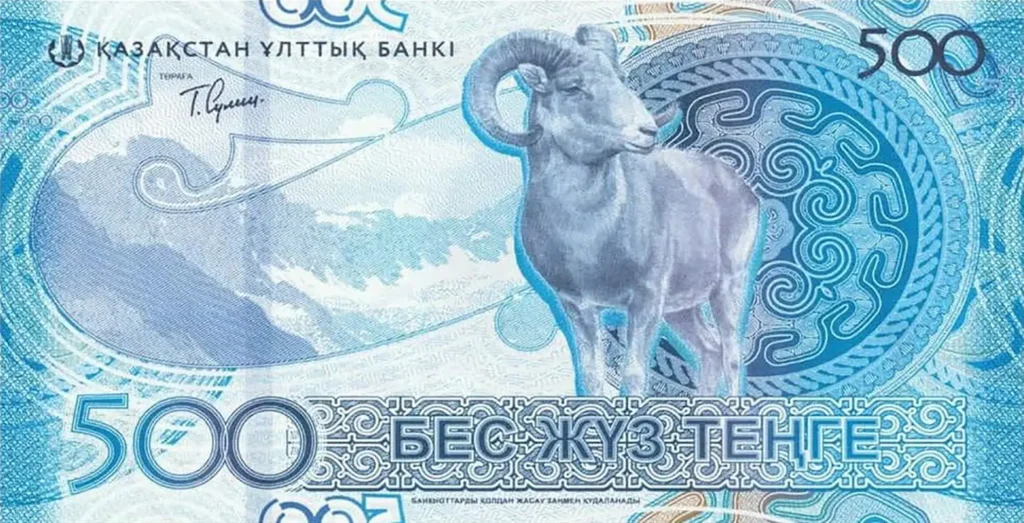
Obverse showcases Transcaspian urial (Ovis vignei arkal) head in profile – endangered mountain sheep native to Central Asian highlands. Reverse depicts standing argali against snow-covered mountains in infinity ornament outline. Conservation awareness meets numismatic artistry.
🔒 Security Upgrades
State-of-the-art anti-counterfeiting features including windowed security thread, micro-text elements, UV-reactive inks, tactile intaglio printing, and multi-level watermarking. Signature 8 by National Bank Chairman Suleymanov. Equipment-readable for automated authentication.
Complete Saka Style Family Timeline
The “Saka Style” series represents Kazakhstan’s most ambitious currency redesign since independence, honoring the ancient Saka people (Eastern Scythians) whose artistic traditions form the foundation of Kazakh national identity. Unveiled by the National Bank in November 2023, this seven-denomination family features vertical orientation, unified design language, and cutting-edge security across all notes from 500 to 20,000 tenge.
Each denomination incorporates elements from the Issyk kurgan “Golden Man” archaeological discovery – a 3rd-4th century BCE burial containing elaborate gold artifacts that symbolize Kazakhstan’s pre-Islamic heritage. The series systematically replaces older horizontal designs issued between 2006-2022, with parallel circulation periods ensuring smooth transitions for businesses and collectors.
| Denom. | Pick # | Release Date | Status | Colors |
|---|---|---|---|---|
| 5,000 | KZT5,000.3 | Dec 25, 2023 | ✅ Circulating | Green, yellow |
| 10,000 | KZT10,000.4 | Jun 28, 2024 | ✅ Circulating | Purple, blue |
| 2,000 | KZT2,000.5 | Dec 2024 | ✅ Circulating | Orange, brown |
| 1,000 | KZT1,000.6 | Early 2025 | ✅ Circulating | Green, olive |
| 500 | KZT500.6 | Dec 25, 2025 | ✅ Just Released | Blue, gray |
| 20,000 | KZT20,000.3 | 2026 | ⏳ Pending | Violet, blue |
Collector Strategy: The staggered release creates natural collecting milestones. Early adopters who acquired 5,000 tenge first-day issues (Dec 2023) have already seen 40-60% appreciation in UNC graded specimens. The 20,000 tenge 2026 release will complete the family – expect significant demand for matched serial number sets spanning all seven denominations.
Design Elements & Cultural Symbolism
The 500 tenge banknote exemplifies the Saka Style’s fusion of archaeological authenticity with contemporary numismatic technology. Every visual element carries layered meanings connecting Kazakhstan’s nomadic past to its modern aspirations as a Eurasian crossroads nation. The vertical format (125 x 70 mm) distinguishes the series from preceding horizontal issues and aligns with international trends toward portrait-oriented currency.
🌳 Obverse (Front) Elements
- Transcaspian Urial Head: Endangered mountain sheep (Ovis vignei arkal) in profile, representing Kazakhstan’s commitment to biodiversity protection and highland ecosystems
- Tree of Life Branch: Sacred motif from Golden Man headgear showing bird in flight – symbolizes cosmic connection between earth (roots), terrestrial life (trunk), and heavens (branches)
- DNA Double Helix: Modern scientific imagery representing genetic heritage, population diversity, and Kazakhstan’s biotech advancement aspirations
- National Emblem: Shanyrak (yurt crown) with winged mythical horses (tulpars), sun rays, and inscription “Қазақстан” in gold microtext
- Kazakh Text: Denomination “БЕС ЖҮЗ ТЕҢГЕ” (Five Hundred Tenge) in national script
⛰️ Reverse (Back) Elements
- Snow-Covered Mountains: Stylized Tian Shan or Altai ranges rendered within infinity ornament outline – evokes eternal nature of Kazakh steppe culture
- Standing Argali: Full-body depiction of mountain sheep in natural habitat, complementing obverse portrait with behavioral context
- Circular Kazakh Ornament: Traditional four-directional pattern incorporating solar symbolism (energy, life force), protective shield motifs, and cardinal points representing territorial sovereignty
- Infinity Symbol Integration: Mathematical ∞ adapted into organic landscape contours – bridges ancestral cyclical worldviews with modern mathematical concepts
- Denomination Numeral: Large “500” in contrasting color for accessibility and rapid denomination identification in transactions
Numismatic Significance: The Saka Style’s ethnographic accuracy and artistic sophistication positions these notes among the most collectible modern Asian currencies. Comparable to Bhutan’s cultural banknotes and Mongolia’s heritage series, Kazakhstan’s approach demonstrates how national currency can serve as “printed museums” celebrating indigenous identity within globalized economies.
🔐 Advanced Anti-Counterfeiting Technology
The 500 tenge incorporates multiple security layers meeting international standards for banknote protection. These features facilitate authentication by financial institutions, retailers, and collectors while deterring sophisticated counterfeiting attempts.
🧵 Windowed Security Thread
Embedded polymer thread alternates between visible (window) and buried segments across the note’s vertical axis. Contains demetalized microtext readable under magnification: “NBK 500 KZT” repeated continuously. Under UV light, thread fluoresces in specific spectrum confirming authenticity.
💧 Samruk Bird Watermark
Multi-tonal watermark depicts Samruk (mythological bird of happiness from Kazakh folklore) with electrotype denomination “500”. Created through differential paper density during manufacturing. Visible when held to light with graduated shading from light to dark tones impossible to photocopy.
🎨 Intaglio Printing
Raised ink textures on obverse portraits, text, and ornaments created via copper plate engraving. Provides distinctive tactile feel for visually impaired users and authentication. High-pressure printing process produces microscopic ink ridges detectable by fingertip but unachievable through flat digital printing.
🔬 Microprinting Elements
Text lines appearing as solid borders contain legible words when viewed under 10x magnification: “ҚАЗАҚСТАН ҰЛТТЫҚ БАНКІ” (National Bank of Kazakhstan). Standard photocopiers reproduce microtext as blurred lines, enabling quick visual verification by trained personnel.
🌈 UV-Reactive Inks
Invisible fluorescent patterns emerge under ultraviolet light (365nm): denomination numerals, geometric ornaments, and security thread segments glow in specific colors (typically green, yellow, red). Position and color sequencing unique to genuine notes prevent UV-pen counterfeits.
🔢 Serial Number Perfection
Horizontal and vertical serial numbers printed in specialized optically variable ink changing hue with viewing angle. Precise registration alignment between front/back serials (when held to light) confirms authentic plate printing versus separate forgery attempts. Font includes proprietary characters with anti-scanning features.
Transition Process & Legal Tender Status
The National Bank of Kazakhstan implements a carefully managed parallel circulation system ensuring minimal disruption to commerce and banking operations. Both the new Saka Style 500 tenge (KZT500.6, featuring argali) and the previous Al-Farabi design (KZT500.5, issued 2006-2017) remain full legal tender throughout the transition period.
📍 Phase 1: Initial Distribution (Q4 2025 – Q2 2026)
New notes enter circulation through National Bank regional branches, gradually supplying commercial banks, ATM networks, and Kazpost offices. Priority distribution to major cities (Astana, Almaty, Shymkent) before expanding to rural areas. Old-design notes continue normal use without exchange requirements. Collectors should target early 2026 circulation finds for lowest serial prefixes.
📍 Phase 2: Parallel Legal Tender (12-18 Months)
Both designs circulate simultaneously with equal acceptance mandated by law. Refusing either version constitutes administrative offense under Kazakhstan’s Code of Administrative Offenses (Article 299). Businesses must accept both types for goods, services, and debt settlement. ATM/terminal upgrades completed to recognize new security features alongside older notes.
📍 Phase 3: Old Design Withdrawal (2027-2029)
National Bank sets official deadline for Al-Farabi 500 tenge demonetization (typically 24-36 months post-release). After deadline, second-tier banks and Kazpost exchange old notes for new design at face value for additional 2-3 years. National Bank branches accept withdrawn notes indefinitely without time limit – ensures no citizen loses currency value due to remote location or extended absence.
📍 Phase 4: Collection Market Formation (2030+)
Withdrawn Al-Farabi notes become numismatic artifacts. UNC specimens with low serials, rare signatures, or replacement prefixes appreciate above face value. Saka Style first-year issues (2025-dated) establish premium over later printings. Complete transition documentation (both designs in matching serial ranges) creates valuable comparative sets for educational collections.
Collector Tip: No urgent need to exchange old 500 tenge notes – they remain spendable for years. However, collectors should acquire UNC examples of both designs now while readily available. Post-demonetization, pristine Al-Farabi specimens become scarcer as most circulated notes get destroyed during bank redemptions.
Strategic Acquisition & Value Preservation
Kazakhstan banknotes represent an undervalued segment of Central Asian numismatics compared to Chinese, Japanese, or Middle Eastern currencies. The Saka Style series offers multiple entry points for collectors at various budget and expertise levels, with strong fundamentals supporting long-term appreciation.
🥇 Serial Number Hunting
- Target prefix AA (first print run) and serials under 010000
- Fancy numbers: radars (121121), ladders (123456), solids (555555)
- Match serial numbers across multiple denominations (500, 1000, 2000, etc.)
- Replacement notes use specific prefixes – monitor collector forums for identification
📊 Complete Set Building
- Acquire all seven Saka Style denominations (500 through 20,000) in sequential order of release
- Option 1: Circulated set for thematic display (budget-friendly)
- Option 2: UNC set for investment-grade holding (grading recommended)
- Option 3: Both old and new designs per denomination (transition documentation)
🏆 Professional Grading
- Submit UNC specimens to PMG or PCGS Currency for authentication and encapsulation
- Grading costs justified for notes estimated value >$50 USD
- Target grades: PMG 66-67 Gem Uncirculated for maximum liquidity
- Population reports track rarity – lower population = higher premiums
🌍 Comparative Regional Sets
- Pair Kazakhstan notes with Uzbekistan, Kyrgyzstan, Tajikistan, Turkmenistan currencies
- Create “Silk Road” or “Turkic Nations” thematic collections
- Educational appeal enhances resale value to museums and institutions
- Geographic diversification reduces single-country political risk
📈 Market Timing Strategy
- Immediate acquisition (2026): Catch early circulation examples before mass distribution
- Mid-term hold (2028-2030): Parallel circulation ends, old design demonetized, scarcity emerges
- Long-term appreciation (2035+): First-generation Saka notes achieve “vintage modern” status similar to 2000s Euro firsts
🎯 Error & Variety Speculation
- Monitor for printing errors: misaligned cuts, ink smears, inverted serials
- Color variations between print runs create collectible varieties
- Signature changes (future National Bank chairmen) produce catalog sub-types
- Major errors authenticated by PMG can reach 500-1000% premiums
Market Dynamics & Price Projections
Kazakhstan’s growing economic prominence as a resource-rich Eurasian hub increases international collector interest in its currency. The Saka Style series benefits from superior artistic merit compared to utilitarian Soviet-era designs, attracting crossover appeal from Asian art collectors and cultural heritage enthusiasts beyond traditional numismatists.
Historical data from previous Kazakh banknote transitions (10,000 tenge 2006→2011→2024 redesigns) shows consistent 15-25% annual appreciation for UNC first-year specimens during the 5 years post-demonetization. The Saka series’ unified family concept and limited production windows create stronger scarcity fundamentals than previous piecemeal replacements.
💰 Conservative Price Estimates (USD)
| Item Category | 2026 | 2030 | 2035 |
|---|---|---|---|
| 500 KZT UNC Single | $2-4 | $6-10 | $15-25 |
| Complete Saka Set (7 notes) | $25-40 | $80-120 | $200-350 |
| PMG 67 Gem (500 KZT) | $15-25 | $40-65 | $100-180 |
| Low Serial (<001000) | $10-18 | $35-60 | $90-150 |
| Matched Serial Set (7) | $60-100 | $180-300 | $500-850 |
| Replacement/Error | $25-50 | $80-140 | $200-400 |
Note: Projections assume stable political conditions, continued economic growth, and normal collector market expansion. Actual values depend on grade, serial desirability, and global numismatic trends. Prices shown for US market; European and Asian markets may vary ±20%.
Market Catalyst Watch: The pending 20,000 tenge release in 2026 will trigger renewed attention to the complete Saka family. Strategic collectors should position ahead of this final issue to capture pre-hype pricing on earlier denominations. Similar pattern observed with European Euro series completions (Estonia 2011, Latvia 2014) where first-issued denominations appreciated 40-70% upon series completion announcements.
Completing the Family: 20,000 Tenge in 2026
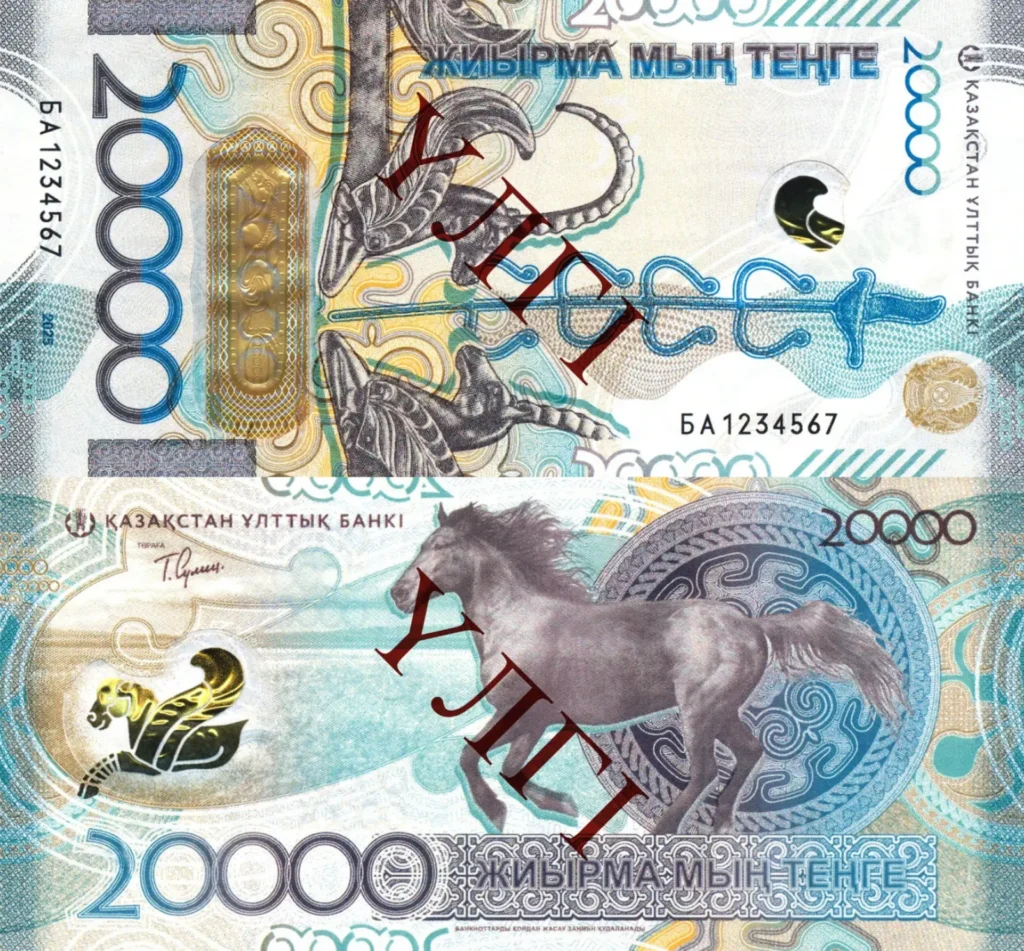
The 20,000 tenge banknote (KZT20,000.3) represents the crown jewel and final denomination of the Saka Style series. As Kazakhstan’s highest-value note (approximately $40-45 USD at current exchange rates), this flagship issue carries special significance for completing collectors’ sets and investment portfolios. The National Bank confirmed 2026 release without specifying exact quarter, creating anticipation similar to limited-edition luxury launches.
Based on National Bank preview materials released in November 2023, the 20,000 tenge design follows the established vertical format while incorporating the most elaborate security features of the entire family. Its larger dimensions (155 x 79 mm – matching the previous 2022 horizontal design) provide expanded canvas for artistic detail and advanced anti-counterfeiting technology.
🎨 Confirmed Design Elements
- Primary Colors: Violet, blue, and yellow with red/purple accents – most vibrant palette in series
- Obverse Central Motif: Facing antelopes ornament (mirror-image composition symbolizing balance and duality in Kazakh cosmology)
- Tree of Life & Golden Man: Consistent sacred branch with soaring bird from Issyk kurgan artifacts
- DNA Spiral: Continuing genetic heritage theme across all denominations
- Reverse Landscape: Plains ecosystem in infinity ornament outline with running horse motif – celebrates steppe pastoral culture
- Gold Stylized Horse: Archaeological artifact rendering (likely from Saka burial treasures) emphasizing equestrian nomadic identity
- Samruk Watermark: Most elaborate multi-level watermark of series with electrotype “20000”
💎 Collector Anticipation Factors
- Series Completion Premium: Final puzzle piece drives completist demand – expect 50-100% markup over face value for first-day UNC specimens
- Highest Denomination Status: Flagship notes historically appreciate faster (compare Swiss 1000 CHF, Singapore $10,000)
- Lower Print Volumes: High-value notes circulate less = smaller production runs = greater scarcity
- Commemorative Packaging Likely: National Bank may issue special folders/albums for the series finale (like ECB did for €500 final printings)
- Investment Allocation: High face value ($40-45) deters casual collectors, creating opportunity for serious numismatists to acquire while competition remains moderate
Strategy Recommendation: Monitor National Bank of Kazakhstan press releases and numismatic news outlets (Banknote News, MRI Guide) throughout 2026 for exact release date announcements. Pre-register with authorized dealers offering first-day allocation services to secure low serial numbers. Budget approximately $100-150 USD for graded PMG 66+ specimen to ensure investment-grade provenance from day one.
Research Sources & Verification
🏛️ Official National Bank Resources
- National Bank of Kazakhstan – Official banknote specifications and releases: Saka Style Series Guide
- NBK Press Releases – Currency policy announcements: Press Release Archive
- NBK Banknotes Section – Current circulation information: Money Guide
📰 Verified News Sources
- MRI Bankers’ Guide to Foreign Currency™ – Kazakhstan 500 tenge announcement: 500 Tenge Issue Report
- Banknote News – Technical analysis and catalog data: 500 Tenge B155a Report
- Tengrinews.kz – Regional financial journalism: New Banknotes Announcement
- World Banknote Store – Detailed design analysis: 500 Tenge Design Review
🔬 Numismatic Research Organizations
- International Bank Note Society (IBNS) – Technical research: www.theibns.org
- World Paper Money (Standard Catalog) – Kazakhstan catalog listings: Krause Catalog
- Numista – Community catalog: Kazakhstan Banknotes
🌐 Collector Communities & Marketplaces
- PMG (Paper Money Guaranty) – Grading services: www.pmgnotes.com
- PCGS Currency – Authentication and grading: www.pcgscurrency.com
- Heritage Auctions – Asian currency auctions: currency.ha.com
- Stack’s Bowers – World paper money: World Currency Auctions
- eBay World Banknotes – Market pricing reference: eBay World Currency