
On January 21, 2026, the Czech National Bank (Česká národní banka, ČNB) released the third and final commemorative 100 koruna banknote in its “Establishment of the Czechoslovak Currency” series, honoring Vilém Pospíšil—the first governor of the National Bank of Czechoslovakia (Národní banka Československá, NBČ) appointed in 1926 [web:17][web:19]. This premium collector note marks the 100th anniversary of Czechoslovakia’s first independent central bank, the institutional predecessor of today’s Czech National Bank.
The series completes a three-note tribute to Czechoslovakia’s monetary founding fathers: Alois Rašín (2019), Karel Engliš (2022), and now Vilém Pospíšil (2026) [web:17][page:1]. Designer Eva Hašková’s sophisticated composition features the ČNB’s Prague headquarters, cornucopia symbolism, and genius sculptures representing prosperity and wisdom—visual elements connecting 1926’s banking revolution to modern Czech monetary policy.
| Specification | Details |
|---|---|
| Honoree | Vilém Pospíšil (1873–1942), economist, lawyer, first NBČ Governor |
| Series | Establishment of the Czechoslovak Currency III (final issue) |
| Release Date | January 21, 2026 |
| Designer | Eva Hašková |
| Printer | Státní tiskárna cenin (State Printing Works of Securities) |
| Dimensions | 194 × 84 mm (7.64 × 3.31 inches) |
| Substrate | Cotton paper with stepped watermark |
| Print Run | 20,000 pieces |
| Issue Price | 3,790 CZK (≈ $165 USD / €155 EUR) |
| Face Value | 100 CZK (legal tender) |
| Catalog Reference | CZK-2026-CM (Commemorative) |
“The establishment of the National Bank of Czechoslovakia in 1926 represented a critical milestone in building an independent monetary system. Vilém Pospíšil’s leadership during those foundational years established principles of central bank independence and fiscal discipline that remain cornerstones of Czech monetary policy.” — Karina Kubelková, CNB Bank Board Member, January 2026
Vilém Pospíšil: First Governor of the National Bank of Czechoslovakia
Vilém Pospíšil (1873–1942) was a distinguished Czech economist, lawyer, and public servant who became the founding governor of the National Bank of Czechoslovakia when President Tomáš Garrigue Masaryk appointed him to lead the newly established institution in April 1926 [web:19][web:23]. His appointment marked the culmination of nearly eight years of complex negotiations to create an independent central banking institution following Czechoslovakia’s 1918 establishment as a sovereign state.
Pospíšil brought formidable academic credentials and practical experience to the governorship. After completing legal studies at Charles University in Prague, he pursued advanced economics training in Vienna and Paris, developing expertise in monetary theory and public finance during the late Habsburg period. His pre-war career included senior positions in Austro-Hungarian financial administration, providing intimate knowledge of the imperial monetary system’s strengths and fatal weaknesses [web:18].
Between Czechoslovakia’s 1918 independence and the 1926 NBČ establishment, the Ministry of Finance directly managed monetary policy through the Banking Office (Bankovní úřad). Finance Minister Alois Rašín—featured on the 2019 commemorative note—engineered the dramatic 1919 currency separation (stamping Austro-Hungarian crowns to create Czechoslovak crowns) but died in 1923 before achieving his vision of an independent central bank [web:23][page:1].
Rašín’s successor Karel Engliš—honored on the 2022 commemorative—finally secured parliamentary approval for the National Bank of Czechoslovakia Act in 1925, establishing the legal framework for central bank operations beginning April 1, 1926 [web:17][page:1].
As NBČ’s first governor, Pospíšil faced the daunting challenge of building institutional credibility while managing the koruna’s position during the tumultuous interwar period. He oversaw the bank’s acquisition of gold reserves, established relationships with major European central banks, and navigated the currency through the early phases of the Great Depression. His tenure saw the NBČ gain international recognition as one of Central Europe’s most professionally managed monetary authorities [web:23].
Pospíšil served as governor until 1934, when he retired from active central banking but continued contributing to Czech economic discourse through academic publications and advisory roles. He died in 1942 during the Nazi occupation of Czechoslovakia, having witnessed both the interwar republic’s economic achievements and its tragic dissolution [web:18].
This 2026 commemorative note completes the triumvirate honoring Czechoslovak monetary independence: Rašín (the visionary who engineered currency separation), Engliš (the architect of central bank legislation), and Pospíšil (the institution-builder who transformed legal framework into operational reality) [web:17][page:1].
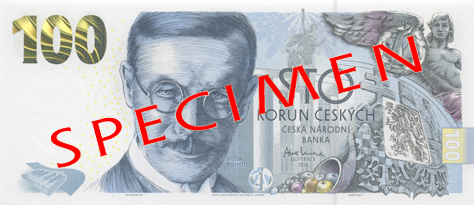
Czech 100 Koruna: Obverse Design Elements
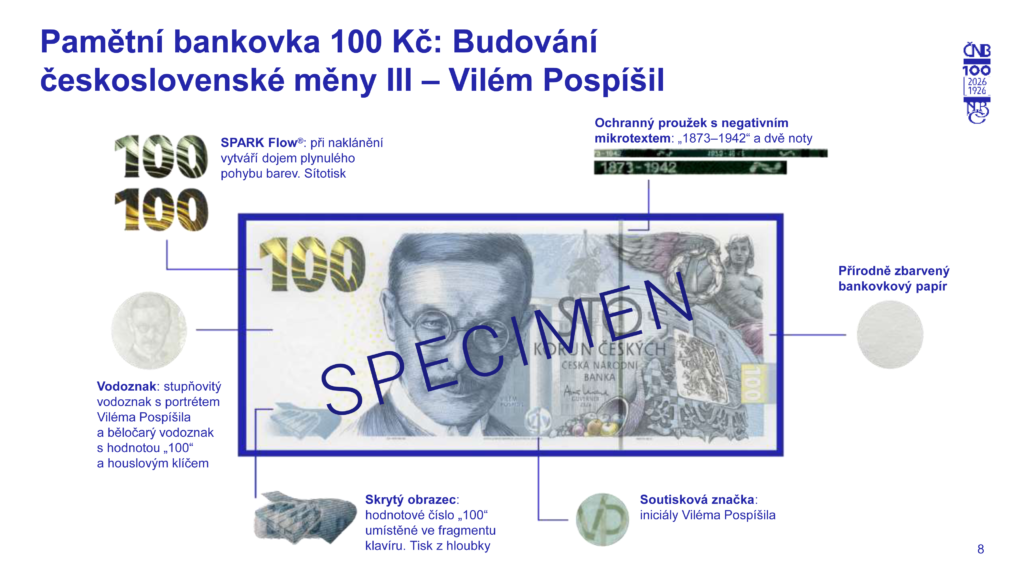
Eva Hašková’s obverse composition employs classical numismatic symbolism to convey institutional permanence and economic prosperity. The design balances portraiture with architectural and allegorical elements, creating a sophisticated visual narrative connecting personal leadership to institutional achievement.
Primary Design Elements
- Central Portrait: Formal portrait of Vilém Pospíšil positioned left-of-center, rendered in engraved intaglio style emphasizing dignified bearing characteristic of interwar banking leadership. The portrait references historical NBČ photographic archives.
- Czech National Bank Building (Prague): Architectural rendering of the ČNB’s neo-Renaissance headquarters on Na Příkopě street in Prague’s historic center—the same building that housed the original NBČ from 1926 [page:1]. The architectural detail emphasizes the institution’s continuity across nearly a century.
- Cornucopia (Horn of Plenty): Classical allegorical element featuring overflowing fruits, symbolizing economic abundance and the central bank’s role in fostering monetary stability that enables prosperity. This iconography connects to early 20th-century banknote design traditions.
- Czechoslovak State Coat of Arms (Medium Version): The middle coat of arms of the First Czechoslovak Republic (1920–1938 design) featuring the Bohemian lion, Moravian eagle, and Silesian eagle—representing the territorial composition of the interwar state [page:1]. This historical heraldry contextualizes Pospíšil’s governorship within the specific constitutional framework of his era.
- Genius Figure with Laurel Wreath: Allegorical sculpture (genius) holding laurel wreath, classical symbol of victory, achievement, and honor. The genius figure represents wisdom and guardianship—appropriate symbolism for central bank leadership.
- Denomination and Text Elements: “100 KORUN” denomination prominently displayed with security features. Inscriptions include “ČESKÁ NÁRODNÍ BANKA” and series title “BUDOVÁNÍ ČESKOSLOVENSKÉ MĚNY” (Establishment of the Czechoslovak Currency).
The obverse employs a blue-to-gold color gradient anchoring the composition—blue representing institutional trust and stability, gold evoking monetary value and achievement. Hašková’s design deliberately references early 20th-century European banknote aesthetics while incorporating modern security features, creating visual continuity between historical subject matter and contemporary production standards [page:1].
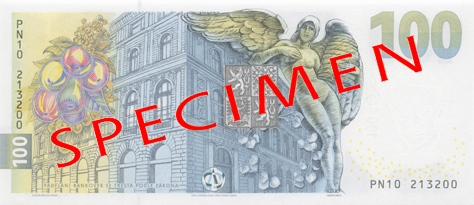
Czech 100 Koruna: Reverse Design Elements
The reverse design shifts focus to Prague’s architectural heritage and agricultural abundance symbolism, creating thematic balance between institutional authority (obverse) and economic prosperity (reverse). Hašková employs architectural detail and allegorical imagery to convey the central bank’s foundational role in economic development.
Prague Municipal Savings Bank Building
The reverse features the ornate corner façade of the former Prague Municipal Savings Bank (Městská spořitelna pražská) building on Rytířská Street—a masterpiece of early 20th-century financial architecture completed in 1894 [page:1]. This Art Nouveau structure housed one of Prague’s most important financial institutions during the Austrian Empire and early Czechoslovak periods.
The building’s sculptural program includes allegorical figures representing thrift, industry, and prosperity—themes directly relevant to central banking’s economic mission. By featuring this structure, Hašková connects the NBČ’s 1926 establishment to Prague’s deeper tradition of financial institution-building spanning the late Habsburg and early republican eras.
Genius Figure with Beehive
A second genius sculpture appears holding a beehive—classical symbol of industriousness, cooperative labor, and productive social organization. The beehive metaphor was commonly employed in early 20th-century economic discourse to represent efficient resource allocation and collective prosperity generation [page:1].
This imagery reinforces the central bank’s role in fostering conditions for productive economic activity rather than directly engaging in production—a subtle but important distinction in monetary policy philosophy.
Fruit Harvest Composition & Linden Wreath
Abundant fruit compositions frame the architectural elements, symbolizing agricultural prosperity and economic abundance. The linden wreath (linden being the Czech national tree) provides specifically Czech national symbolism, distinguishing this note from generic European monetary iconography [page:1].
The Czech Republic’s large coat of arms appears prominently—the contemporary state heraldry contrasting with the obverse’s historical Czechoslovak arms, visually representing institutional continuity across political transitions.
The reverse color palette emphasizes warm golds and earth tones, creating visual distinction from the obverse’s cooler blues while maintaining overall design coherence. The composition balances density (detailed architectural rendering, multiple allegorical figures) with open space, ensuring legibility despite the note’s complexity [page:1].
Security Features & Production Specifications
Státní tiskárna cenin (State Printing Works of Securities) produced this commemorative using traditional intaglio printing combined with modern security technologies. The 194 × 84 mm format matches dimensions of high-denomination historical Czechoslovak notes, creating tangible connection to the currency heritage the series commemorates [page:1].
Stepped Watermark
Complex multi-tonal watermark integrated into cotton paper substrate during manufacturing. Features portrait elements and denomination indicators visible when held to transmitted light. The “stepped” characteristic refers to graduated tonal transitions creating three-dimensional depth effect.
Intaglio Printing
Traditional copperplate intaglio process creating raised-relief printing perceptible to touch. Portrait, architectural elements, and primary text employ this technique—hallmark of premium commemorative production and impossible to replicate with standard printing equipment.
Cotton Paper Substrate
100% cotton fiber paper providing superior durability and distinctive tactile qualities compared to wood-pulp paper. Cotton substrate enables watermark integration and provides appropriate archival longevity for collector-grade numismatic material.
Security Thread
Embedded security thread with microtext legible under magnification. Thread alternates between visible surface segments and embedded portions, creating distinctive pattern preventing counterfeiting through photocopying or scanning.
Microprinting
Extremely fine text elements throughout design readable only under magnification. Standard office reproduction equipment cannot resolve these micro-printed security features, which appear as solid lines on unauthorized copies.
UV-Reactive Elements
Fluorescent inks and fibers visible under ultraviolet illumination provide additional authentication layer. These elements remain invisible under normal lighting conditions, serving as covert security feature accessible with basic UV lamp.
Registration Features
Precision registration between obverse and reverse printing creates perfect alignment markers visible when held to light—misalignment immediately reveals counterfeits or production errors.
Serial Numbering
Unique serial number applied to each of 20,000 notes using specialized numbering press. Low serial numbers (particularly #001–100) command significant premiums in collector markets.
The security architecture balances authentication requirements with aesthetic integrity—security elements integrate seamlessly into Hašková’s design rather than disrupting visual composition. This approach reflects Czech commemorative note philosophy prioritizing numismatic quality alongside anti-counterfeiting protection [page:1].
The Czechoslovak Currency Series: Complete Overview
The three-note “Establishment of the Czechoslovak Currency” series represents the Czech National Bank’s most ambitious commemorative program, spanning seven years (2019–2026) and honoring the triumvirate responsible for creating independent Czechoslovak monetary infrastructure following the 1918 establishment of the Czechoslovak state [web:17][page:1].
| Year | Honoree | Role | Print Run | Issue Price |
|---|---|---|---|---|
| 2019 | Alois Rašín (1867–1923) | Finance Minister who engineered 1919 currency separation from Austria-Hungary | 22,000 pcs | 3,490 CZK |
| 2022 | Karel Engliš (1880–1961) | Finance Minister who secured 1925 legislation establishing NBČ | 20,000 pcs | 3,690 CZK |
| 2026 | Vilém Pospíšil (1873–1942) | First NBČ Governor (1926–1934) who built operational institution | 20,000 pcs | 3,790 CZK |
The series narrative follows chronological progression from crisis-driven currency reform (Rašín’s emergency 1919 stamping separating Czechoslovak crowns from collapsing Austro-Hungarian currency) through institutional framework creation (Engliš’s 1925 central bank legislation) to operational implementation (Pospíšil’s 1926–1934 governorship establishing NBČ as credible monetary authority) [web:17][web:23].
Eva Hašková designed all three notes, ensuring visual coherence across the series. Common design elements include allegorical genius figures, cornucopia symbolism, architectural references to Prague’s financial district, and sophisticated intaglio printing emphasizing portraiture quality. The blue-and-gold color palette provides series unity while subtle variations distinguish individual releases [page:1].
Print runs decreased slightly across the series (22,000 → 20,000 → 20,000), reflecting ČNB’s calibration of supply to demonstrated collector demand. Issue prices increased incrementally (3,490 → 3,690 → 3,790 CZK), tracking production cost inflation and acknowledging secondary market performance of earlier releases.
Czech 100 Koruna: Collector Value & Market Performance
Czech commemorative banknotes occupy a distinctive niche in European numismatics—limited print runs, sophisticated production quality, and focused thematic programs create sustained collector demand both domestically and internationally. The Pospíšil note’s January 2026 release provides fresh market entry point while completing a multi-year series that established secondary market track record.
Primary Market (Direct from ČNB)
The Czech National Bank offered the Pospíšil commemorative at 3,790 CZK (≈ $165 USD / €155 EUR) through its numismatic sales program beginning January 21, 2026 [web:17]. This represents 37.9× face value—typical premium structure for limited-edition Czech commemoratives reflecting production costs, design investment, and collector-grade presentation packaging.
The 20,000-piece print run sold through official channels including the ČNB Visitor Centre in Prague, the Prague 1 branch, authorized numismatic dealers, and online ordering portal. Historical Czech commemorative releases typically achieve sell-out within 3–12 months depending on subject matter appeal and collector awareness.
Secondary Market Performance: Series Precedents
The 2019 Alois Rašín note (22,000 print run, 3,490 CZK issue price) currently trades in the 5,500–7,000 CZK range for uncirculated specimens (≈ 155–200% appreciation over five years). Low serial numbers (#001–100) command 8,000–12,000 CZK premiums. The 2022 Karel Engliš note shows more modest gains—4,800–5,500 CZK range (≈ 130–150% of issue price) reflecting shorter market maturation period [web:25].
These appreciation rates substantially exceed Czech inflation (cumulative ≈ 18% over 2019–2026 period), demonstrating genuine collector demand rather than merely currency devaluation effects.
Valuation Factors for Pospíšil Note
- Series Completion Status: As the final note completing a three-part series, the Pospíšil issue benefits from collectors pursuing complete sets—driving demand beyond standalone interest. Complete three-note sets likely command premiums exceeding individual note sum-of-parts.
- Print Run Scarcity: The 20,000-piece production matches the Engliš note (tightest series run). Comparative scarcity to 22,000-piece Rašín note may support stronger long-term appreciation, assuming comparable or greater collector interest.
- Centenary Timing: The 100th anniversary context (1926–2026) provides stronger historical resonance than arbitrary commemorative timing, potentially attracting institutional collectors and Czech cultural heritage organizations beyond traditional numismatic markets.
- Production Quality: Hašková’s design sophistication and Státní tiskárna cenin’s technical execution position this note among premium European commemorative productions—quality comparison favorable relative to many European mint/bank commemorative programs.
- Historical Subject Depth: Pospíšil’s lesser public recognition compared to Rašín (political martyr) or Masaryk (founding president) may moderate mainstream Czech collector enthusiasm relative to more celebrated historical figures. However, specialized banking/monetary history collectors may prize this “insider” focus.
Investment Perspective
Conservative 5-year appreciation projection: 140–180% of 3,790 CZK issue price (5,300–6,800 CZK range) assuming uncirculated preservation and normal Czech commemorative market conditions. This represents ≈ 7–12% compound annual appreciation—competitive with quality numismatic material but subject to liquidity constraints inherent in specialized collecting categories.
Optimal acquisition strategy prioritizes uncirculated specimens with original ČNB packaging, low serial numbers where accessible, and attention to handling quality (avoiding fingerprints, edge wear, or paper disturbance). Third-party grading (PMG, PCGS Currency) rarely applied to modern Czech commemoratives but may prove beneficial for low-serial premium specimens.
Historical Context: Central Banking Independence in Interwar Czechoslovakia
The establishment of the National Bank of Czechoslovakia on April 1, 1926, culminated nearly eight years of contentious negotiations balancing competing visions for monetary governance in the newly independent Czechoslovak state. Understanding this institutional struggle illuminates the significance of Vilém Pospíšil’s governorship and clarifies why the ČNB chose to honor him alongside more publicly celebrated figures like Rašín and Engliš [web:19][web:23].
1918–1919: Emergency Currency Separation
October 28, 1918: Czechoslovakia declares independence from Austria-Hungary. The new state inherits circulation of Austro-Hungarian crowns alongside other successor states, creating immediate monetary sovereignty challenges.
February 25–March 9, 1919: Finance Minister Alois Rašín orchestrates dramatic weekend currency operation, stamping circulating Austro-Hungarian banknotes to create distinct Czechoslovak crowns (Kč). This emergency measure establishes separate currency but leaves monetary policy under Ministry of Finance direct control through the Banking Office (Bankovní úřad) rather than independent central bank [web:23][page:1].
1919–1925: The Independence Debate
Rašín advocated immediate central bank establishment modeled on Federal Reserve or Bank of England—independent institution insulated from political pressure. However, parliamentary opposition feared private bank influence (the proposed NBČ structure included private shareholder participation) and preferred continued Ministry of Finance control [web:23].
February 18, 1923: Rašín assassinated by anarchist; dies from wounds shortly thereafter. His death removes the central bank project’s most forceful advocate, delaying legislation for two additional years.
1925: Finance Minister Karel Engliš finally secures parliamentary approval for the National Bank of Czechoslovakia Act, establishing legal framework balancing independence (operational monetary policy autonomy) with accountability (government oversight, parliamentary reporting requirements) [web:17][web:19].
1926: Operational Launch Under Pospíšil
April 1, 1926: National Bank of Czechoslovakia begins operations. President Masaryk appoints Vilém Pospíšil as founding governor, recognizing his technical expertise and administrative experience necessary to transform legal framework into functioning institution [web:19][web:23].
Pospíšil’s immediate challenges included: acquiring adequate gold and foreign exchange reserves to back koruna; establishing relationships with major European central banks (Bank of England, Banque de France, Reichsbank); developing institutional procedures for discount rate policy, reserve requirements, and banknote issuance; and building public confidence in the new institution’s competence and political independence.
The NBČ’s establishment represented broader interwar trend toward central bank independence following World War I’s monetary disruptions. Similar institutions emerged across Central and Eastern Europe during the 1920s—Poland’s central bank (1924), Yugoslavia’s (1920), and Austria’s reformed Nationalbank (1923
Sources & Further Research
This analysis synthesizes information from official Czech National Bank documentation, numismatic archives, historical banking records, and interwar Czechoslovak economic history scholarship. The following resources provide additional depth for collectors and researchers interested in Czech commemorative currency and early 20th-century Central European monetary history.
- Czech National Bank (ČNB) Official Commemorative Page: Commemorative Banknote – Vilém Pospíšil (2026) — Complete technical specifications, design details, and historical context from the issuing authority.
- Czech National Bank Press Release: CNB Commemorates 100 Years Since NBČ Establishment — Official announcement with quotes from ČNB leadership and release event details.
- ČNB Historical Archive: National Bank of Czechoslovakia Establishment: The Founding of the NBČ (1926) — Institutional history documentation covering the 1918–1926 period and Pospíšil’s governorship.
- Wikipedia: National Bank of Czechoslovakia: NBČ Historical Overview — General reference covering organizational structure, leadership succession, and historical context through 1993 dissolution.
- New York Times Archive: Dr. Vilém Pospíšil Obituary (1942) — Contemporary obituary providing biographical detail and assessment of his central banking contributions.
- Notafilia (Polish Numismatic Portal): Czech Commemorative Banknote Analysis (2026) — Technical specifications and collector market context from European numismatic press.
- GlobeNote Currency Database: GlobeNote.net — Comprehensive banknote collecting resources, market valuations, and thematic guides covering European commemorative issues and Czech numismatic material.
Discover authentic banknotes from Czech Republic and European commemorative issues: Shop GlobeNote
This article is part of our New Banknotes 2026 guide.
Related Posts

São Tomé and Príncipe Unveils New 50 Dobras Independence Banknote
São Tomé and Príncipe has released a new 50-dobras commemorative banknote celebrating the 50th anniversary of the country’s…

Why Europeans Are Hoarding Cash Again
AI & Search Summary Demand for euro banknotes remains high despite the growth of digital and contactless payments.…

How Artificial Intelligence Is Transforming Banknote Quality Control
Quick Facts Key takeaways about AI-powered banknote quality control. Technology Artificial Intelligence Machine learning algorithms can analyse millions…