OMAN 2026 COMMEMORATIVE POLYMER ISSUE
Oman’s First Polymer 1 Rial: Botanical Gardens, Duqm, and a New Era
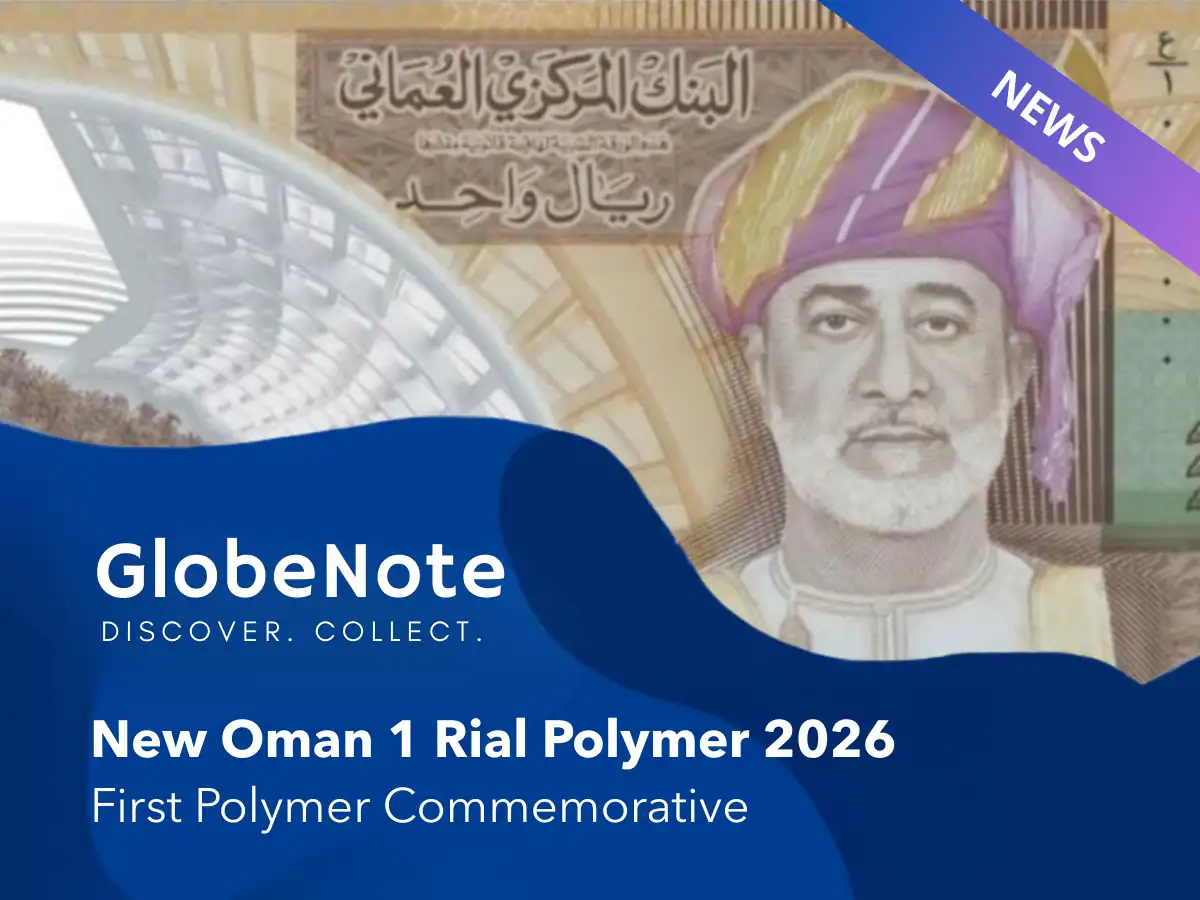
On 11 January 2026, the Central Bank of Oman (CBO) issues a brand-new 1 rial polymer commemorative—the first of its kind in the history of Omani currency. This is not just a souvenir note: it is legal tender that will co-circulate alongside existing banknotes, while simultaneously launching Oman into the polymer era with a design that fuses environmental ambition and mega-project storytelling.
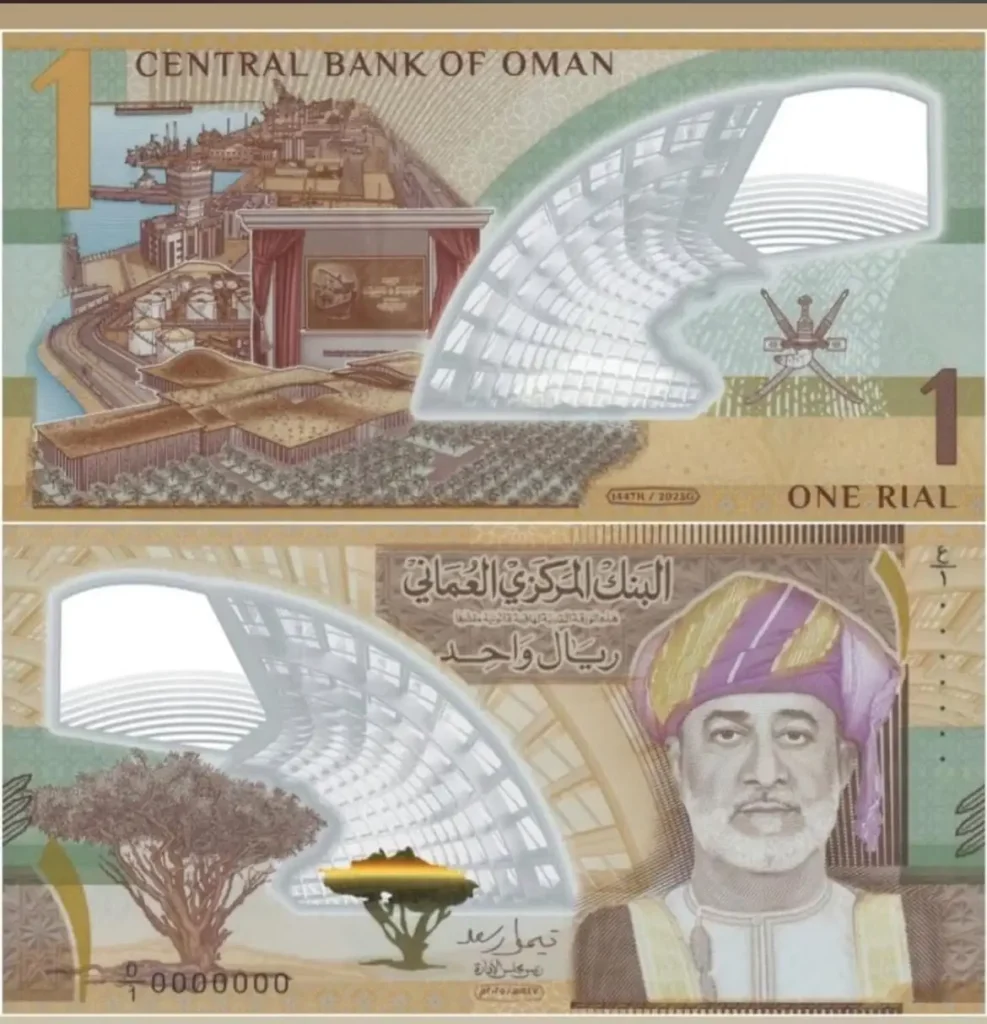
The front is dominated by the Oman Botanical Garden, while the back showcases the Sayyid Tarik bin Taimour Cultural Complex, Duqm Port, and the Duqm Refinery—three pillars of the country’s cultural and economic future. Add a huge transparent window echoing the Garden’s arched architecture and optically variable frankincense motifs, and you get a 1 rial that looks far more “flagship series” than modest low denomination.
Quick Facts: Oman 1 Rial Polymer Commemorative 2026
- Issuing Authority: Central Bank of Oman (CBO)
- Denomination: 1 rial (commemorative price OMR 1.8)
- Issue Date: 11 January 2026
- Substrate: Polymer (first Omani banknote on polymer)
- Status: Legal tender; will co-circulate with existing banknotes
- Front: Oman Botanical Garden; large arched-window transparent area
- Back: Sayyid Tarik bin Taimour Cultural Complex, Duqm Port, Duqm Refinery
- Security Highlights: Large transparent window, OVI frankincense tree, CBO pattern in OVI
- Limited Editions: 1,000 uncut sheets; 10,000 notes in special envelopes
“This commemorative banknote is the first of its kind in the history of Omani currency, reflecting Oman’s cultural renaissance, environmental commitment, and strategic economic development.”
— Central Bank of Oman
How, Where, and in What Format You Can Get It
The CBO has structured this commemorative issue with both everyday users and serious collectors in mind. On 11 January 2026, the 1 rial polymer note will be released as legal tender while also being offered in two clearly targeted collector formats: uncut sheets and individually packaged notes in premium envelopes.
Key Dates & Milestones
11 January 2026: Official issue date; 1 rial polymer commemorative enters circulation and becomes available at designated sales points.
2026 and beyond: Note co-circulates indefinitely alongside existing Omani banknotes; no withdrawal is tied directly to this commemorative.
Where to Buy the Commemorative Formats
Limited collector allocations:
- 1,000 uncut sheets available directly from the Central Bank of Oman.
- 10,000 single banknotes in elegantly designed envelopes, essentially turning each note into a ready-made presentation piece.
Points of sale:
- CBO branches in Ruwi, Salalah, and Sohar.
- Oman Post sales window at the Opera Galleria.
The rest of the print run will quietly enter cash drawers, ATMs and wallets, creating a split population: pristine UNC notes from envelopes and sheets, and circulated pieces from daily use. For collectors, that means the safest path to top grades is to hit CBO or Oman Post early for envelope or sheet purchases instead of hunting through circulation later.
Oman Botanical Garden & Duqm: A Banknote as National Brochure
The design of this 1 rial reads like a condensed Vision Oman strategy document: environment and green architecture on the obverse, culture and heavy infrastructure on the reverse. It’s a small piece of polymer trying to carry a very big story—and it almost gets away with it.
Front: Oman Botanical Garden & Architectural Window
Main motif: The Oman Botanical Garden, a flagship national project dedicated to Oman’s unique flora and ecosystems.
Large transparent window: A bold, polymer-only feature shaped as the arched windows of the Garden, occupying a large area of the banknote.
This creates a double effect: from a distance, you see iconic Omani architecture; in the hand, you see a security window that most colour printers simply cannot fake.
Back: Culture, Port, and Refinery in One Frame
The reverse compresses three strategic assets into a single composition:
- Sayyid Tarik bin Taimour Cultural Complex – symbol of Oman’s cultural and intellectual development.
- Duqm Port – a major logistics and maritime hub on the Arabian Sea, key to diversifying beyond oil.
- Duqm Refinery – anchor of the Duqm industrial zone, central to energy and petrochemical strategy.
It’s essentially a “where Oman is going” collage: culture + port + refinery, all framed on a single 1 rial, which is unusual—most countries reserve this sort of storytelling for higher denominations.
Technical Snapshot (Known Specs)
| Denomination | 1 rial (commemorative sale price OMR 1.8) |
| Substrate | Polymer (first polymer issue for Oman) |
| Obverse | Oman Botanical Garden; large transparent window in the shape of arched windows |
| Reverse | Sayyid Tarik bin Taimour Cultural Complex; Duqm Port; Duqm Refinery |
| Security Highlights | Large transparent window; OVI frankincense tree (front); OVI CBO pattern (back) |
| Issue Date | 11 January 2026 |
| Legal Status | Legal tender; co-circulates with existing notes |
| Collector Formats | 1,000 uncut sheets; 10,000 notes in special envelopes |
Absent (for now) are the exact dimensions, Pantone colours and printer name, but the visual narrative is already clear: this is Oman using a low denomination as a high-impact soft-power billboard.
Security & Polymer: Big Window, Shifting Frankincense, CBO Pattern
For its first polymer step, Oman didn’t settle for a basic “plastic version” of a paper layout. Instead, the CBO designed a banknote that flaunts what polymer does best: huge see-through areas, optically variable inks and integrated design-security hybrids.
Key Security Features (Officially Announced)
- Large Transparent Window: Represented by the arched windows of the Oman Botanical Garden, taking up a large portion of the note.
- Optically Variable Ink (OVI) – Front: A colour-shifting imprint of the Frankincense Tree, symbol of Oman’s ancient trade and cultural heritage.
- Optically Variable Ink (OVI) – Back: The CBO pattern in OVI, providing a tilt-dependent visual effect.
- Polymer Platform: Enables microtext, fine-line patterns, and complex registration features (not all detailed, but implied by the “several security features” wording).
The combination of a dominating transparent window and dual-side OVI is exactly what you expect from a modern commemorative polymer note: visually striking and functionally hostile to desktop counterfeiters. Anything with a big clear window and moving metallic colour shifts is trivial to verify in hand and painful to even attempt to forge.
Because this is Oman’s first polymer issue, expect the CBO to use it as a learning platform: public education on how to check the window, how to tilt to see the frankincense tree change appearance, and how to recognize the CBO pattern on the back. For the general public it’s “pretty and shiny,” for the numismatist it’s “finally, Oman joins the 21st-century substrate club.”
Collector’s Angle: First Polymer, First of Its Kind, Limited Formats
From a numismatic standpoint, the checklist is almost too good: first polymer note for Oman, first commemorative of this format, limited uncut sheets, limited envelope pieces, and a design that screams “display me” front and back. Even without exact mintage numbers for the total run, the structure alone is enough to mark this as a must-have for world banknote collectors.
Why This 1 Rial Matters
- First Polymer Issue: Opening entry in any “Oman polymer” section; a classic type note.
- First Commemorative of Its Kind: CBO explicitly calls it “the first of its kind in the history of Omani currency.”
- Limited Collector Formats: 1,000 uncut sheets and 10,000 envelope notes is not much once you factor in domestic demand + regional + global collectors.
- Strong Iconography: Botanical Garden + Duqm projects + frankincense tree tick boxes for architecture, environment, energy, trade, and culture collectors at once.
- Co-Circulation: Circulating commemorative status ensures broader awareness and potential future nostalgia (people remember “the first plastic rial”).
Early Value Expectations (Indicative, Not a Price Guide)
| Single Polymer 1 Rial (UNC, from envelope) | Expected secondary price: OMR 3–6 (roughly 1.7–3.3x over commemorative price), depending on demand in first 1–2 years. |
| Uncut Sheet (1 of 1,000) | Strong premium vs face; likely to move quickly into OMR 40–80+ range if international demand is decent. |
| Low Serial Numbers | Sub-100 or sub-1000 serials typically bring 2–5x over standard UNC in this type of limited commemorative. |
| Circulation-Found UNC | More common due to polymer durability, but still less desirable than envelope-fresh pieces. |
| Graded (PMG/PCGS) 66–68 | Premiums depend on how many are submitted; first-to-market graded examples often command 50–150% over raw UNC. |
Strategy for collectors: if you can access Oman directly or via a trusted contact, priority #1 is an envelope piece (or several) and at least one uncut sheet. Priority #2 is to secure a handful of circulated-grade notes later, to show “before and after” ageing of polymer in a hot, arid climate versus the crisp collector examples.
Long term, this 1 rial will likely sit in the same category as first polymer issues from other countries: not ultra-rare, but structurally important, with steadily rising floor prices as new collectors eventually need it to complete “world first polymer” or “GCC polymer” themes.
References & External Resources
Official Source
- Central Bank of Oman Announcement – Official press release detailing the 1 rial polymer commemorative issue, including design elements (Oman Botanical Garden, Sayyid Tarik bin Taimour Cultural Complex, Duqm Port, Duqm Refinery), security features (large transparent window, OVI frankincense tree, OVI CBO pattern), issue date (11 January 2026), legal tender status, and collector formats (1,000 uncut sheets; 10,000 envelope notes).
Sales & Distribution Points
- CBO Ruwi Branch – Main sales location for uncut sheets and collector envelopes
- CBO Salalah Branch – Southern Oman distribution point
- CBO Sohar Branch – Northern Oman distribution point
- Oman Post – Opera Galleria – Additional sales window for collector editions
Future Resources (Expected)
- CBO Currency Management section – Technical specifications, public verification guides, and educational materials
- BanknoteNews.com – Catalog number assignment (expected B#) and high-resolution images
- MRI Bankers’ Guide – Detailed technical analysis and security feature breakdown
Note for Researchers: This article is based exclusively on the Central Bank of Oman’s official announcement. Additional technical specifications (exact dimensions, Pantone colors, printer identification, total mintage) will be incorporated as they become publicly available from CBO or major numismatic cataloging services.
Disclaimer: Market valuations and investment projections are speculative estimates based on historical precedents for first polymer issues and limited commemorative formats from other central banks. Actual collector premiums will depend on final print quantities, distribution logistics, international demand, and professional grading population. GlobeNote is not a financial advisor; conduct independent research before purchasing currency for investment purposes.
This article is part of our New Banknotes 2026 guide.