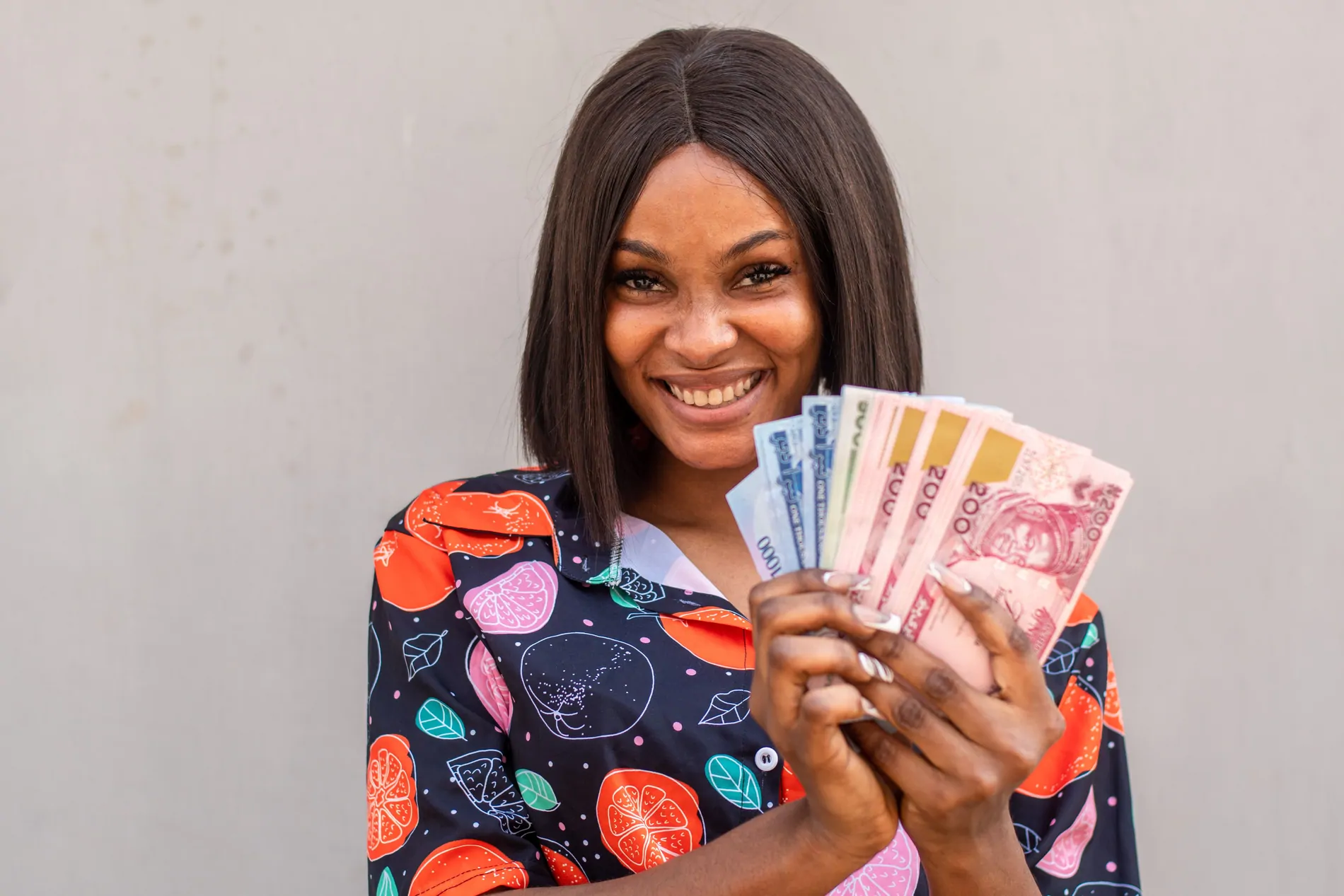
Sir Ahmadu Bello is the person pictured on the front of Nigeria’s 200 Naira note. Known as the Sardauna of Sokoto, he was one of Nigeria’s most influential political leaders and the first Premier of Northern Nigeria. The reverse shows cattle and agricultural produce, representing the importance of farming and livestock to the Nigerian economy.
This guide explains who appears on the Nigeria 200 Naira note, what is shown on the reverse, when the denomination and current issue were introduced, how to recognise its security features, which Pick and signature varieties exist, and what collectible examples may be worth.
Quick answer
Who is on the 200 Naira note? The portrait on the front is Alhaji Sir Ahmadu Bello, the Sardauna of Sokoto and first Premier of Northern Nigeria. The back shows cattle and agricultural products. The current paper issue measures 151 x 78 mm.
Quick Facts
- Country: Nigeria
- Denomination: 200 Naira
- Portrait: Alhaji Sir Ahmadu Bello
- Reverse: Cattle and agricultural produce
- First denomination issue: 2000
- Current issue released: 26 October 2022
- Material: Paper
- Dimensions: 151 x 78 mm
- Issuer: Central Bank of Nigeria
- Printer: Nigerian Security Printing and Minting Company
- Pick references: P-47a, P-47b and P-47c
- Status: Legal tender
Collect banknotes related to this article
Explore authentic world banknotes connected to this country, region or collecting theme.


Who Is on the Nigeria 200 Naira Note?
The person on the Nigeria 200 Naira note is Alhaji Sir Ahmadu Bello. His portrait appears prominently on the front, alongside the denomination, the name of the Central Bank of Nigeria, serial numbers and the signatures of the issuing officials.
Ahmadu Bello carried the traditional title Sardauna of Sokoto. He was a major political figure during the years leading to and following Nigerian independence, and he served as the first Premier of Northern Nigeria from 1954 until 1966.
The answer to searches such as “who is on the 200 Naira note?”, “whose picture is on the Nigeria 200 Naira note?” and “what is the name of the person on the 200 Naira note?” is therefore the same: Sir Ahmadu Bello.
Who Was Sir Ahmadu Bello?
Sir Ahmadu Bello was born in 1910 in Rabbah, in present-day Sokoto State. He became one of the most important leaders in Northern Nigerian politics and helped establish the Northern People’s Congress in 1949.
As Premier of Northern Nigeria, Bello played an important role in regional administration, education and political development. His position in Nigerian history explains why his portrait was selected for one of the country’s higher-value banknotes.
Why is Ahmadu Bello on the 200 Naira note?
The portrait recognises his political importance, his leadership in Northern Nigeria and his role during a formative period in the country’s modern history.
What Is Shown on the Back of the 200 Naira Note?
The reverse of the Nigeria 200 Naira note shows cattle and agricultural produce. The composition represents livestock farming, food production and the broader importance of agriculture to Nigeria’s economy.
The design creates a deliberate contrast. The front focuses on political leadership and national history, while the reverse turns toward the daily economic activity of farms, markets and rural communities.
When Was the 200 Naira Note Introduced?
Nigeria first introduced the 200 Naira denomination in 2000 as part of the expansion of its higher-denomination currency system.
The current issue covered in this guide was released by the Central Bank of Nigeria on 26 October 2022. Later notes dated 2023 and 2024 retain the same principal design while introducing different dates and signature combinations.
Important distinction: the denomination itself dates from 2000, but the current P-47 series discussed here begins with the 2022 issue.
Nigeria 200 Naira Note Design
The current 200 Naira is a paper banknote measuring 151 x 78 mm. Its design combines dark grey, blue-green and multicoloured elements, with black serial numbers and official signatures.
Front design
- Portrait: Alhaji Sir Ahmadu Bello appears on the left.
- Denomination: large 200 numerals and the words “Two Hundred Naira”.
- Issuer: Central Bank of Nigeria.
- Scripts: both Latin and Arabic scripts appear in the design.
- Date: the issue date appears toward the left side.
- Signatures: signature combinations identify different catalogue varieties.
Reverse design
- Main subject: cattle and agricultural produce.
- Theme: livestock, food production and Nigeria’s agricultural economy.
- Lettering: Central Bank of Nigeria and Two Hundred Naira.
Security Features of the 200 Naira Note
The 200 Naira includes several features intended to make visual and physical authentication easier. Collectors can also use these elements to examine condition and originality.
- Portrait watermark: hold the note against a bright light to reveal the watermark.
- Electrotype: the watermark area includes the denomination-related CBN200 element.
- Windowed security thread: metallic segments form a continuous line when viewed against light.
- UV activity: selected elements and the security thread react under ultraviolet light.
- Raised printing: important design elements should retain a tactile printed surface.
- Unique serial numbers: every issued note carries its own identifying serial number.
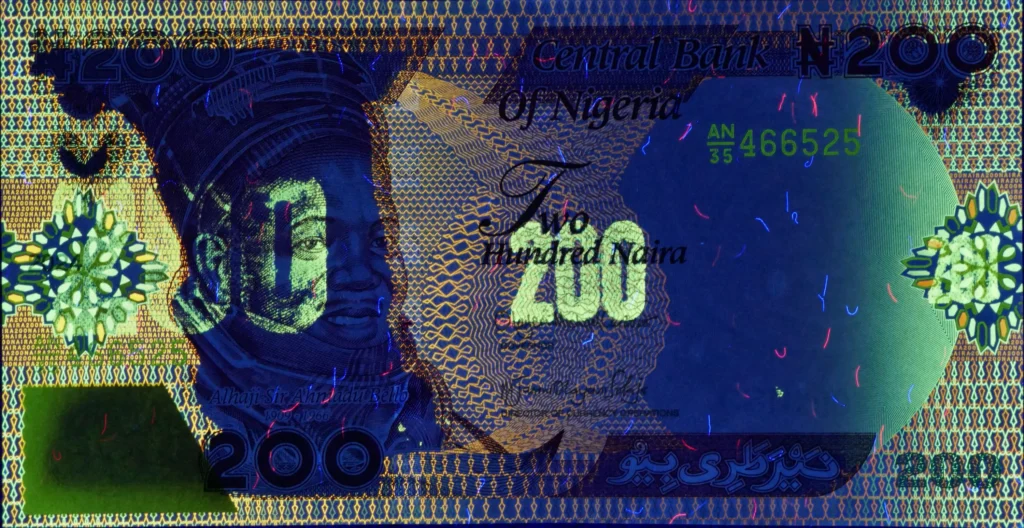
Collector tip: security features should not be judged in isolation. Compare the printing quality, paper, serial numbers, watermark, thread and overall design with a confirmed genuine example.
2022-2024 Pick and Signature Variants
The current design is catalogued under Pick 47. The letter following the Pick number generally identifies the year or principal variety, while specialist references may divide the same year into additional signature combinations.
| Year | Pick | TBB reference | Signature codes |
|---|---|---|---|
| 2022 | P-47a | 244a | GIE – ABU |
| 2023 | P-47b | 244b | GIE – ABU |
| 2023 | P-47b | 244c | GIE – EAK |
| 2023 | P-47b | 244d | OMC – EAK |
| 2024 | P-47c | 244e | OMC – EAK |
| 2024 | P-47c | 244f | OMC – MJOS |
How to identify your 200 Naira variant
- Check the printed year on the front of the note.
- Read both official signatures.
- Compare the combination with the Pick and specialist catalogue references.
- Record the serial-number prefix when cataloguing the banknote.
Catalogue references can be revised as new varieties are documented. Always check the latest specialist catalogue before assigning a final reference.
How Much Is a Nigeria 200 Naira Note Worth?
A circulated 200 Naira banknote is generally worth close to its face value as currency. Collector prices become more relevant for uncirculated notes, better signature varieties, consecutive serial numbers and authenticated examples.
Circulated note
Usually close to face value unless it is an unusual variety or error.
Standard UNC note
Common dealer asking prices are generally around $1 to $3 per single note.
Premium example
Authentication, exceptional condition or scarcer varieties may command more.
Dealer price snapshot
| Example | Observed asking price | Seller |
|---|---|---|
| 2023 P-47b.2, UNC | $0.96 | Banknote World |
| 2024 P-47, UNC | $2.39 | NotesHobby |
| 2023 P-47, UNC | EUR 3.00 | CGB France |
| 2024 P-47c, UNC | EUR 1.79 | GlobeNote |
Prices checked in June 2026. These are public dealer asking prices, not guaranteed realised sale values. Prices may change according to availability, shipping, condition, signatures and certification.
What affects collector value?
- Condition: folds, stains, tears and handling reduce collector appeal.
- UNC quality: crisp paper and strong original colour are preferred.
- Centering: evenly positioned margins improve presentation.
- Signature combination: some varieties are encountered less frequently.
- Serial numbers: low, repeating or consecutive numbers may attract interest.
- Authentication: third-party presentation can affect retail pricing.
Collect the Nigeria 200 Naira Note
Explore the 2024 P-47c in uncirculated condition, featuring Sir Ahmadu Bello on the front and Nigeria’s agricultural economy on the reverse.
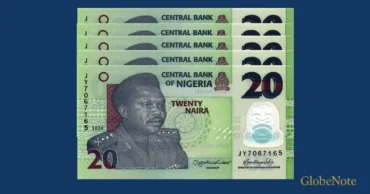
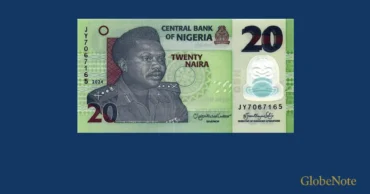
Do Not Confuse the 200 Naira with the 20 Naira Note
200 Naira: Sir Ahmadu Bello appears on the front; cattle and agricultural produce appear on the reverse.
20 Naira: General Murtala Mohammed appears on the front, while potter Ladi Kwali appears on the reverse.
The 200 Naira is a larger paper note. The modern 20 Naira is printed on polymer.
Nigeria 200 Naira Note FAQ
Who is on the 200 Naira note?
Alhaji Sir Ahmadu Bello, the Sardauna of Sokoto and first Premier of Northern Nigeria, appears on the front.
What is the full name of the person on the 200 Naira note?
His name is Alhaji Sir Ahmadu Bello. He is commonly known by his traditional title, Sardauna of Sokoto.
What is shown on the back of the 200 Naira note?
The reverse shows cattle and agricultural produce representing livestock and farming in Nigeria.
When was the 200 Naira note introduced?
Nigeria introduced the 200 Naira denomination in 2000. The current issue discussed in this guide was released on 26 October 2022.
Is the 200 Naira note still legal tender?
Yes. The 200 Naira remains part of Nigeria’s legal-tender banknote structure.
How much is a Nigeria 200 Naira note worth?
Common circulated notes are generally worth close to face value. Standard UNC collector examples are often offered for approximately $1 to $3, while premium varieties may cost more.
What is the Pick number of the Nigeria 200 Naira note?
The current series is catalogued as P-47, including P-47a for 2022, P-47b for 2023 and P-47c for 2024.
Sources and Further Reading
- Central Bank of Nigeria – 200 Naira
- Central Bank of Nigeria – Features of Nigerian Currency
- Central Bank of Nigeria – Currency Gallery and History
- Numista – Nigeria 200 Naira
- BanknoteWorld.org – Nigeria 200 Naira P-47c
- BanknoteNews – Nigeria signature varieties
- GlobeNote – What Makes a Banknote More Valuable?