Picture this: you’re holding a Venezuela 100000 Bolivares banknote, the highest denomination at the time. You feel rich, almost invincible—until you try to buy groceries and realize it barely covers a chicken, or worse, a pack of toilet paper. Welcome to the surreal world of Venezuela 2017, where money lost its meaning faster than you could say “hyperinflation.”
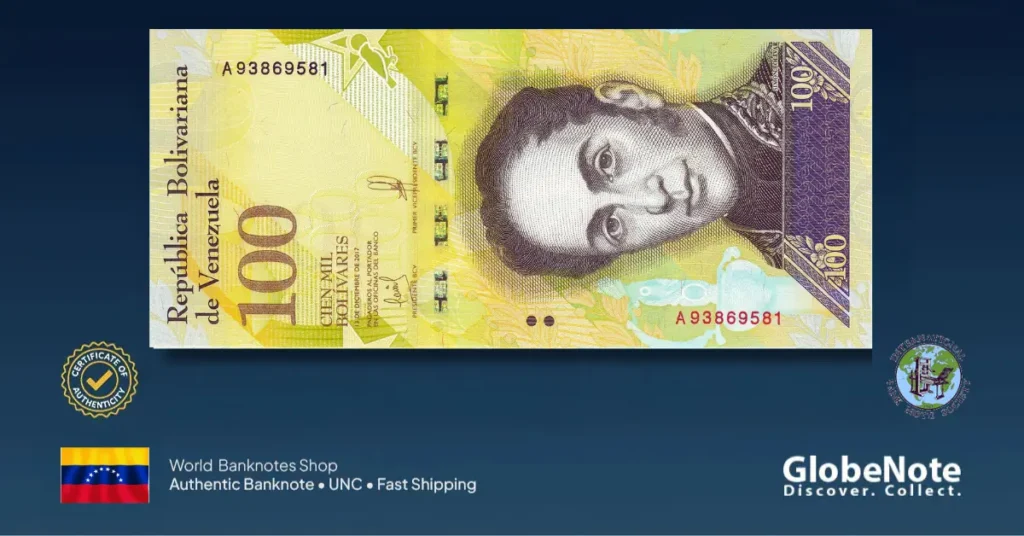
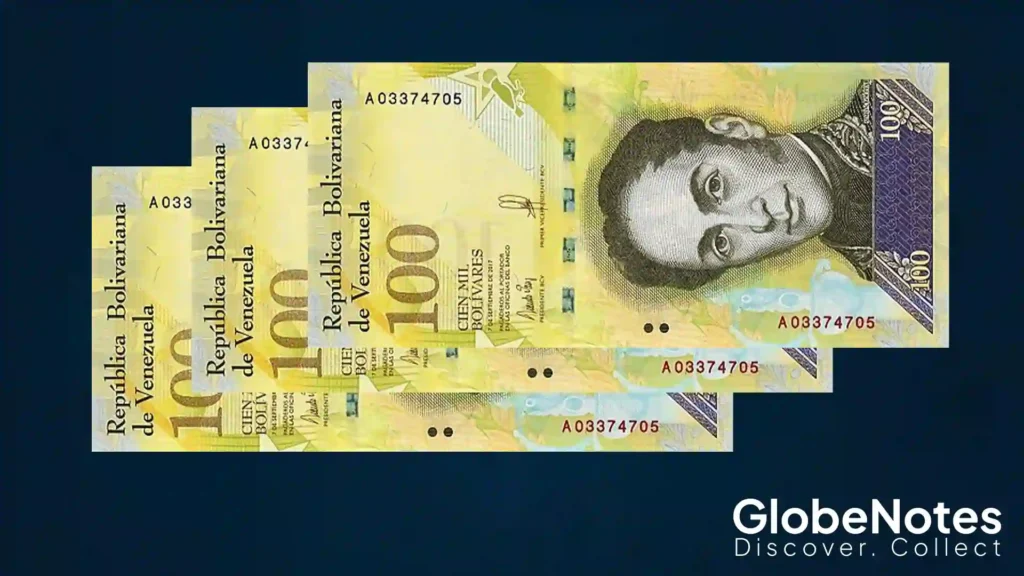
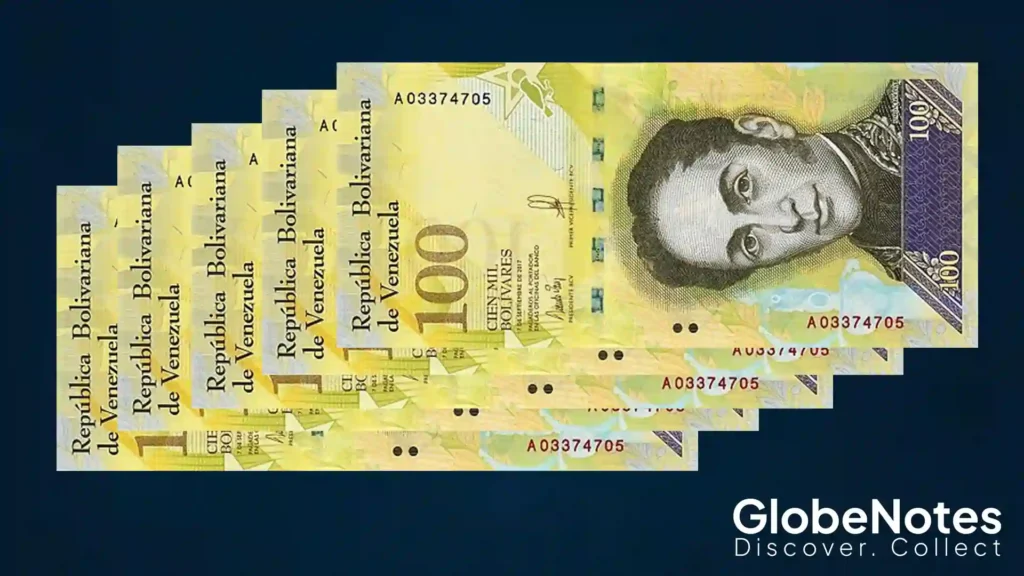
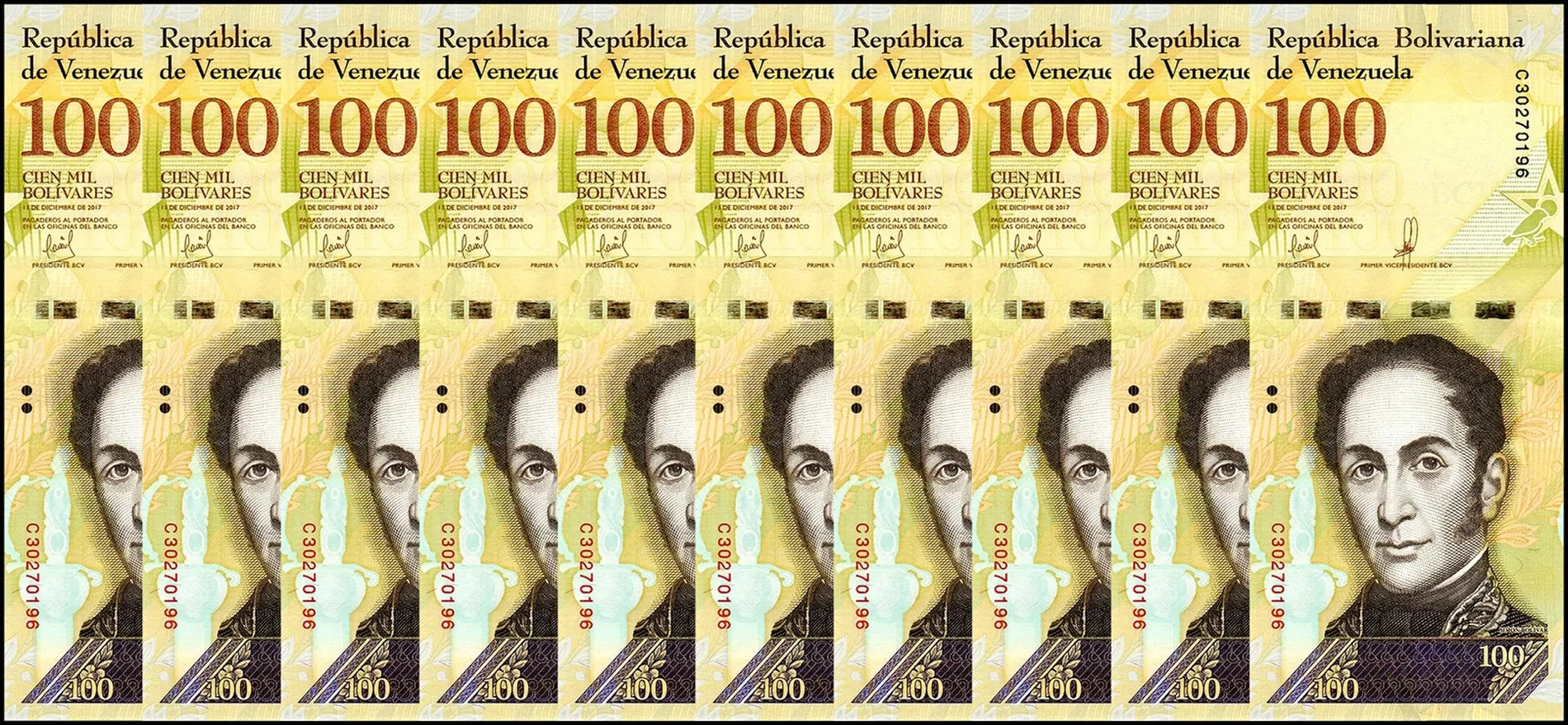
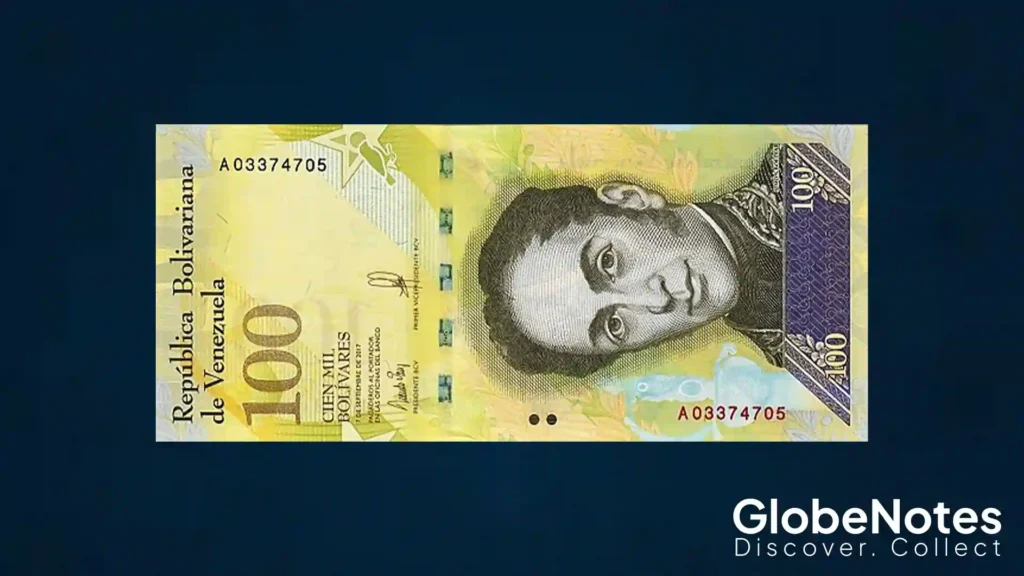
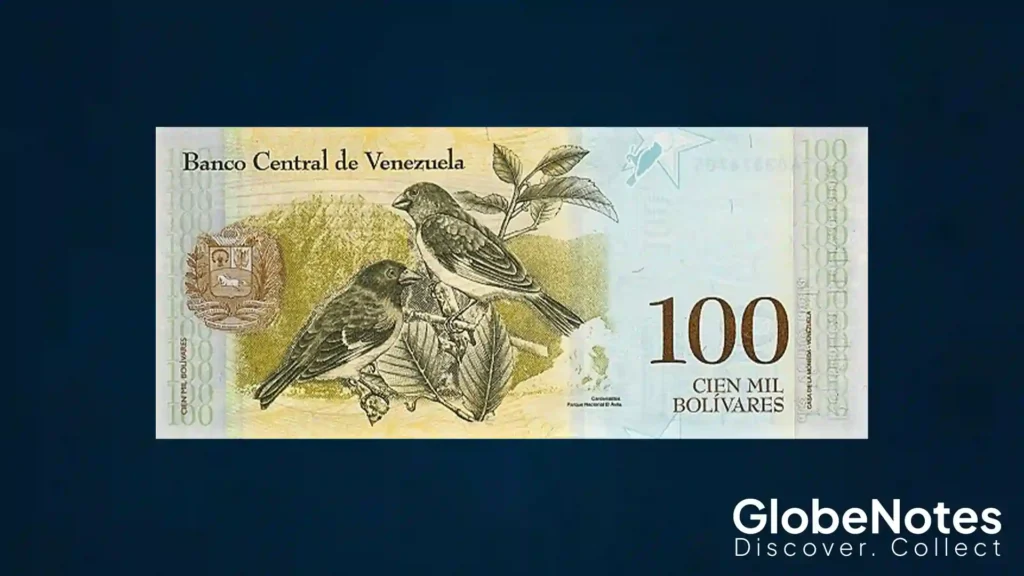
The Venezuela 100000 Bolivares 2017 was issued by the Central Bank of Venezuela during peak hyperinflation. It features Simón Bolívar on the obverse and Venezuela’s national tree on the reverse. Today, collectors value UNC examples between €1 and €3, while circulated ones often sell for less than €1.
Technical Specifications
| Country | Venezuela |
| Denomination | 100000 Bolivares |
| Year of Issue | 2017 |
| Issuer | Banco Central de Venezuela |
| Pick Reference | P-103 |
| Size | 156 × 69 mm |
| Material | Paper |
| Obverse | Portrait of Simón Bolívar |
| Reverse | Araguaney tree & Waraira Repano National Park |
| Security Features | Watermark (Bolívar), security thread, microtext, UV fibers |
Design & Security Features Venezuela 100000 Bolivares
If you thought the Venezuela 100000 Bolivares note was just paper with Bolívar’s face slapped on it, think again. The design team tried to deliver dignity in a time when dignity was in short supply.
Front side: The obverse proudly displays Simón Bolívar, the Liberator himself, staring at you as if to say: “I fought empires, and now you can’t even buy bread with me.” His portrait is flanked by intricate linework and microtext that counterfeiters would find more annoying than effective.
Back side: The reverse features the Araguaney tree, Venezuela’s national tree, along with the lush landscape of Waraira Repano National Park. It’s almost poetic — a reminder of natural beauty in a country where inflation erased economic beauty entirely.
Security features:
- A watermark of Bolívar’s profile, visible when held to the light.
- A security thread running vertically through the paper.
- UV fluorescent fibers that light up under blacklight, perfect for late-night collectors’ parties.
- Microtext inscriptions, because apparently adding tiny words makes a currency “serious.”
Security Features & UV Tricks
For a banknote that was worth less than a bus ticket within months of its release, the Venezuela 100000 Bolivares was surprisingly well protected against counterfeiting. The irony is delicious: why would anyone fake a note that loses value faster than it can be printed?
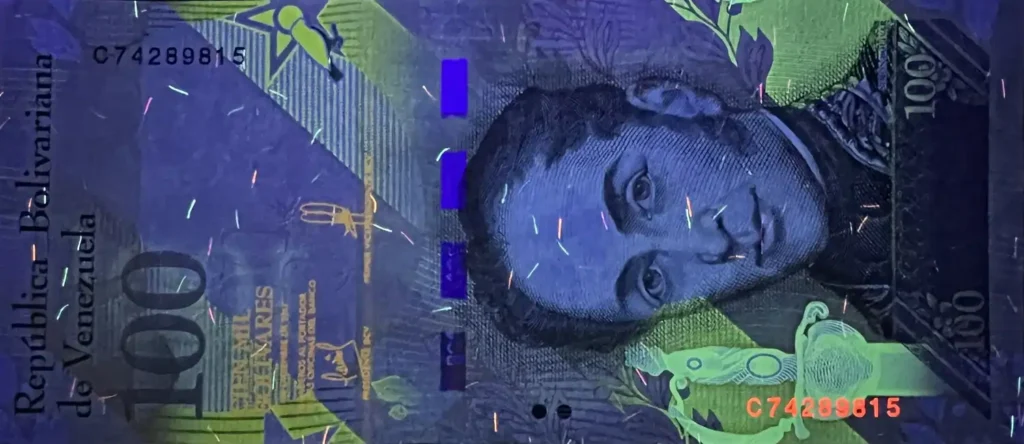
Under normal light, you’ll notice the watermark of Simón Bolívar’s head, perfectly aligned with the printed portrait. There’s also a security thread running vertically, with text micro-engraved that reads “BCV” (Banco Central de Venezuela). Tilt the note and you’ll catch subtle changes in the color-shifting ink, giving it that premium touch nobody could actually spend with confidence.
Switch on a UV lamp, and the fun really begins. The security thread fluoresces in bright green, while small fibers embedded in the paper glow in neon blue and red. Even the denomination “100000” lights up like a disco sign, as if mocking you with the reminder that this was once supposed to buy you groceries.
Additional features include microtext around Bolívar’s portrait, raised intaglio printing that you can feel with your fingertips, and a carefully detailed coat of arms on the reverse. In other words: the Banco Central went all in on features, but forgot the basic one — stability of value.
Geo Context: Venezuela in 2017
The Venezuela 100000 Bolivares wasn’t just money — it was a symptom. By late 2017, Venezuela was knee-deep in one of the worst hyperinflation crises in modern history. Banknotes were being printed faster than you could say “petrodollar,” and yet, by the time this note entered circulation, it was already almost worthless.
Picture the scene: people walking around with plastic bags full of cash just to buy groceries. A taxi ride? Stack of notes. A cup of coffee? Another stack. This wasn’t economics, it was performance art.
The 100000 Bolivares bill, despite its imposing number, represented barely a couple of US dollars at the official rate. On the black market — which everyone actually used — it was often less than one dollar. The bill became both a practical necessity and a symbol of collapse, proof that even the Liberator’s face couldn’t rescue a drowning economy.
From a collector’s perspective, this gives the note a strange charm. It’s history pressed into paper: a snapshot of a nation where money was cheaper than toilet paper (and yes, many people used it as such).
Historical & GEO Context
The Venezuela 100000 Bolivares banknote is less a piece of currency and more a tragicomic souvenir of economic collapse. Issued in late 2017, it was meant to be the “solution” to spiraling inflation — except by the time it reached circulation, inflation had already made it almost useless.
Imagine this: a brand new banknote featuring the face of national hero Simón Bolívar, released with great fanfare, only to discover that it couldn’t even buy a decent lunch a few months later. In fact, by 2018, the note’s purchasing power had evaporated so dramatically that bundles of them were sold by weight, not value.
GEO context makes the story even richer. This note circulated during one of Venezuela’s darkest economic chapters — a time when hyperinflation topped one million percent, shelves were empty, and citizens carried stacks of cash in bags just to buy bread. International news outlets turned the bolívar into a meme, with photos of people wallpapering homes or making handicrafts out of now-worthless bills.
From a collector’s perspective, this makes the 100000 Bolivares a snapshot of financial chaos. It’s not just money — it’s a paper monument to a failed economic experiment, a warning to future generations that trust in a currency can evaporate faster than ink dries on freshly printed notes.
Variants & Pick Numbers Venezuela 100000 Bolivares
The Venezuela 100000 Bolivares (Pick P-109) might look like a single design, but collectors know that nothing is ever that simple. There are printing variations, subtle changes in signatures, and differences tied to production runs that make one piece slightly more “special” (or frustrating) than another.
| Year | Pick | Signature | Relative Availability* | Typical Price Impact** |
|---|---|---|---|---|
| 2017 | P-109a | Sánchez – Zerpa | Very common | Baseline value |
| 2017 | P-109b | Sánchez – León | Common | Slight premium over UNC bulk |
| 2018 (early) | P-109c | Different ink tone / serial style | Less common | +10–15% in UNC |
| 2018 (late) | P-109d | Minor printing differences | Scarcer | +20–30% in UNC |
*Relative availability is based on auction frequency and dealer listings (eBay, Delcampe, etc.).
**Price impact refers to premiums compared to the baseline common variant in UNC condition.
Why do these variants exist? Because in times of hyperinflation, central banks are forced into speed-printing mode. Paper suppliers change, inks vary, and quality control is more of a wish than a standard. The result? A family of slightly different notes that catalogers list as subtypes — often with minor differences in market value.
On today’s market, UNC examples of the main variant (P-109a) trade cheaply in bulk, but scarcer serial runs or unusual printing quirks can command higher premiums. Circulated notes, however, usually have little to no added value — collectors overwhelmingly prefer crisp, untouched examples when it comes to hyperinflation notes.
Don’t overthink it: variants on the Venezuela 100000 Bolivares 2017 are mostly about year marks, signatures, serial style and minor print nuances. Here’s the quick routine collectors use in-hand.
- Check the date/issue line: locate the year marking or frame legend tied to the 2017 issue; note any micro-differences in placement or font weight.
- Read the two signatures: Governor + secondary signatory (BCV). Different pairings = different Pick sub-types; compare with your catalog.
- Scan the serials: look at prefix/suffix style, color (often red vs. black), font spacing and alignment; odd fonts can indicate a distinct print run.
- Security thread glance: confirm position and look for “BCV” text style; slight shifts in windowing or tone can signal a later/earlier batch.
- Colour tone & paper: some runs show different ink intensity or paper brightness; place two notes side-by-side under the same light to spot it fast.
- Microtext & intaglio: loupe the portrait ring/borders; crisp micro and tactile intaglio usually correlate with earlier, better-calibrated prints.
- Cross-reference: match what you see to Pick P-109 sub-letters (and, if you use it, the more granular TBB entries) to log the exact subtype.
Collector tip: take a flat photo under neutral light and compare it to your reference image set; colour drift and serial font differences jump out immediately on screen.
Market & Prices Venezuela 100000 Bolivares
Hyperinflation-era notes are plentiful, but collectors still pay for sharp, well-centered UNC pieces. For the Venezuela 100000 Bolivares 2017, recent public listings show a typical single-UNC range around $1–$3, with outliers below (used) and above (certified, curated serials). Sources in table below.
- Typical range (2024–2025): $1.00–$3.00 (public marketplaces)
- Used/TAP authenticated: used pieces can list as low as ~$0.47; authentication pushes higher asks
- Bulk lots: per-note cost often lower, but excluded from pricing here to keep the focus on single-note retail
Current public examples (singles only)
| Listing | Price (USD) | Source |
|---|---|---|
| Single UNC, 2017 (P-100b.x) | $2.99 (Buy-It-Now) | eBay |
| Single AU-UNC, 2017 (auction ended) | $0.99 (final bid) | eBay |
| Single UNC, 2017 (P-100b.4) | $1.19 (retail) | 100Trillions |
| Used (TAP authenticated), 2017 (P-100) | $0.47 (retail, used) | BanknoteWorld |
Notes: snapshots change with inventory and demand; bulk bundles can be far cheaper per note, but we purposely benchmark single-note UNC retail to reflect a collector’s purchase, not a wholesaler’s carton.
Indicative price trend (Singles, UNC)
Across public marketplaces, single UNC prices have hovered in a narrow band since 2019; the flood of supply kept values low, with a slight firming in 2024–2025 as more collectors file this as a “hyperinflation essential.” The mini-chart below uses a midpoint of sampled single-note listings by year.
Citations: single UNC $2.99 Buy-It-Now (eBay); $0.99 ended auction; UNC retail $1.19 (100Trillions); used/TAP as low as $0.47 (BanknoteWorld). See links above.
Shop hand-picked single UNC Venezuela 100000 Bolivares →
PMG-graded Sales — Venezuela 100000 Bolivares (2018–2021)
Scatter plot of average sale prices by year and PMG grade (USD). Point size reflects number of recorded sales; hover to see details. Data: PMG sales you provided (single-note sales).
Frequently Asked Questions — Venezuela 100000 Bolivares (2017)
What is the Venezuela 100000 Bolivares 2017 banknote?
It’s the highest denomination issued in 2017 by the Central Bank of Venezuela during hyperinflation, featuring Simón Bolívar on the front and national symbols on the back. Today it’s a hyperinflation icon and a low-cost collectible.
Is the 100000 Bolivares still legal tender?
It was issued under the “bolívar fuerte” regime; subsequent redenominations (soberano, then digital) effectively removed it from everyday use. As a practical matter, it no longer circulates for payments; it circulates in collections.
What are the key design elements?
Front: portrait of Simón Bolívar with intricate guilloches and microtext. Back: national imagery (tree/landscape, coat of arms). The layout aims for dignity despite the chaotic monetary context.
What security features should I check?
Watermark of Bolívar, vertical security thread with “BCV,” UV fluorescent fibers, microtext, and tactile intaglio on the portrait and large numerals. Under UV, fibers and selected elements glow distinctly.
How much is a Venezuela 100000 Bolivares worth today?
Single UNC pieces typically retail around $1–$3 on public marketplaces; used examples can be below $1, and certified pieces can ask more. See our Market & Prices section for current examples and the trend chart.
Why are there variants (Pick sub-letters)?
High-speed printing in a hyperinflationary crisis meant changes to inks, paper lots, signatures, and serial styles. Catalogs capture these as Pick sub-variants with small value differences in UNC.
How do I spot my variant quickly?
Check date/issue line, read the two signatures, note serial font/colour, glance at the thread windowing, and compare ink/paper tone under consistent light. Then match to Pick/TBB references.
What’s the collecting sweet spot for this note?
Well-centered, crisp UNC singles with strong eye appeal. If grading, prioritise centering and clean paper. Serial “fancies” (radars, lows) add desirability even on modern hyperinflation issues.
Are counterfeits common?
Less common than you’d think—counterfeiting something with minimal purchasing power isn’t profitable. Still, rely on watermark, thread, UV fibers, and intaglio feel to vet anything suspicious.
Should I grade the Venezuela 100000 Bolivares?
Only if the example is outstanding (top centering, flawless paper) or has a special serial. For ordinary UNC, third-party grading fees can exceed the note’s market value.
How should I store it?
Acid-free sleeve, flat, away from UV and humidity. Avoid folds or tight holders that crush corners; eye appeal drives what little premium exists.
Can I still exchange it at a bank?
In practice no; redenominations and exchange windows have long passed. Its value is numismatic, not monetary. Treat it as a collectible, not spendable cash.
Does the Venezuela 100000 Bolivares have investment potential?
Think of it as an historical conversation piece. Prices are low due to massive supply; modest upside exists for top-eye-appeal UNC, special serials, or scarcer sub-variants.
References & Further Reading
- Banco Central de Venezuela (official site) – official issuer and background documents on Venezuelan currency.
- Numista Catalogue – Venezuela 100000 Bolivares 2017 – detailed specifications, user photos, and collector swaps.
- Banknote.ws Venezuela page – historical notes and catalogue entries.
- eBay Marketplace – Venezuela 100000 Bolivares listings – current and past sales for real-world pricing insight.
- Delcampe Marketplace – Venezuela 100000 Bolivares – auctions and fixed-price listings with historical price records.
- PMG Population Report & Registry – data on graded populations and certified examples.
- Explore Venezuelan Banknotes on GlobeNote – shop for UNC and circulated examples, including the 100000 Bolivares.
- GlobeNote Free Valuation Service – get an expert valuation of your Venezuela 100000 Bolivares or any other note in your collection.
Recommended products
-
Venezuela 100000 Bolivares 2017 Banknote UNC | Pick P-100 | GlobeNote
Original price was: 1.20 €.0.79 €Current price is: 0.79 €. -
Venezuela 100000 Bolivar 2017 Banknote Lot UNC | Pick P-100 | GlobeNote
Original price was: 2.10 €.1.49 €Current price is: 1.49 €. -
Venezuela 100000 Bolivar Fuerte 2017 Banknote UNC | Pick P-100 | GlobeNote
Original price was: 3.25 €.1.75 €Current price is: 1.75 €.