
Thailand Launches Revolutionary 100 Baht Polymer Note: Four Times More Durable, Harder to Counterfeit
On November 21, 2025, the Bank of Thailand (BOT) officially introduced a groundbreaking 100 baht polymer banknote (catalog reference B202a), marking the first time Thailand’s most-circulated denomination transitions from paper to advanced polymer substrate. Announced by Governor Dr. Sethaput Suthiwartnarueput on August 29, 2025, the new note promises revolutionary improvements: four times longer lifespan than paper, superior resistance to moisture and dirt, enhanced anti-counterfeiting features, and significant environmental benefits by eliminating the need for 350 million replacement notes annually.
• Launch date: November 21, 2025
• Denomination: 100 baht (~US$3.05)
• Catalog reference: B202a (PNL)
• Substrate: Polymer (150 x 72 mm)
• Signatures: Sig. 92 — Chunhavachira/Suthiwartnarueput
• Printer: Note Printing Works
• Environmental impact: Reduces need for 350M replacement notes/year
— Dr. Sethaput Suthiwartnarueput, Governor, Bank of Thailand
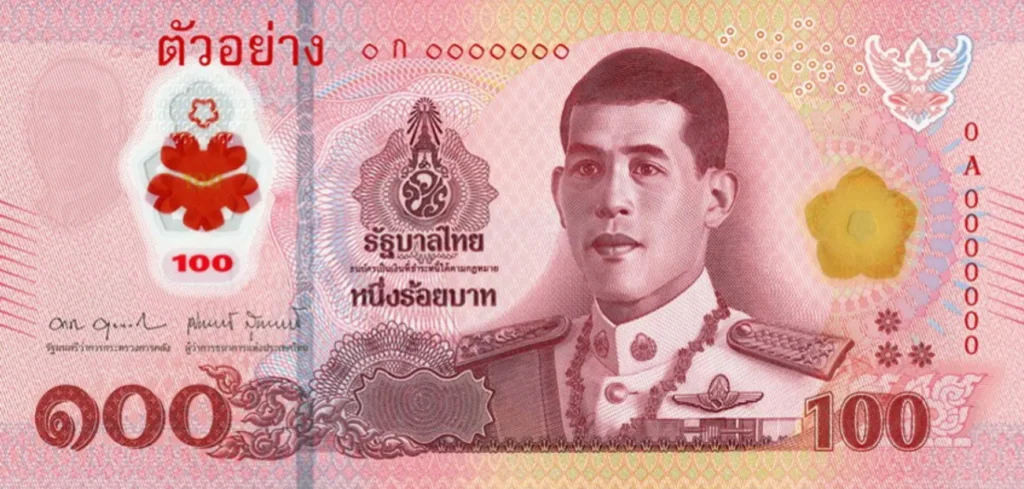
Obverse Design — King Rama X in Royal Thai Air Force Regalia
Continuity meets innovation: familiar iconography on revolutionary substrate
| Element | Description |
|---|---|
| Primary Portrait | His Majesty King Maha Vajiralongkorn Bodindradebayavarangkun (Rama X) wearing the Royal Thai Air Force uniform, symbolizing the monarch’s role as Supreme Commander of the Armed Forces |
| Royal Garuda Emblem | The mythical Garuda—half-man, half-bird—serves as Thailand’s national emblem, representing power, protection, and the monarchy’s divine authority |
| Thai Script | Traditional Thai text reinforces national identity and cultural continuity |
| Color Palette | Red, orange, brown, and green—maintaining visual consistency with the Series 17 paper predecessor to ease public transition |
| Watermark | Shadow image of King Rama X, visible when held to light, provides primary authentication feature |
The Bank of Thailand deliberately maintained the design theme from the current paper series to ensure immediate public recognition and smooth adoption. The polymer substrate allows for sharper image reproduction and more vivid colors compared to traditional cotton-paper notes.
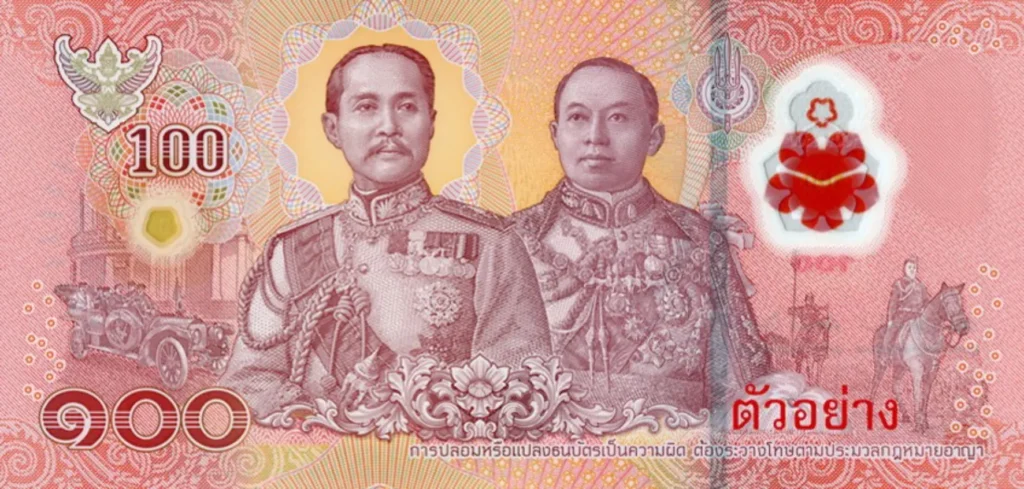
Reverse Design — Honoring the Chakri Dynasty Legacy
Rama V and Rama VI: Modernization and reform in Thai history
The reverse of the 100 baht polymer note continues Thailand’s tradition of honoring the Chakri royal dynasty by featuring portraits of two transformative monarchs who shaped modern Thailand during critical periods of reform and international engagement.
King Chulalongkorn (Rama V, reigned 1868-1910) is celebrated as Thailand’s great modernizer. His reign witnessed the abolition of slavery, establishment of modern infrastructure (railways, postal service), educational reform, and diplomatic maneuvering that preserved Thailand’s independence during the colonial era when surrounding nations fell under European control. His portrait symbolizes progress and national sovereignty.
King Vajiravudh (Rama VI, reigned 1910-1925) continued modernization by promoting Thai nationalism, establishing compulsory education, founding Chulalongkorn University, and introducing the Thai surname system still in use today. His portrait represents cultural identity and educational advancement.
The Royal Garuda emblem appears prominently on the reverse as well, flanked by Thai script, reinforcing the note’s dual themes of royal continuity and national pride.
Advanced Security Features: Polymer-Exclusive Protection
Six layers of anti-counterfeiting technology unique to polymer substrate
The transition to polymer enables security features impossible on paper currency, making the new 100 baht note significantly harder to counterfeit:
- Transparent window: A clear polymer window visible from both sides—impossible to replicate on paper—serves as the most distinctive security feature. The window allows light to pass through entirely, providing instant authentication.
- Embossed numeral in window: Within the transparent window, the denomination “100” appears as a raised, tactile embossing that can be felt by touch, combining visual and tactile verification.
- Color-shifting ink: Special optically variable ink (OVI) changes color when the note is tilted, shifting between red and green depending on viewing angle—a feature that cannot be photocopied or scanned.
- Simulated security thread: A demetallized thread running through the note displays “100 บาท / 100 BAHT” and appears to weave in and out of the substrate.
- Shadow watermark: King Rama X’s portrait appears as a continuous-tone watermark when held to light, created by variations in polymer thickness rather than paper density.
- Enhanced tactile features for visually impaired: Raised embossed symbols in Braille indicate the denomination, while diagonal raised lines on both edges make the note easy to identify by touch—a significant accessibility improvement mandated by the Bank of Thailand.
These features align with international best practices established by polymer-leading nations like Australia, Canada, and the United Kingdom.
Why Polymer? The Environmental and Economic Case
Four times longer lifespan, 350 million fewer replacement notes annually
The Bank of Thailand’s decision to transition the 100 baht denomination—which accounts for one-third of all banknotes in circulation—to polymer reflects a strategic commitment to sustainability and cost efficiency:
Durability Revolution
Polymer notes last four times longer than cotton-paper equivalents in Thailand’s hot, humid tropical climate. Paper notes degrade rapidly from moisture, sweat, and frequent handling—polymer resists all three.
Environmental Impact
By eliminating the need for 350 million replacement notes annually, the polymer transition dramatically reduces the carbon footprint of currency production, transportation, and disposal.
Cost Savings
While polymer substrate costs more per note initially (~40-60% premium), the extended lifespan results in significant long-term savings for the central bank and taxpayers.
Hygiene Benefits
Polymer’s non-porous surface resists dirt, oil, and bacteria far better than paper, resulting in cleaner currency throughout its lifecycle—critical in post-pandemic public health considerations.
Thailand follows the successful precedent of its 20 baht polymer note, introduced earlier in Series 17, which demonstrated these advantages in real-world circulation.
Thailand’s Polymer Journey: From 20 Baht to Full Series Transition
Building on success: Series 17 polymer strategy
Thailand’s polymer transition began cautiously with the 20 baht denomination, allowing the Bank of Thailand to test public acceptance, printing logistics, and circulation performance before committing to higher-value notes. The success of that pilot paved the way for the November 21, 2025 launch of both 50 and 100 baht polymer notes simultaneously.
This measured approach mirrors strategies employed by Australia (world’s first polymer currency in 1988), Canada (2011 transition), and the United Kingdom (2016 polymer £5 launch). By introducing lower denominations first, central banks minimize risk and gather real-world data on durability and public reception.
The 100 baht denomination is particularly significant: it accounts for one-third of all Thai banknotes in circulation, making it the workhorse of daily transactions—from street food vendors to taxi fares to small retail purchases. Transitioning this denomination to polymer will have an outsized impact on currency lifecycle costs and environmental footprint.
Future expansion to 500 and 1,000 baht polymer notes is expected, completing Thailand’s transition to a fully modern, polymer-based currency series by the late 2020s.
Collector Market Analysis & Future Value Projections
Early adopter premiums and long-term investment potential
Thailand’s transition to polymer creates predictable collector demand patterns based on historical precedent from other nations’ polymer transitions:
| Market Segment | Current Status | 6-Month Outlook | 2-5 Year Outlook |
|---|---|---|---|
| UNC first-day notes | Face value + 20-40% (US$3.60-$4.30) | Premiums stabilize at +15-25% | Modest appreciation if print runs disclosed as limited |
| Low serial numbers (000001-001000) | Not yet available; high anticipation | Expect 200-500% premiums at auction | Solid appreciation; serial 000001 could reach $500-1,000 |
| Replacement notes (if issued) | Not yet confirmed by BOT | Immediate +300-800% premiums if rare | Strong demand from Thai specialists |
| Last paper 100 baht notes | Still circulating; minimal premium | +10-20% as paper becomes scarce | Matched sets (paper + polymer) gain appeal |
| Presentation folders | Expected from BOT; pricing TBD | Retail $15-25; secondary market stable | Long-term value tied to folder rarity |
• Act quickly: First-print runs often have subtle variations sought by specialists
• Pursue low serials: Numbers under 001000 will command premiums indefinitely
• Acquire matched sets: Paper + polymer 100 baht pairs document the transition
• Condition is critical: Polymer notes show fingerprints easily—handle with care
• Watch for printing errors: Early polymer runs occasionally have alignment or color issues that become valuable
Comparative precedent: When Canada transitioned the $100 note to polymer in 2011, first-day UNC notes traded at 50-80% premiums within weeks. Australia’s 1988 $10 polymer commemorative—the world’s first—now trades at 300-500% over face value in UNC condition. Thailand’s 100 baht polymer has similar potential given the country’s economic importance and collector base across Asia.
What This Means for Collectors: Southeast Asian Numismatics
Historical significance meets modern innovation
Thailand’s 100 baht polymer note represents a significant acquisition opportunity for collectors specializing in Southeast Asian currency, polymer notes, or royal-themed banknotes. Several factors elevate its numismatic appeal:
First 100 baht polymer: This marks the first time Thailand’s most-used denomination appears on polymer substrate, making it a milestone issue that documents technological transition.
Royal iconography: Collectors of monarchy-themed currency appreciate the note’s celebration of three Chakri kings (Rama X, Rama V, Rama VI), each representing distinct eras of Thai sovereignty and modernization.
Regional polymer adoption: As Southeast Asia transitions to polymer (Singapore, Brunei considering, Malaysia evaluating), Thailand’s Series 17 polymer expansion positions these notes as representative of regional monetary evolution.
Accessibility: Unlike remote or conflict-affected nations, Thailand’s stable economy and tourism infrastructure make acquiring these notes relatively straightforward through commercial banks, currency exchanges, and established dealers.
Presentation packaging: The Bank of Thailand historically produces high-quality commemorative folders for polymer launches—expect official first-day covers and collector sets that will appreciate over time.
FAQ — Thailand 100 Baht Polymer Note 2025
When did the 100 baht polymer note launch?
November 21, 2025, through all commercial banks, specialized financial institutions, and ATMs nationwide.
Can I still use old paper 100 baht notes?
Yes. All previous series remain legal tender indefinitely. The Bank of Thailand will gradually withdraw worn paper notes through normal circulation cycles.
How long do polymer notes last compared to paper?
Approximately four times longer in Thailand’s tropical climate—polymer resists moisture, dirt, and physical wear far better than cotton-paper notes.
What is the main security feature unique to polymer?
The transparent window visible from both sides, with an embossed numeral inside, is impossible to replicate on paper currency and provides instant authentication.
Will polymer notes work in vending machines and ATMs?
Yes. The Bank of Thailand coordinated with machine manufacturers to ensure full compatibility. ATMs began dispensing polymer 100 baht notes on launch day.
Where can collectors obtain these notes?
Thai commercial banks (Bangkok Bank, Siam Commercial Bank, Kasikornbank), currency exchanges in Thailand, or international numismatic dealers specializing in Asian currency. For official presentation folders, check the Bank of Thailand website at www.bot.or.th.
Sources & References
- BanknoteNews: Thailand new polymer 100-baht note (B202a) reported
- Bank of Thailand: Official Press Release 32/2025 (August 29, 2025)
- The Nation Thailand: Bank of Thailand to Introduce New Polymer Banknotes
- Thailand Government News: Thailand upgrades 50 & 100 baht banknotes to polymer
- Polymer Notes: Bank of Thailand to Introduce New Polymer Banknotes
- World Banknote Society: Introduction of New Polymer Banknotes in Thailand
- CCL Secure: Congratulations to Bank of Thailand on polymer launch
- Courtesy: Mike Teseling (banknote specialist)
All information verified through official Bank of Thailand communications, government press releases, and reputable numismatic sources.
Discover our Shop Globenote: collectible and authentic banknotes from around the world