
For decades, the portrait of Queen Elizabeth II occupied a familiar place on Eastern Caribbean money. It connected the banknotes used across eight island territories to a shared colonial past and to the wider visual tradition of Commonwealth currency.
That era is now drawing to a close.
The Eastern Caribbean Central Bank has unveiled a redesigned family of EC dollar banknotes that replaces the late British monarch with national heroes, political pioneers, intellectuals and cultural icons from across the Eastern Caribbean Currency Union.
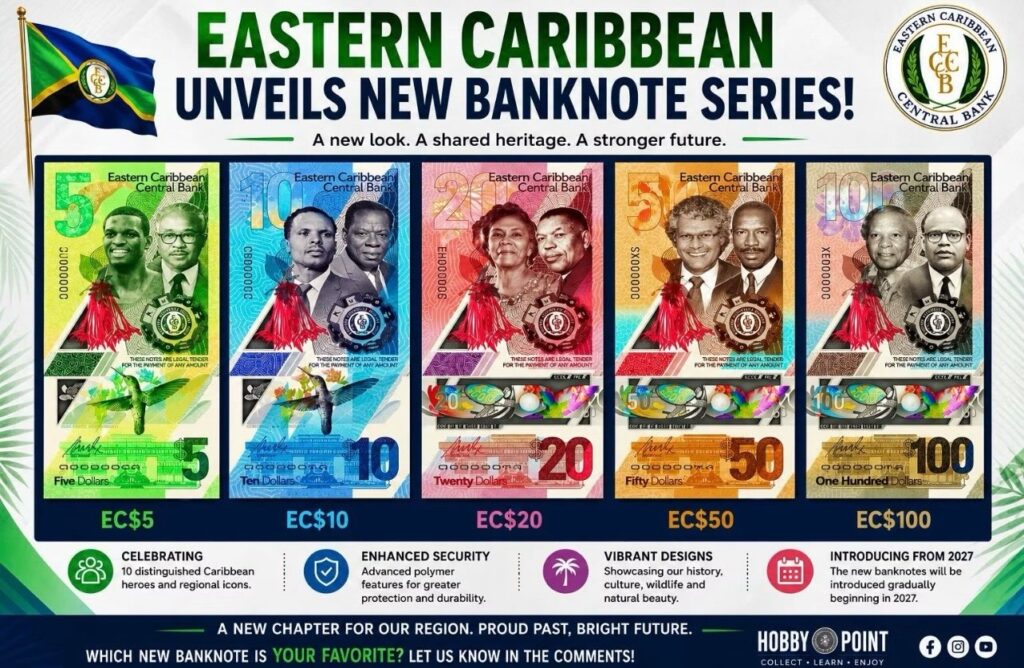
Five denominations will collectively honour ten regional figures. Every note will pair two personalities whose lives represent leadership, independence, economic development, public service or extraordinary achievement.
This is not merely a portrait change. It is a fundamental rewriting of what Eastern Caribbean money is intended to represent.
Instead of looking outward to the Crown, the new banknotes look inward, towards the people who built the modern Caribbean.
Quick Facts
Essential information about the redesigned Eastern Caribbean dollar banknotes featuring national heroes and regional icons.
- Currency Eastern Caribbean dollar
- Currency code XCD
- Issuer Eastern Caribbean Central Bank
- Region Eastern Caribbean Currency Union
- Redesigned denominations EC$5, EC$10, EC$20, EC$50 and EC$100
- People represented Ten regional personalities
- Portraits per banknote Two people on each denomination
- Main design change Regional heroes replace Queen Elizabeth II
- Public consultation July to December 2023
- Designs unveiled July 2026
- Planned circulation EC$100 expected by late 2027, followed by other denominations
- Catalogue status Final Pick numbers not yet confirmed
The announced circulation timetable may be updated by the ECCB before production banknotes are officially released.
What happened
The new Eastern Caribbean banknotes will be released next year in a staggered fashion as the stocks of current notes with Queen Elizabeth II portrait are exhausted. It is estimated that the first denomination to be issued will be the 100 dollars (XCD100.7.) Source: Eastern Caribbean Central Bank. Courtesy: Gabriel’s Numismatic Market,…
The report was first identified through MRI Guide, with a source publication date of 2026-07-10 16:42.
The redesign was unveiled in July 2026 after a consultation process initiated by the ECCB Monetary Council three years earlier. The bank says the new family honours the people, heritage and achievements of its eight member countries while preserving the security and public trust associated with the EC dollar.
A Currency Shared by Eight Territories
The Eastern Caribbean dollar is unusual because it is not the currency of a single independent country.
It is issued for:
- Anguilla
- Antigua and Barbuda
- Dominica
- Grenada
- Montserrat
- Saint Christopher and Nevis
- Saint Lucia
- Saint Vincent and the Grenadines
These territories differ in political status, history, size and national identity, yet share one central bank and one monetary system. The ECCB has served as their common monetary authority since 1983.
Designing a banknote family for such a union is delicate work. A single country can place its own leaders, landscapes and national symbols on every denomination. A currency union must instead create a visual language in which several communities can recognize themselves.
The new banknotes attempt to solve that problem by turning the complete series into a regional gallery.
No single island dominates the family. Political founders appear alongside an economist, a central banker and an Olympic champion. The notes present the Eastern Caribbean not simply as a collection of territories, but as a shared historical project.
Why Was Queen Elizabeth II Removed?
The decision originated at the 105th meeting of the ECCB Monetary Council on 21 July 2023.
The Council approved replacing the image of Queen Elizabeth II and instructed the central bank to consult the public. Consultations continued from July through December 2023 and reportedly produced strong support for national heroes and nation builders to appear on the redesigned currency.
The change is therefore not being presented as a rejection of the legal history of the currency. It is being framed as an evolution in regional representation.
Queen Elizabeth II died in September 2022. Her portrait remained on the existing EC polymer banknotes, but the need for future production created an unavoidable design question: should the currency adopt King Charles III, use a neutral institutional emblem or choose people from within the currency union?
The ECCB chose the third path, supported by a regional symbol.
The space formerly associated with the monarch will feature the ECCB logo encircled by the flags of the union’s member territories. The design shifts the symbolic centre of authority from an individual sovereign to the institution and communities that sustain the currency.
EC$5: Robert Milton Cato and Sir Kirani James
The new EC$5 banknote will feature Robert Milton Cato and Sir Kirani James.
Cato served as the first prime minister of Saint Vincent and the Grenadines and was one of the early signatories connected with the creation of the Eastern Caribbean Central Bank. His presence represents political independence, institution-building and regional cooperation.
Kirani James offers a strikingly different form of achievement. The Grenadian athlete became an Olympic champion and one of the Caribbean’s most internationally recognised sports figures. The ECCB associates him with discipline, humility and sporting excellence.
Pairing the two broadens the traditional definition of a national hero.
The lowest denomination does not look only towards political history. It links the generation that helped construct the region’s institutions with a living figure whose achievement has carried Grenada onto the global stage.
EC$10: William Henry Bramble and James Ronald Webster
The EC$10 note will honour William Henry Bramble of Montserrat and James Ronald Webster of Anguilla.
Bramble was Montserrat’s first chief minister and a major figure in the territory’s political development.
Webster led the Anguilla Revolution and is widely regarded as the father of modern Anguilla. His place on the banknote recognizes the island’s campaign for political self-determination and the formation of its present identity.
Together, the two portraits give particular visibility to two of the currency union’s smaller territories.
That matters. A common currency can easily become visually dominated by its largest members. By placing Montserrat and Anguilla on a circulating denomination, the ECCB presents their histories as essential chapters in the regional story rather than footnotes at the edge of it.
EC$20: Sir Vere Cornwall Bird and Dame Mary Eugenia Charles
The EC$20 banknote will feature Sir Vere Cornwall Bird Sr of Antigua and Barbuda and Dame Mary Eugenia Charles of Dominica.
Bird was Antigua and Barbuda’s first prime minister and a central figure in the country’s labour movement, political development and transition to independence. He also supported wider Caribbean economic integration.
Charles served as prime minister of Dominica from 1980 to 1995. She was the Caribbean’s first female prime minister and the first woman to serve on the ECCB Monetary Council.
Her inclusion is especially significant because the new family contains only one woman among its ten named figures.
That makes the EC$20 note both an acknowledgement of a major Caribbean political leader and a reminder of how rarely women have historically been represented on circulating banknotes.
EC$50: Sir K. Dwight Venner and Sir Robert Llewellyn Bradshaw
The EC$50 banknote will pair Sir K. Dwight Venner with Sir Robert Llewellyn Bradshaw.
Venner served as Governor of the ECCB from 1989 until 2015, the longest gubernatorial tenure in the institution’s history. He is closely associated with the stability, credibility and development of the Eastern Caribbean monetary system. His portrait already appears on the existing EC$50 polymer banknote.
Bradshaw was a major labour and political leader in Saint Kitts and Nevis and is recognised as the country’s first national hero.
The pairing gives the note a clear institutional theme. Bradshaw represents organised labour, political advancement and nation-building, while Venner represents the regional monetary architecture that binds the member territories together.
EC$100: Sir Arthur Lewis and Sir John Compton
The highest denomination will honour two of Saint Lucia’s most influential figures: Sir William Arthur Lewis and Sir John George Melvin Compton.
Lewis was awarded the Nobel Prize in Economic Sciences and became one of the Caribbean’s most important intellectual figures. His work examined economic development, labour and the structural challenges facing developing economies.
His portrait is already present on the current EC$100 note and will remain part of the redesigned denomination.
He will be joined by Compton, Saint Lucia’s first prime minister and a central figure in the country’s political development, independence and regional integration.
The EC$100 therefore places economic thought beside political action.
Lewis studied how developing societies could transform their economies. Compton helped guide one such society through the practical work of state-building. Their pairing makes the highest-value note a compact dialogue between ideas and governance.
The Complete Portrait Lineup
The five denominations will honour the following pairs:
| Denomination | Regional figures |
|---|---|
| EC$5 | Robert Milton Cato and Sir Kirani James |
| EC$10 | William Henry Bramble and James Ronald Webster |
| EC$20 | Sir Vere Cornwall Bird Sr and Dame Mary Eugenia Charles |
| EC$50 | Sir K. Dwight Venner and Sir Robert Llewellyn Bradshaw |
| EC$100 | Sir William Arthur Lewis and Sir John George Melvin Compton |
The names and allocations were confirmed in the ECCB announcement and subsequent government and banking reports.
What Will Change on the Reverse?
The redesign is not expected to erase the existing visual identity of the EC dollar.
Most of the established regional imagery on the reverse sides will reportedly be retained, although several scenes will be modified or replaced.
Reported changes include:
- Dark View Falls replacing Admiralty Bay on the EC$10;
- Montserrat’s national bird and heliconia flower replacing the former Montserrat House imagery;
- an expanded representation of Brimstone Hill on the EC$50;
- adjustments to other regional background elements.
The reverse of each note will therefore continue to function as a geographical panorama of the currency union, while the human figures strengthen its political and cultural narrative.
This creates a useful division of labour within the design.
The portraits tell the story of the people who shaped the region. The landscapes, buildings, flora and fauna represent the places those people belonged to.
Will the New Notes Still Be Polymer?
The current EC banknote family is printed on polymer and uses a vertical, portrait-oriented format. The ECCB began introducing the polymer series in 2019 and completed the full family with the EC$5 note in 2021.
The July 2026 redesign announcement concentrates primarily on the replacement of portraits and the selection of regional figures. It does not announce a return to paper or a completely new substrate.
The Government of Saint Lucia states that the redesigned family will retain the security features, integrity and public confidence associated with the existing EC currency. Until fuller technical specifications are published, it is safest to describe the project as a major visual redesign of the current banknote family rather than an entirely new technological platform.
When Will the New Banknotes Enter Circulation?
The timing has evolved since the redesign was first discussed.
Information published in 2024 suggested that the new EC$100 banknote would be introduced by late 2027, followed by the EC$5, EC$10, EC$20 and EC$50 as existing stocks were depleted.
More recent regional reporting indicates that the ECCB has also considered a possible September or October 2026 introduction, while acknowledging that the rollout could move into 2027.
The July 2026 official unveiling did not establish a definitive public circulation date for every denomination.
The most responsible conclusion is therefore that the new family is expected to begin circulating between late 2026 and 2027, with the EC$100 likely to be among the first denominations released. The final schedule should be treated as provisional until confirmed directly by the ECCB.
Will Existing EC Banknotes Become Invalid?
No immediate demonetisation has been announced.
The new notes are expected to circulate alongside existing EC currency during the transition. This approach allows banks, businesses and the public to become familiar with the new designs while older stocks remain usable.
A gradual introduction is particularly practical across a currency union composed of several islands.
Banknotes must be distributed through different national banking systems, cash centres, businesses and communities. Replacing the entire family at once would create unnecessary logistical pressure and could cause public confusion.
Collectors should therefore expect old and new designs to coexist for some time.
What Will Happen to the Coins?
The redesign also has implications for Eastern Caribbean coins.
Regional reporting indicates that the traditional ship design will remain on the reverse. The portrait of Queen Elizabeth II on the obverse will be replaced by the same ECCB emblem surrounded by the flags of the member territories that appears on the new banknotes.
The visual transformation will consequently extend across the currency system rather than stopping with paper money.
The ship preserves continuity with the long-established EC coinage, while the new obverse removes the monarchy from daily circulation and reinforces the identity of the currency union.
A Decolonial Change Without a Currency Break
The redesign arrives within a wider Caribbean discussion about sovereignty, republicanism and the symbols inherited from colonial rule.
Yet the ECCB is not launching a new currency, breaking the monetary union or altering the fundamental nature of the EC dollar.
The notes retain the same denominations. Existing money remains valid. The central bank continues to manage the currency, and the security and monetary framework remain intact.
That distinction matters.
The new series changes the story printed on the currency without destabilising the currency itself.
It is a form of symbolic independence achieved through continuity rather than rupture.
Why the New Series Matters to Collectors
For banknote collectors, this family will mark a clear dividing line in the history of Eastern Caribbean currency.
It will be the first regular EC banknote series without Queen Elizabeth II and the first to distribute ten regional figures across the five principal denominations.
The redesign may eventually generate:
- five new principal catalogue types;
- separate replacement-note varieties;
- different signatures or issue dates;
- transitional combinations of old and new notes;
- first-prefix and low-number serial interest;
- possible differences between announced and final designs.
No official Pick numbers had been confirmed at the time of the unveiling. Provisional catalogue identifiers reported by specialist publications should not be confused with final Pick classifications.
The current images should also be treated as unveiled designs until the production notes enter circulation. Small security, colour, inscription or layout changes may still appear in the final versions.
From a Royal Portrait to a Regional Pantheon
The most remarkable feature of the new Eastern Caribbean banknotes is not simply that Queen Elizabeth II has been removed.
It is what has replaced her. The ECCB could have chosen a neutral building, a generic crest or a purely decorative motif. Instead, it has used the complete banknote family to construct a regional pantheon.
Political founders stand beside an Olympic champion. A Nobel Prize-winning economist shares the currency with labour leaders, independence figures, a central banker and the Caribbean’s first female prime minister.
Together, they tell a more complicated and more local story than a single inherited portrait ever could.
Money is never merely a payment instrument. It is one of the most frequently handled forms of public history.
With this redesign, the Eastern Caribbean has decided that the faces circulating through its shops, banks and communities should belong to the region itself.
Frequently Asked Questions
Direct answers about the portraits, denominations, circulation schedule and historical importance of the redesigned EC dollar banknotes.
What are the new Eastern Caribbean banknotes?
They are redesigned Eastern Caribbean dollar banknotes issued by the Eastern Caribbean Central Bank. The five-note family features ten national heroes, leaders and regional figures.
Which EC dollar denominations are being redesigned?
The redesigned family includes the EC$5, EC$10, EC$20, EC$50 and EC$100 banknotes.
Why is Queen Elizabeth II being removed from the EC banknotes?
The ECCB Monetary Council approved the portrait change in July 2023. Public consultations held through December 2023 showed strong support for featuring Eastern Caribbean national heroes and nation builders.
Who will appear on the new EC$5 banknote?
The EC$5 banknote will feature Robert Milton Cato of Saint Vincent and the Grenadines and Sir Kirani James of Grenada.
Who will appear on the new EC$10 banknote?
The EC$10 banknote will feature William Henry Bramble of Montserrat and James Ronald Webster of Anguilla.
Who will appear on the new EC$20 banknote?
The EC$20 banknote will feature Sir Vere Cornwall Bird Sr. of Antigua and Barbuda and Dame Mary Eugenia Charles of Dominica.
Who will appear on the new EC$50 banknote?
The EC$50 banknote will feature former ECCB Governor Sir K. Dwight Venner and Sir Robert Llewellyn Bradshaw of Saint Kitts and Nevis.
Who will appear on the new EC$100 banknote?
The EC$100 banknote will feature Saint Lucian economist and Nobel laureate Sir William Arthur Lewis together with Saint Lucia’s first prime minister, Sir John George Melvin Compton.
When will the new Eastern Caribbean banknotes enter circulation?
The EC$100 banknote was expected to begin circulating by late 2027. The EC$5, EC$10, EC$20 and EC$50 were expected to follow as existing stocks are used. The ECCB may revise the final schedule.
Are the new EC banknotes commemorative issues?
No. They are intended as regular circulating banknotes. Their portraits nevertheless honour important political, economic, cultural and sporting figures from the Eastern Caribbean.
Which countries and territories use the Eastern Caribbean dollar?
The currency is used in Anguilla, Antigua and Barbuda, Dominica, Grenada, Montserrat, Saint Kitts and Nevis, Saint Lucia, and Saint Vincent and the Grenadines.
Do the redesigned banknotes already have Pick numbers?
Final Pick numbers have not yet been authoritatively confirmed. GlobeNote will update the catalogue after the production banknotes and their official classifications become available.
References
This article was prepared using the official ECCB announcement, regional banking and government publications, and a supplementary collector discussion.
- Primary official source Eastern Caribbean Central Bank: ECCB Unveils New EC Banknotes Featuring National Heroes and Regional Icons Official announcement of the redesigned banknote family, portrait selections and public-consultation background.
- Regional banking source Bank of Saint Lucia: Redesigned EC Currency to Be in Circulation by 2027 Information about the original circulation timetable, the planned EC$100 release and the progressive introduction of the remaining denominations.
- Government source Government of Saint Lucia: Sir John Melvin Compton Selected for the New EC$100 Banknote Confirmation of the EC$100 portraits and the complete lineup of personalities selected for the five denominations.
- Supplementary collector source World of Coins Forum: Discussion of the Redesigned Eastern Caribbean Banknotes Collector discussion included for supplementary context. It should not be treated as the primary authority for issue dates, security specifications or catalogue classifications.
Designs, circulation dates, technical specifications and catalogue references may change before the production banknotes are issued. GlobeNote will update the article and catalogue when the ECCB publishes further official documentation.