Brazil 50,000 Cruzeiros Reais: The Baiana Banknote That Closed a Monetary Era
Brazil • 50,000 cruzeiros reais • Baiana do Acaraje • Monetary transition
Brazil’s 50,000 cruzeiros reais note is not merely a high denomination from the inflation years. It is a farewell speech printed in purple ink: a banknote from a currency that was already walking toward the exit while the next monetary system was waiting in the corridor.
The cruzeiro real was created in 1993 as a transitional currency between the cruzeiro and the modern real. For collectors, that short life is exactly the appeal. Short-lived currencies often leave behind the best kind of notaphilic evidence: urgent designs, odd denominations, provisional decisions and notes that feel like they were issued with one eye on the printing press and the other on the economic fire alarm.
Quick Facts
- Country: Brazil
- Denomination: 50,000 cruzeiros reais
- Year: 1994
- Issuer: Banco Central do Brasil
- Theme: Bahia, Baiana do Acaraje and Afro-Brazilian culture
- Status: Short-lived transitional currency banknote
Collect banknotes related to this article
Explore authentic world banknotes connected to this country, region or collecting theme.
| Specification | Details |
|---|---|
| Currency | Cruzeiro real |
| Monetary Context | Transitional currency between the cruzeiro and the real |
| Conversion | 1 cruzeiro real replaced 1,000 old cruzeiros |
| Design Subject | Idealized baiana linked to Bahia and Afro-Brazilian cultural identity |
| Collector Interest | High denomination, short circulation window, emblematic design and relative scarcity |
| Strategic Tags | Brazil, cruzeiro real, 50,000 cruzeiros reais, Baiana, hyperinflation, 1994 |
In the great Brazilian denomination carousel, this note is one of the more memorable passengers. Between 1942 and 1994, Brazil cycled through several monetary signs, repeatedly cutting zeros from the currency. The cruzeiro real was one of those bridge currencies: necessary, temporary and deeply collectible.
A banknote from the end of a cycle
The 50,000 cruzeiros reais arrived in 1994, the same year Brazil introduced the real. That timing matters. It was the highest denomination of its moment, yet the monetary stage under its feet was already being rebuilt.
Why short circulation matters
Notes issued near a monetary reform often survive in higher grades because they do not circulate for long. That is part of the attraction here: a large denomination, a brief life and a design that looks much more deliberate than a temporary emergency note.
Not a portrait of one famous person
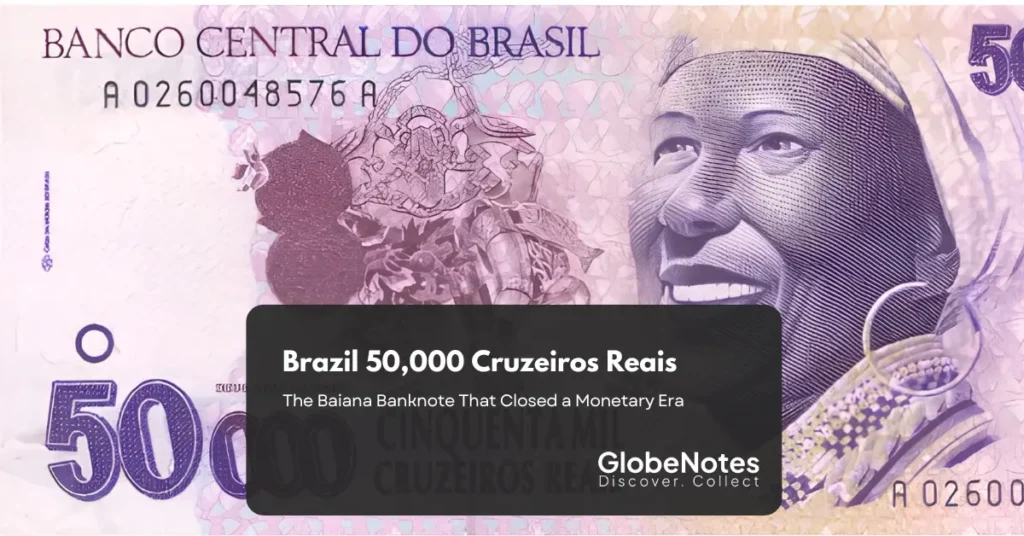
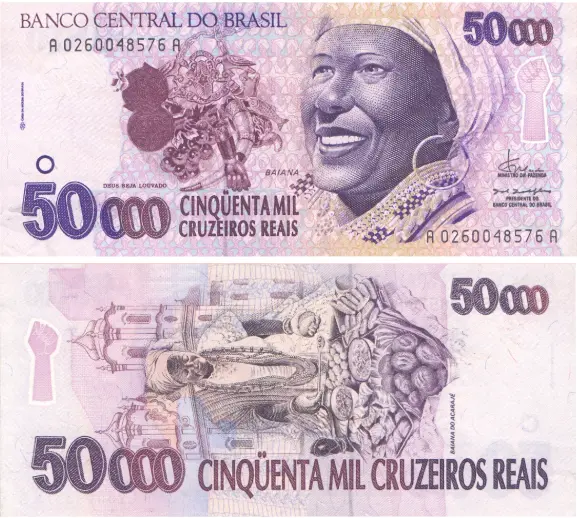
The design does not honour a single named statesman. Instead, it presents an archetypal cultural figure: the baiana, connected to Bahia’s food traditions, dress, religious syncretism and Afro-Brazilian identity.
Obverse design: the Baiana and the politics of recognition
The obverse shows the baiana not as a decorative costume figure, but as a cultural statement. The note links money to work, memory and the public recognition of traditions that were often pushed to the margins.
Design details to notice
- Baiana figure: A visual reference to Bahia and the women associated with acaraje street-food traditions.
- Balanganda: A jewellery and amulet motif connected with Afro-Brazilian symbolism.
- Raised fist: A visual sign of solidarity, struggle and collective identity.
- Purple palette: A distinctive colour choice that helps the note stand apart from many modern Brazilian issues.
Reverse design: Bahia as a stage
The reverse continues the Bahia story with a vertical composition, cultural objects and religious architecture. The Church of Nosso Senhor do Bonfim and the associated festivities give the note a layered identity: Catholic, Afro-Brazilian, urban and ceremonial all at once.
Collector market angle
The note combines several desirable ingredients: high face value, short-lived currency, strong cultural symbolism and a design that avoids the predictable “great man portrait” formula. That makes it a useful anchor for any collection focused on Latin American monetary reform or social identity on banknotes.
How to collect it
For GlobeNote readers, the 50,000 cruzeiros reais is best understood as a story note. Condition matters, of course, but the historical frame is what gives the piece its electricity.
What to look for
- Clean UNC or high-grade examples with sharp corners.
- Original colour freshness, especially in the purple fields.
- Well-centred printing and intact security features.
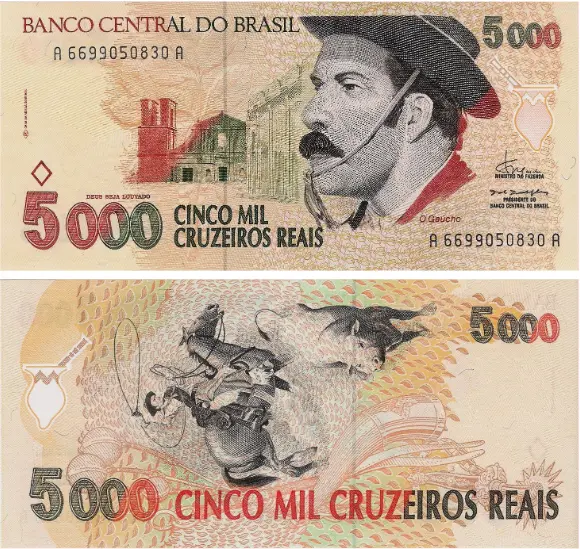
- Comparison examples with the 5,000 cruzeiros reais gaucho note.
- Context notes from the cruzeiro and real transition period.
This is the kind of banknote that reminds collectors why inflation-era money is not just “lots of zeros”. Sometimes those zeros carry a cultural archive in their pockets.
Sources and Further Research
This article was built from verified sources and specialist banknote reporting. Broken or unconfirmed links were excluded from this public sources box.
- Blog Numismatico: Original Spanish article on the 50,000 cruzeiros reais banknote
- GlobeNote: Collectible world banknotes in the GlobeNote shop
Browse authentic notes, modern issues and collector favourites in the GlobeNote shop: Shop GlobeNote
Frequently Asked Questions
What is the Brazil 50,000 cruzeiros reais banknote?
It is a 1994 Brazilian high-denomination note from the short-lived cruzeiro real currency, remembered for its Baiana design.
Why is the cruzeiro real important?
It was a transitional currency between the cruzeiro and the modern real, created during Brazil’s monetary reform period.
Who is shown on the 50,000 cruzeiros reais note?
The main figure is a baiana, a cultural archetype associated with Bahia and Afro-Brazilian traditions.
Is this a hyperinflation banknote?
It belongs to Brazil’s inflation and monetary-reform context. It is especially interesting because it appeared just before the real replaced the cruzeiro real.
What makes it collectible?
The short issue period, high denomination, strong cultural design and relative scarcity make it attractive to modern world banknote collectors.
This article is part of our world banknote research archive.
For more inflation-era stories, browse the GlobeNote shop and follow our collector guides.