Money is usually studied through exchange rates, inflation, purchasing power or the volume of cash in circulation. But another measurement can reveal an equally powerful story:
How often has the world created a genuinely new type of banknote?
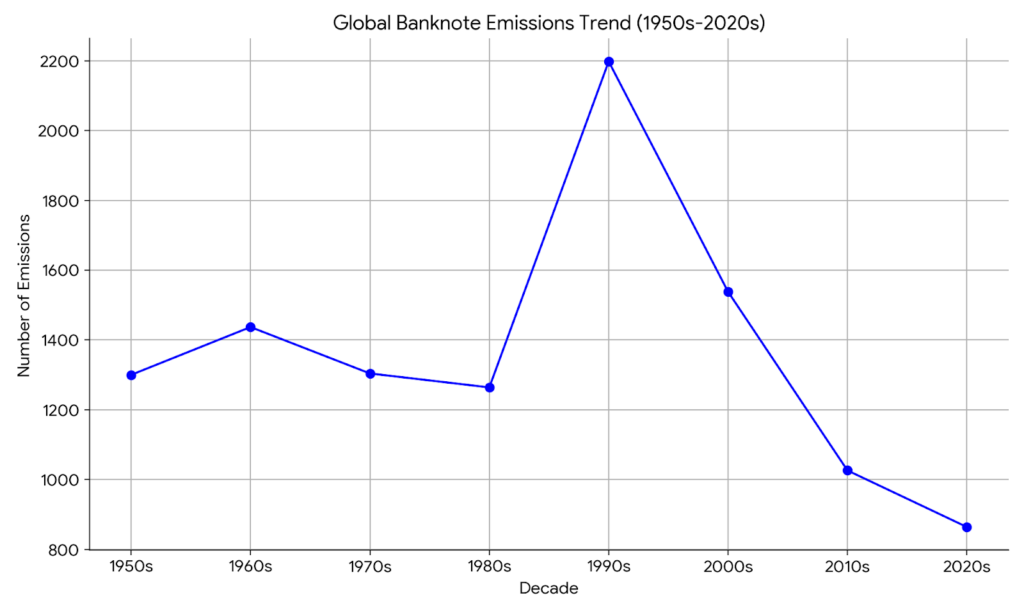
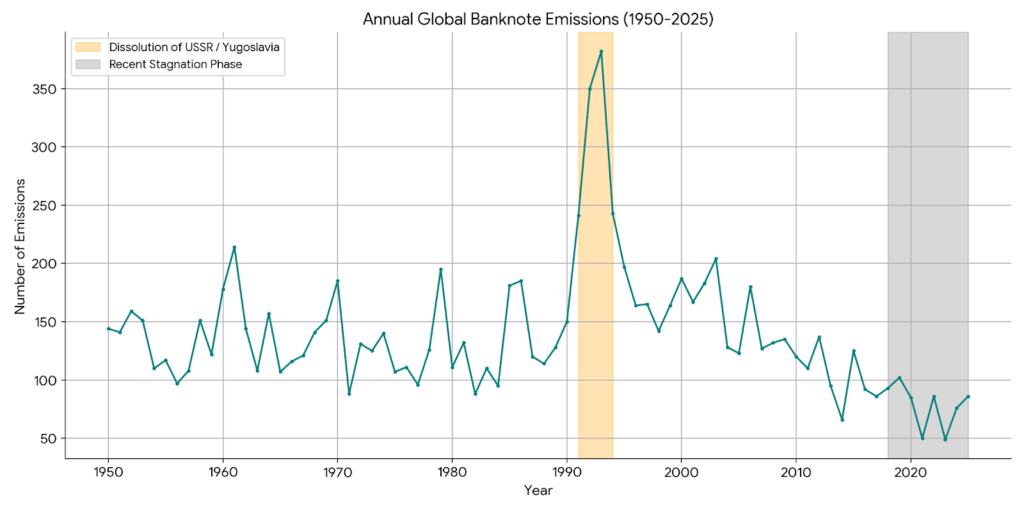
Using the GlobeNote banknote database, we examined distinct banknote issues recorded between 1950 and 2025. The result is not a smooth progression. It resembles a historical seismograph.
For almost forty years, the number of new banknote types remained surprisingly stable. Then, during the early 1990s, the curve rose almost vertically. New states appeared, shared currency systems disintegrated, inflation accelerated and national authorities hurried to place new money into circulation.
The annual total reached its highest point around 1993, when the GlobeNote dataset records approximately 380 distinct banknote issues.
That peak was not simply a numismatic event. It reflected a world whose political and monetary map was being redrawn.
Quick Facts
- Period analysed: 1950–2025
- Geographical scope: Worldwide
- Source: GlobeNote Banknote Database
- Measurement: Distinct Pick-numbered banknote issues
- Highest decade: The 1990s
- Peak year: Approximately 1993
- 1990s total: Around 2,200 distinct issues
- Commemorative banknotes: Included
- Date and signature variants: Not counted separately
- Replacement notes and specimens: Excluded
- Important limitation: 2020–2025 is only a partial decade
What Counts as a New Banknote Issue?
For this analysis, an issue is counted when a banknote represents a distinct type identified by a new Pick number.
The dataset includes:
- newly introduced denominations;
- new banknote series;
- redesigned types receiving a separate Pick classification;
- commemorative banknotes.
The dataset does not count different dates or signature combinations as separate emissions when the underlying banknote retains the same Pick number. Replacement notes, specimens and other minor variants are also excluded.
A banknote issued with several dates or different groups of signatories is therefore counted only once unless it becomes a separately classified Pick-numbered type.
This distinction is essential. The graphs do not measure the number of physical banknotes printed, the monetary value placed into circulation or the number of individual notes used by the public.
They measure the creation of distinct catalogued banknote types.
In other words, the data records how frequently countries redesigned, replaced or expanded their physical money.
Four Decades of Relative Stability
From the 1950s through the 1980s, the number of distinct banknote issues remained within a relatively narrow range.
The GlobeNote data records approximately:
| Decade | Distinct banknote issues |
|---|---|
| 1950s | 1,300 |
| 1960s | 1,435 |
| 1970s | 1,300 |
| 1980s | 1,260 |
| 1990s | 2,200 |
| 2000s | 1,540 |
| 2010s | 1,020 |
The 1960s produced a noticeable increase, but nothing comparable to the explosion that would follow three decades later.
The 1960s produced a noticeable increase, but nothing comparable to the explosion that would follow three decades later.
One possible influence was the rapid advance of decolonization. In 1960 alone, 17 new states joined the United Nations, 16 of them African. New political independence often required new central banks, monetary authorities, currencies and national symbols.
Not every newly independent country immediately introduced an entirely independent currency. Some retained colonial monetary arrangements, joined regional currency unions or continued using an existing currency. Nevertheless, the political transformation of Africa, Asia, the Caribbean and the Pacific created fertile ground for new banknote systems.
A new national banknote could perform several jobs at once. It provided a means of payment, communicated state authority and carried portraits, languages, landscapes and symbols chosen by the newly independent country.
Money became a pocket-sized declaration of sovereignty.
The 1990s Were Not a Normal Decade
The stability ended abruptly in the 1990s.
The decade generated around 2,200 distinct banknote issues, roughly three-quarters more than the 1980s and more than 40% above the total recorded during the 2000s.
The annual chart reveals that this was not merely a gentle decade-long increase. The strongest concentration occurred in the first half of the 1990s, culminating in the extraordinary peak around 1993.
Several historical processes converged almost simultaneously:
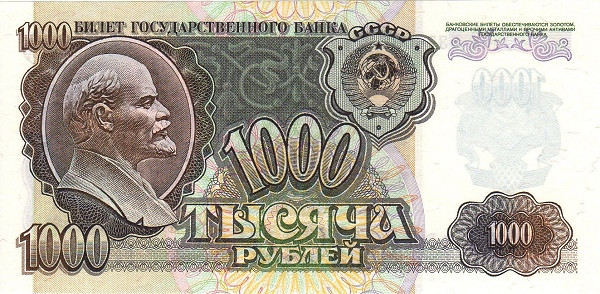
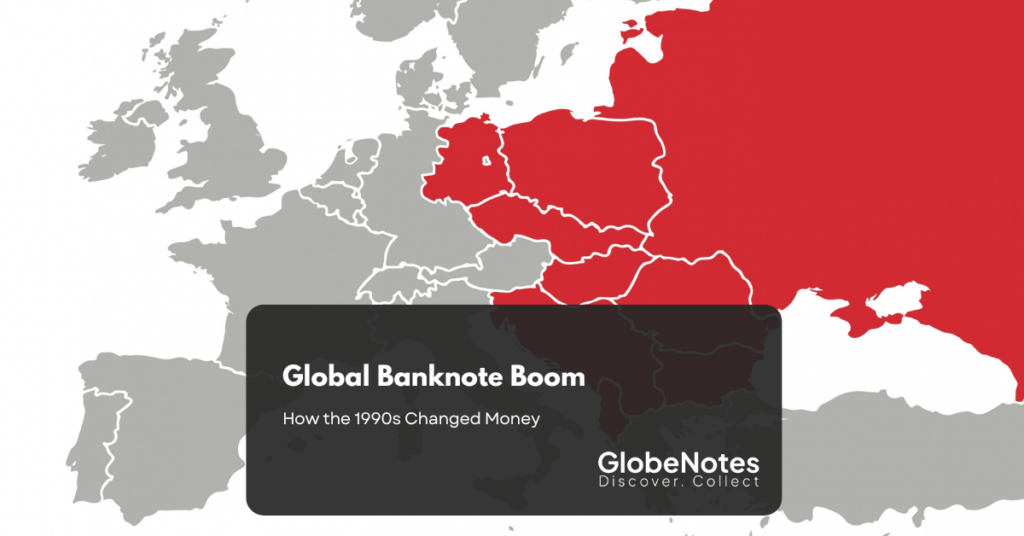
- the dissolution of the Soviet Union;
- the collapse of the Soviet ruble area;
- the breakup of Yugoslavia;
- the introduction of currencies by newly independent states;
- severe inflation and hyperinflation;
- currency reforms and redenominations;
- rapid replacement of provisional banknote series;
- the creation of new national visual identities.
The dataset does not by itself prove how many issues were caused by each event. However, the timing of the peak closely overlaps with one of the most intense periods of political and monetary fragmentation in modern history.
The End of the Soviet Ruble Area
When the Soviet Union dissolved in late 1991, its former republics did not all introduce permanent national currencies immediately.
For a time, much of the region continued to use the ruble or a mixture of rubles, coupons, temporary notes and parallel monetary instruments. The arrangement became increasingly difficult to manage because the newly independent states had different fiscal needs, inflation rates and political objectives.
The International Monetary Fund’s historical account describes the challenge of conducting regional finance after the collapse of the Soviet system and without the Soviet ruble as a stable common currency.
During 1992 and 1993, several former Soviet republics began leaving the ruble area. Estonia introduced the kroon in June 1992, while other states introduced temporary or permanent currencies over the following months. The Kyrgyz Republic launched the som in May 1993, and Ukraine used transitional currency arrangements before introducing the hryvnia later in the decade.
For banknote history, each transition could produce several layers of issues:
- temporary coupons or provisional notes;
- an initial national currency;
- new denominations required by inflation;
- a redesigned permanent series;
- later redenominations or monetary reforms.
One political collapse could therefore generate not one new banknote, but entire families of new Pick numbers across numerous countries.
Yugoslavia: Fragmentation, Inflation and Rapid Replacement
A parallel monetary upheaval was unfolding in Yugoslavia.
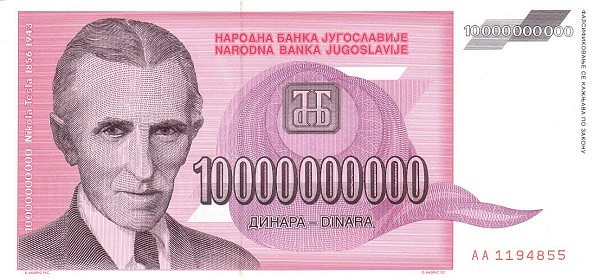
As the federation disintegrated, the seceding republics needed to establish their own currencies and payment systems. An IMF historical account notes that as Yugoslav monetary disorder moved towards hyperinflation in 1991 and 1992, each departing republic had to create a currency of its own.
At the same time, inflation repeatedly eroded the usefulness of existing denominations.
Yugoslav inflation had already developed into hyperinflation by the end of the 1980s, while the Federal Republic of Yugoslavia later experienced the devastating 1993 hyperinflation.
Hyperinflation compresses the lifespan of a banknote series. A denomination that appears adequate at the beginning of a year can become practically useless within months or even weeks.
Authorities respond by issuing:
- higher denominations;
- revised currency units;
- notes with additional zeros;
- emergency designs;
- replacement currencies;
- redenominated series.
For a catalogue based on distinct Pick-numbered types, this creates a dense cluster of new issues.
The paper money of the former Yugoslav region consequently became a record of political separation, economic collapse and repeated attempts to restore monetary credibility.
Banknotes as Instruments of National Identity
The early 1990s surge was not driven only by economics.
Newly independent states needed objects that could make sovereignty visible in everyday life. Flags appeared over government buildings, passports crossed borders and banknotes passed continuously from hand to hand.
A banknote could replace the imagery of a former federation with:
- national writers and political figures;
- local architecture;
- historical rulers;
- indigenous languages;
- religious or cultural monuments;
- native wildlife and landscapes;
- newly adopted coats of arms.
Viewed through the GlobeNote catalogue, many 1990s banknotes function as miniature state-building documents.
They show governments deciding not only what their money was worth, but what their country wished to say about itself.
Why the Peak Did Not Continue
After the 1990s, the number of distinct banknote issues declined.
The 2000s still recorded around 1,540 issues, considerably above most earlier decades, but far below the extraordinary 1990s total.
Part of this reduction likely reflects the stabilization of the monetary systems created after the Soviet and Yugoslav dissolutions. Temporary currencies were replaced, inflation was brought under greater control in many countries and newly established central banks developed longer-lasting series.
Europe also underwent a different type of monetary consolidation.
On 1 January 2002, euro banknotes and coins entered circulation in 12 countries, serving a combined population of approximately 308 million. It was the largest cash changeover undertaken up to that point.
The euro itself created a major new banknote family. However, one supranational series also replaced the separate circulating banknote systems of numerous countries.
It is reasonable to infer that this consolidation contributed to a reduction in the number of independent European series that might otherwise have been redesigned or replaced separately. The euro cannot explain the entire worldwide decline, but it represents an important structural change in the geography of banknote issuance.
The 2010s: The Quietest Complete Decade
The 2010s produced approximately 1,020 distinct issues, the lowest total among the complete decades shown in the GlobeNote chart.
This does not mean that banknote design stopped evolving.
Many central banks introduced sophisticated new families incorporating:
- transparent windows;
- colour-shifting elements;
- holographic features;
- tactile marks;
- improved portrait engraving;
- machine-readable security systems;
- polymer or hybrid substrates.
What changed was the frequency with which entirely new Pick-numbered types appeared.
Modern series can remain in circulation for long periods while receiving gradual security or production updates. Some changes create a new catalogue number, while others remain variants of an existing type.
Consequently, a period of intense technological development does not necessarily produce a high count of distinct Pick numbers.
Are Polymer Banknotes Part of the Explanation?
Polymer banknotes are more durable than traditional paper notes and can remain usable for longer under demanding circulation conditions.
The Reserve Bank of Australia states that polymer is more resistant to moisture, dirt and damage, and that its longevity reduces the number of replacement banknotes required. The Bank of England has estimated that some polymer notes last around two and a half times longer than their paper predecessors.
This directly affects how many physical notes must be printed and replaced.
Its effect on the number of distinct Pick-numbered types is less direct. A more durable substrate does not automatically prevent a central bank from launching a new design or series. Political decisions, counterfeiting risks, public accessibility and technological changes remain important.
Polymer should therefore be treated as part of the broader context, not as a proven explanation for the decline shown by the GlobeNote data.
Did Digital Payments End the Banknote?
Digital and contactless payments have expanded rapidly, particularly since the COVID-19 pandemic. The Bank for International Settlements reported that the pandemic accelerated a shift from physical cash towards digital and contactless payment instruments.
Yet fewer new banknote types do not mean that cash has disappeared.
BIS payment statistics continue to show an important role for physical cash, even as cashless transactions grow. In the euro area, 62% of consumers surveyed in 2024 considered it important to retain cash as a payment option.
The GlobeNote graph measures variety, not usage.
A country can circulate vast quantities of cash while keeping the same banknote family for many years. Another country can introduce several short-lived series even when the total amount of currency in circulation is relatively small.
The number of new banknote types and the public’s demand for cash are related only indirectly.
How to Read the 2020–2025 Data
The current decade must be handled carefully.
The years 2020 to 2025 represent only six years, whereas every earlier decade contains ten. A partial total should never be compared directly with a full-decade total without adjustment.
The annual chart is more useful for studying the recent period. It indicates lower and sometimes volatile yearly totals, but it does not yet tell us where the full 2020s will stand.
Several events could still alter the final result:
- large coordinated redesign programmes;
- redenominations following inflation;
- new countries or monetary authorities;
- withdrawals of older series;
- security-driven banknote replacements;
- commemorative programmes;
- changes in Pick classification.
The 2020s should therefore be labelled “2020–2025, partial period”, not simply “2020s” without qualification.
What the GlobeNote Data Does Not Measure
The analysis should not be interpreted as a global measure of banknote production.
It does not reveal:
- how many notes were printed;
- the total face value issued;
- how much cash remained in circulation;
- how often individual notes were replaced;
- the economic importance of each currency;
- the number of date or signature varieties;
- the collector value of the banknotes.
A small island state and a major international currency issuer each contribute one unit when they introduce one new Pick-numbered type.
The count is democratic in a peculiar way: every distinct banknote design receives one place in the timeline, regardless of the population or economic size behind it.
Catalogue Data Is a Living Record
Pick classifications and catalogue information can be revised when new research becomes available.
A note once treated as a date variety may later be identified as a distinct type. Two apparent issues may be consolidated, or a previously undocumented banknote may be added retrospectively.
The GlobeNote figures therefore represent the structure of the database at the time of analysis.
This does not weaken the value of the study. It simply means that, like any serious historical dataset, the catalogue is capable of becoming more accurate over time.
Why This Matters to Collectors
For collectors, the graph reveals where some of the richest and most complicated areas of modern banknote history are located.
The 1990s offer an extraordinary concentration of:
- provisional currencies;
- short-lived states and issuers;
- emergency banknotes;
- rapidly escalating denominations;
- newly created national series;
- redenominated currencies;
- transitional designs;
- commemorative issues linked to independence.
A collector examining these notes is not merely assembling different colours and denominations.
They are reconstructing the monetary consequences of borders moving, governments collapsing, institutions forming and inflation rewriting prices faster than printers could produce currency.
The peak around 1993 is therefore more than the highest point on a chart.
It is a compressed portrait of a world in transition.
A History Written in Pick Numbers
Between 1950 and 2025, the world did not create new banknotes at a constant pace.
The GlobeNote data reveals a long period of relative stability, interrupted by a unique explosion during the 1990s. The collapse of shared political and monetary systems generated new currencies, new denominations and new national identities at a speed rarely seen before or since.
The following decades were quieter. Monetary institutions matured, regional systems consolidated and many banknote families remained in circulation for longer.
But quiet does not mean irrelevant.
Every new Pick number still marks a decision: a country has changed the appearance, structure, denomination or message of its money.
A banknote may be small enough to disappear inside a wallet, yet together these notes form an immense paper archive of political history.
The graphs show when the world produced new money.
The banknotes explain why.
Frequently Asked Questions
Key answers about the GlobeNote analysis of distinct global banknote issues between 1950 and 2025.
Which decade produced the most distinct banknote issues?
The 1990s produced the highest total in the GlobeNote dataset, with approximately 2,200 distinct Pick-numbered banknote issues.
Which year recorded the highest number of distinct banknote issues?
The annual GlobeNote data indicates that the peak occurred around 1993, with approximately 380 distinct banknote issues.
Does one issue mean one physical banknote was printed?
No. One issue represents a distinct Pick-numbered banknote type. Thousands or millions of physical notes may have been printed for a single issue.
Are commemorative banknotes included in the analysis?
Yes. Commemorative banknotes are included when they are recognised as distinct Pick-numbered banknote types.
Are different dates counted as separate banknote issues?
No. Different issue dates are not counted separately when the banknote retains the same Pick number.
Are different signature combinations counted separately?
No. Signature variations of the same Pick-numbered banknote type are counted as a single issue.
Are replacement notes and specimens included?
No. Replacement notes, specimens and other minor catalogue variants are excluded from this analysis.
Why were so many new banknote types issued in the 1990s?
The peak coincided with the dissolution of the Soviet Union and Yugoslavia, the creation of new national currencies, severe inflation, redenominations and the rapid development of new monetary systems.
Does the decline in new issues mean that cash is disappearing?
No. The dataset measures the number of distinct banknote types, not the volume of cash printed, the value of currency in circulation or the frequency with which people use cash.
Can the 2020s be compared directly with earlier decades?
Not yet. The current dataset covers only the years from 2020 to 2025, while the earlier periods represent complete ten-year decades.