Greek Hyperinflation Banknotes: When Drachmas Became Paper Thunder
Greece • World War II occupation • Hyperinflation • Drachma banknotes
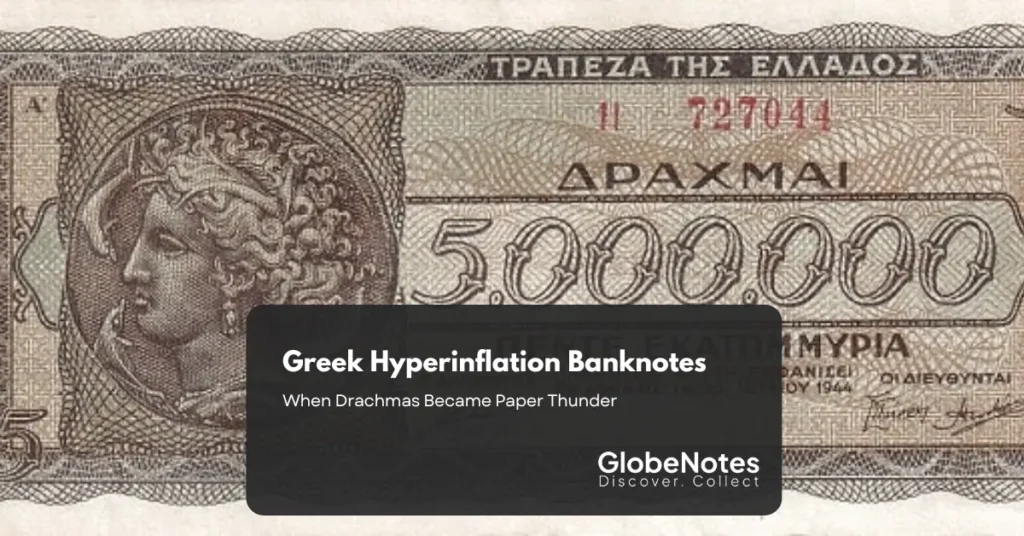
Greek hyperinflation notes are among the most dramatic pieces of twentieth-century paper money. They look like banknotes, but they behave like economic seismographs. Each extra zero records pressure, panic and the collapse of trust during the Second World War occupation.
During the occupation of Greece, the economy was stripped, production collapsed and the cost of military occupation was pushed onto the country. The result was a monetary spiral in which ordinary denominations became useless and the Bank of Greece had to print values that would have looked absurd only a few years earlier.
Quick Facts
- Country: Greece
- Currency: Drachma
- Main Period: 1941-1944 occupation and liberation period
- Highest Cited Value: 100 billion drachmas
- Theme: World War II hyperinflation and monetary collapse
- Strategic Tag: hyperinflation
Collect banknotes related to this article
Explore authentic world banknotes connected to this country, region or collecting theme.
| Specification | Details |
|---|---|
| Issuer | Bank of Greece |
| Early Occupation Values | 100, 500, 1,000 and 5,000 drachmas |
| Later High Values | 10,000, 25,000, 100,000, millions and finally 100 billion drachmas |
| Peak Context | October 1944 is described as the most extreme phase |
| Reform | A new drachma was introduced in November 1944 |
| Collector Angle | Historical narrative, denomination escalation and classical Greek design motifs |
These notes are collectible not because they are rare in every denomination, but because they are readable history. Put them in sequence and the album page becomes a monetary disaster movie with better typography.
From occupation to denomination explosion
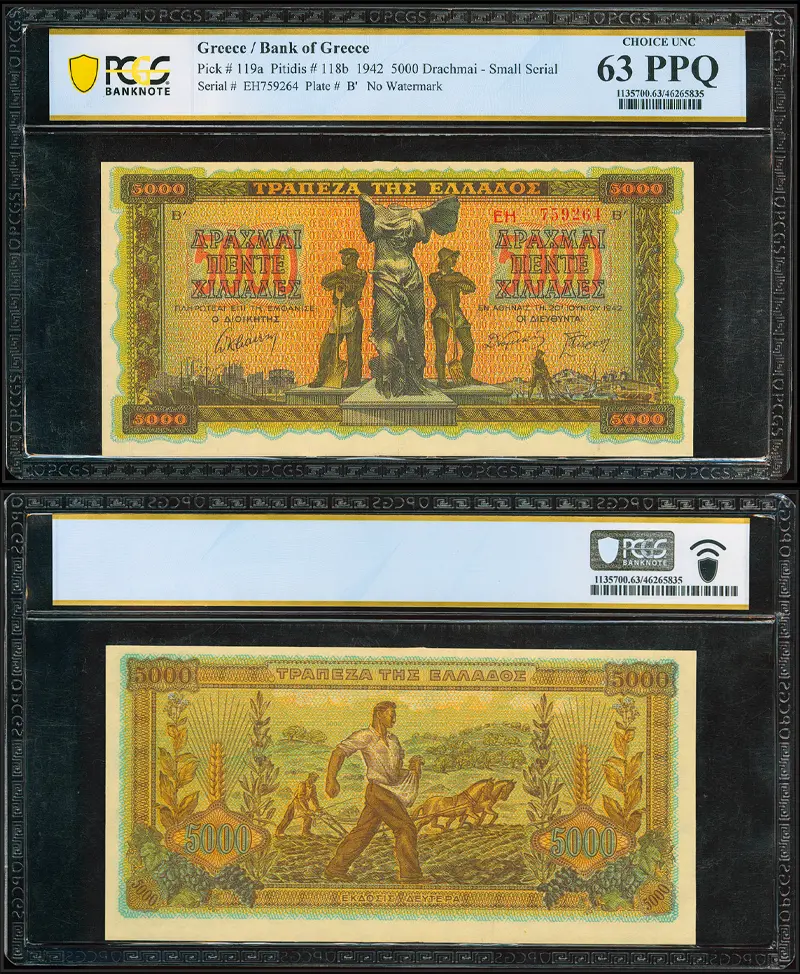
At first, the values remained within the realm of ordinary banknote logic: hundreds and thousands of drachmas. But once inflation accelerated, those values became pocket lint with official signatures.
The occupation economy
The occupation forces looted resources, disrupted production and imposed financial burdens. With taxes and loans insufficient, money creation became the emergency lever. The lever was pulled until it came off in someone’s hand.
The denomination ladder
Collectors can trace the collapse through denominations: 5,000 drachmas, then 10,000 and 25,000, then 100,000, millions and eventually 100 billion drachmas.
Design under collapse: Greece kept its own visual language
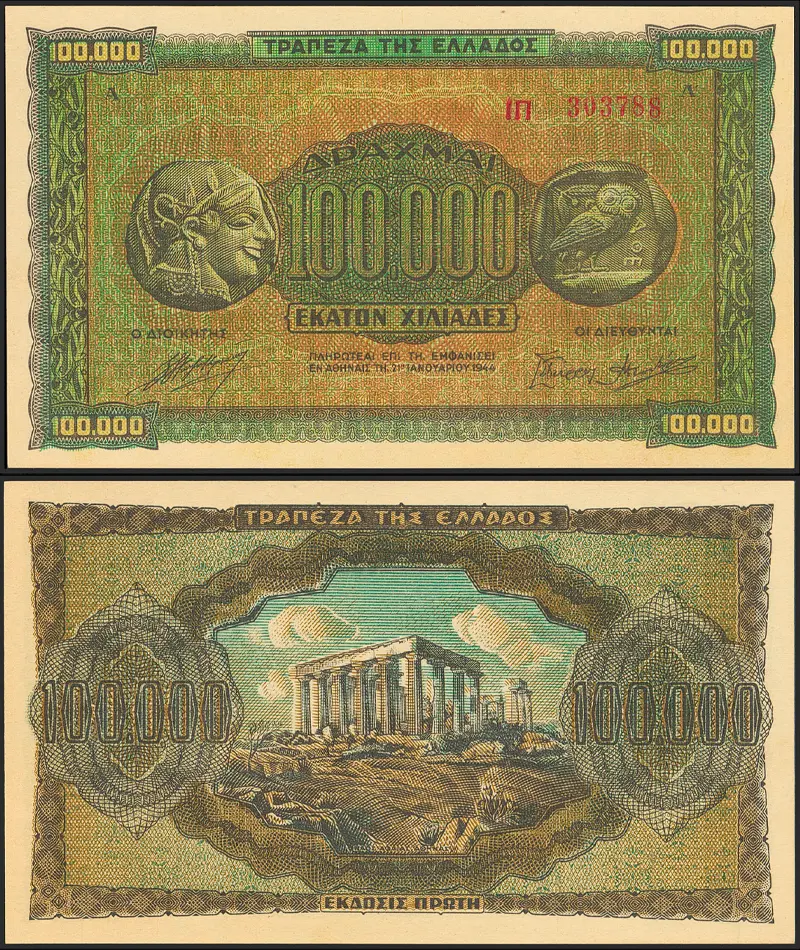
One striking detail is that the notes did not become visual propaganda for the Axis powers. Their designs remained connected to Greek identity, classical antiquity, mythology and ancient monuments.
Motifs collectors should notice
- Ancient coins: Classical coin imagery appears as a link to Greek heritage.
- Temples and ruins: Architecture becomes a visual anchor when the currency itself is losing value.
- Mythological figures: Greek mythology survives on paper even while the economy is being crushed.
- Escalating denominations: The zeros are not decorative. They are the main historical evidence.
The 100 billion drachmas note
The extreme symbol of the sequence is the 100 billion drachmas note, issued around the liberation period. It is one of those banknotes that needs no marketing department. The denomination alone kicks the door open.
Collector significance
Greek hyperinflation notes are ideal for collectors who build educational sets: one early occupation note, one mid-escalation note, one million-level note and one 100 billion drachmas piece if budget and availability allow.
After the zeros: reform and distrust
After liberation, Greece attempted monetary reform. The new drachma was introduced at an enormous conversion ratio, but confidence was not restored overnight. Money is not only arithmetic. It is trust with a watermark.
What makes these notes powerful
They show that hyperinflation is not just a financial event. It is a social event: savings vanish, prices lose meaning and people search for alternative stores of value.
What to collect
- Sequential denominations that show the inflation curve.
- Examples with strong classical motifs.
- High-grade notes where available, especially for lower denominations.
- Extreme denominations such as 100 billion drachmas for display impact.
Sources and Further Research
This article was built from verified sources and specialist banknote reporting. Broken or unconfirmed links were excluded from this public sources box.
- Blog Numismatico: Original Spanish article on Greek hyperinflation banknotes
- GlobeNote: World banknotes in the GlobeNote shop
Browse authentic notes, modern issues and collector favourites in the GlobeNote shop: Shop GlobeNote
Frequently Asked Questions
What caused Greek hyperinflation during World War II?
The occupation economy, looting, production collapse and forced financing needs contributed to massive money creation and loss of confidence in the drachma.
What was the highest Greek hyperinflation denomination?
The article highlights the 100 billion drachmas note as the extreme high-denomination issue of the period.
Are Greek hyperinflation notes rare?
Some values are accessible, while others are scarcer or more condition-sensitive. Their strongest appeal is historical and educational.
Why do Greek hyperinflation notes show ancient motifs?
The designs remained linked to Greek classical identity rather than occupation symbolism, which makes them especially interesting to collectors.
How should collectors build a Greek hyperinflation set?
A strong set should show denomination escalation: thousands, tens of thousands, hundreds of thousands, millions and the largest available high-value note.
This article belongs naturally with GlobeNote’s hyperinflation content and world banknote education pages.
Browse collectible historical notes in the GlobeNote shop.