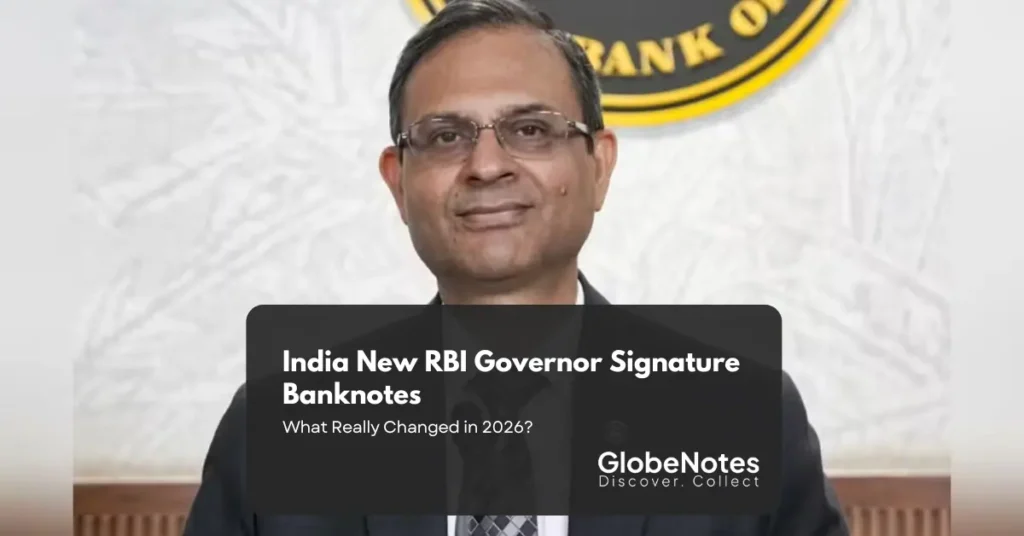
India New RBI Governor Signature Banknotes: What Really Changed in 2026?
India’s 2026 banknote story is not a thunderclap redesign. It is something quieter, and for collectors, often more interesting: a governor-signature and issue-cycle update inside the familiar Mahatma Gandhi (New) Series.
The basic artwork stays recognisable, but the details collectors chase begin to move: signature, date, prefix behaviour, security-reference comparisons and the exact denomination affected. In modern banknote collecting, that is not a footnote. It is the small hinge that makes a variety.
Quick Facts
- Country: India
- Denomination: Multiple denominations: 10, 50, 100, 200 and 500 rupees
- Year: 2025-2026 update cycle
- Issuer: Reserve Bank of India
- Material: Paper / cotton-based banknote substrate
- Status: Updated circulating banknote varieties
| Specification | Details |
|---|---|
| Issuer | Reserve Bank of India |
| Series | Mahatma Gandhi (New) Series |
| Update Type | Governor signature / issue-cycle update |
| Known Design Family | Existing ₹10, ₹50, ₹100, ₹200 and ₹500 layouts remain the reference designs |
| Collector Angle | Signature varieties, date varieties and denomination comparison |
| Polymer Context | Separate public discussion exists, but the current banknote updates should not be described as polymer issues |
Collect banknotes related to this article
Explore authentic world banknotes connected to this country, region or collecting theme.
The result is a perfect GlobeNote article: not because the note shouts, but because it teaches collectors how to look at quiet changes before the market notices them.
Why a Signature Update Matters
In casual use, a new governor signature is almost invisible. For collectors, it can create a new variety worth documenting, especially when the base design stays the same.
Not a Full Redesign
The article should be clear: this is not a new visual family of Indian rupee notes. It is a modernized or updated issue within the existing design vocabulary.
The Sanjay Malhotra Factor
Signature changes become dateable markers. Once a new governor signs the promise clause, notes with the previous signature and notes with the new signature become separate collector references.
Why the Polymer Rumor Belongs in the Article
Public attention around India and polymer notes is high, but the collector article must separate confirmed circulating paper notes from proposals, speculation and online rumor. That distinction is useful for AEO and AI search because it answers the obvious question directly.
Obverse Design Elements
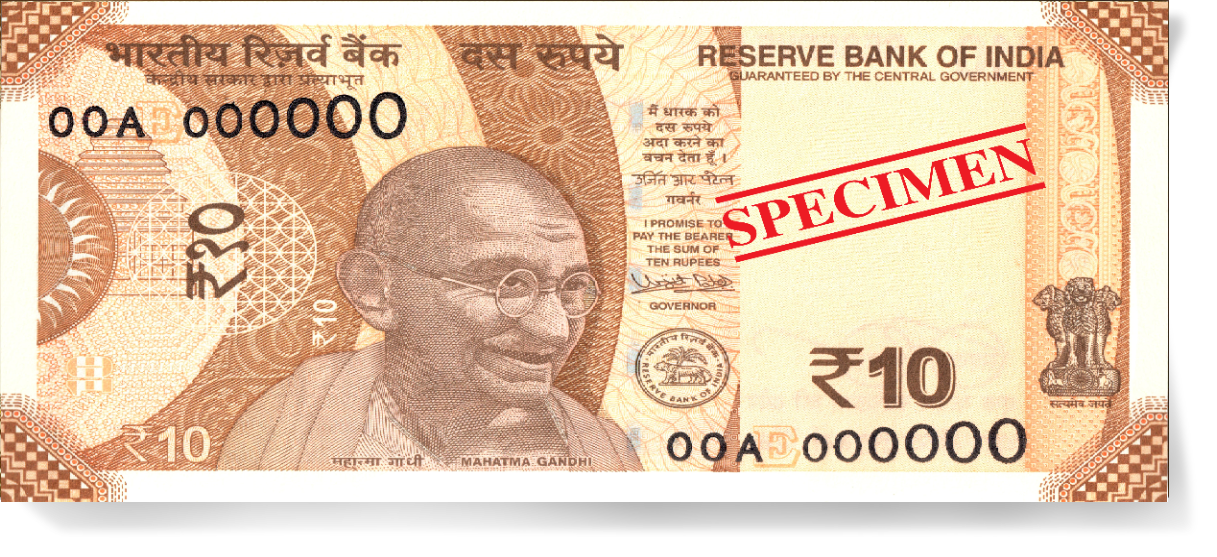
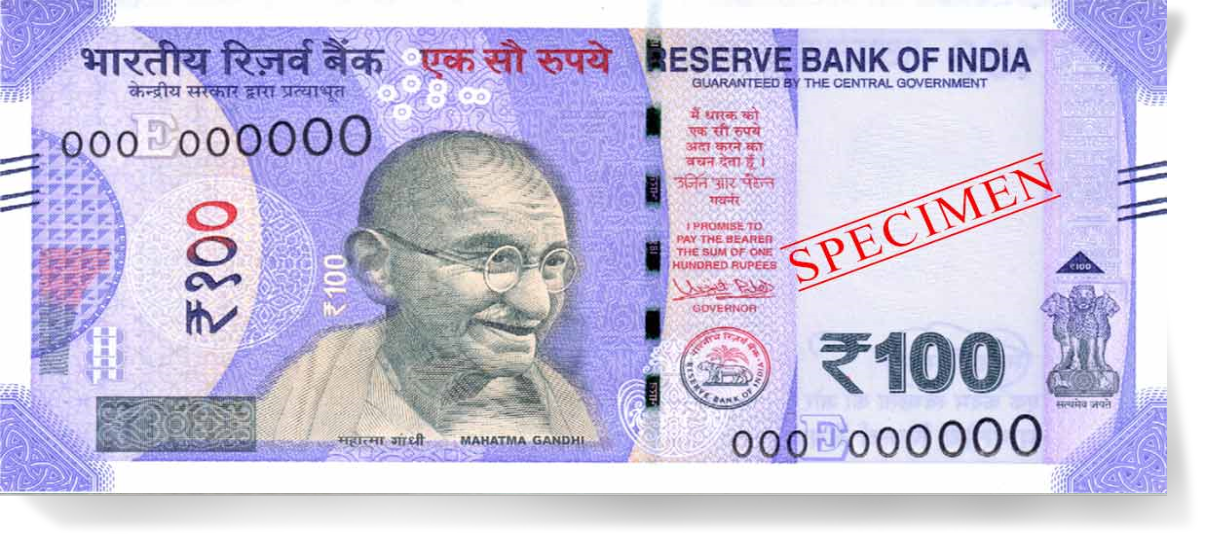
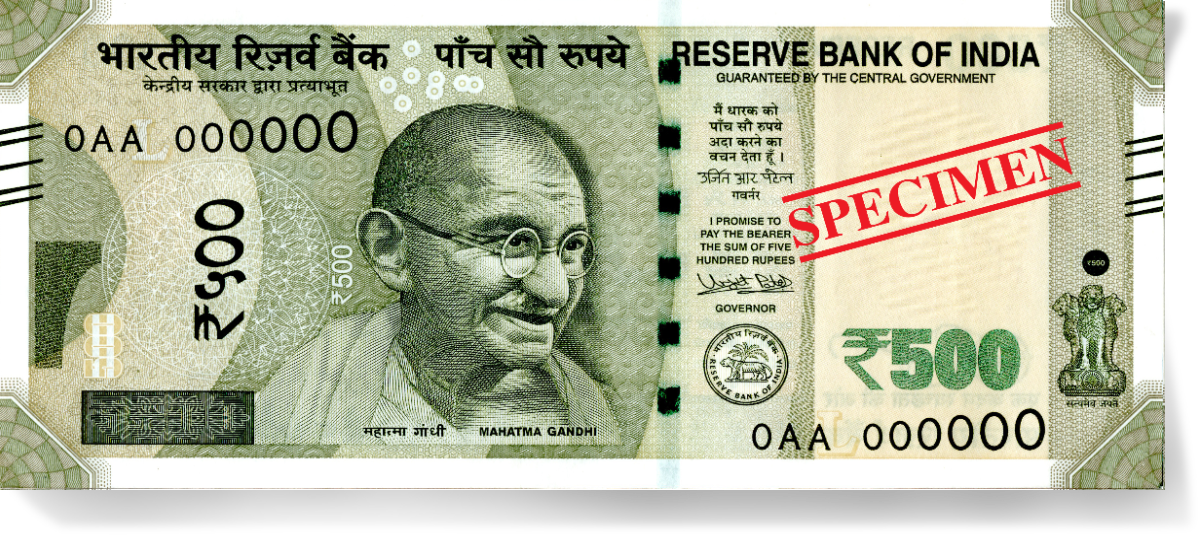
The updated notes retain the familiar Mahatma Gandhi portrait structure, issuer text and denomination placement of the Mahatma Gandhi (New) Series.
Key Obverse Elements to Compare
- Governor Signature: The most important collector marker in this update cycle.
- Denomination Panel: Compare font weight, Devanagari numeral and value placement with older examples.
- Security Thread Position: Useful when checking whether a note belongs to the same security family.
- Serial Number Prefix: Prefixes can matter when a new issue begins circulating.
- Microtext and See-Through Register: These features help confirm the note belongs to the correct modern series.
For GlobeNote readers, the practical advice is simple: do not collect the note only by denomination. Collect it by denomination, signature, year and condition.
Reverse Design Elements
The reverse side remains the best way to identify the design family: Konark Sun Temple on ₹10, Rani ki Vav on ₹100 and Red Fort on ₹500 are not merely decoration. They are the note’s passport.
Reverse Motifs
- ₹10: Konark Sun Temple, anchoring the brown small-denomination note in Indian architectural heritage.
- ₹100: Rani ki Vav, the stepwell motif that makes the lavender note instantly identifiable.
- ₹500: Red Fort, one of the most recognizable motifs in India’s modern currency system.
- Language Panel: Maintains India’s multilingual currency identity.
- Design Continuity: No redesign means the reverse remains a comparison tool, not a surprise party.
This is why the story is best told as a variety guide rather than a “new banknote design” article.
Security Features & Anti-Counterfeiting Technology
The existing Mahatma Gandhi (New) Series security architecture remains central to the updated notes.
Watermark
Collectors should verify the Mahatma Gandhi watermark, electrotype denomination and watermark window when comparing examples.
Security Thread
Modern Indian notes use windowed security-thread systems with inscriptions and, on higher values, colour-shifting effects.
See-Through Register
The printed register completes under transmitted light, making it useful for authentication and educational photography.
Microletters
Fine microtext helps differentiate genuine notes from low-grade reproductions and scanned copies.
Security features should be described from official RBI pages, not guessed from auction images.
Issue Context & Polymer Rumor Control
India is a huge currency market, so even a small banknote update becomes a public-interest story. That also makes it vulnerable to rumour.
What Is Confirmed
Updated banknotes are being discussed as circulating notes within the existing Mahatma Gandhi (New) Series design family, with the governor signature as a key reference point.
What Is Not Confirmed
Do not present these updated circulating notes as polymer banknotes. Polymer discussion exists separately, but the current article should preserve the distinction between confirmed paper issues and proposals.
Why This Helps Search
Users will ask whether India is replacing paper money with plastic notes. The article should answer that clearly while still covering the confirmed collector variety.
Collector Market Analysis & Numismatic Significance
Signature varieties often start quietly. Later, they become the difference between “just a note” and “the right note”.
What to Collect
- UNC examples by denomination.
- Previous-signature and new-signature comparison pairs.
- Low-prefix or early-prefix examples where documented.
- Notes with clean margins and sharp security features.
Best GlobeNote Angle
This article should teach collectors how to build a modern Indian rupee signature set, while linking naturally to GlobeNote’s modern banknote guides.
Sources & Further Research
This article was built from verified sources, issuer material where available, and specialist banknote reporting. Broken, blocked or unconfirmed links were excluded from the public sources box and recorded separately in the audit sheet.
- Bonistika: Modernization of Indian banknotes – Primary input link. The page could not be parsed directly by the browser tool, but indexed snippets identify the topic as RBI banknote modernization.
- Reserve Bank of India / Paisa Bolta Hai: ₹10 Mahatma Gandhi New Series page – Official design and security-reference page for the ₹10 note.
- Reserve Bank of India / Paisa Bolta Hai: ₹100 Mahatma Gandhi New Series page – Official design and security-reference page for the ₹100 note.
- Reserve Bank of India / Paisa Bolta Hai: ₹500 Mahatma Gandhi New Series page – Official design and security-reference page for the ₹500 note.
- Business Standard: RBI governor on polymer-banknote proposal – Context for polymer discussion: proposal under consideration, not proof that current notes are polymer.
Browse authentic notes, modern issues and collector favourites in the GlobeNote shop: Shop GlobeNote
Frequently Asked Questions
Are India’s 2026 signature-update banknotes new designs?
No. The important point is that these notes are signature and issue updates within the existing Mahatma Gandhi (New) Series design family, not a wholesale visual redesign.
Do older Indian rupee banknotes remain legal tender?
Yes. Reports and official-style notices indicate that older notes of the same denominations remain legal tender unless the Reserve Bank of India specifically withdraws them.
Are these Indian notes polymer?
No. India’s current circulating banknotes remain paper-based, while public discussion about polymer banknotes should be treated separately from the actual signature-update issues.
Why do collectors care about a signature change?
Signature changes create collectible varieties. For modern circulating notes, governor signature, date, prefix, security thread and print run details can define important subtypes.
Which denominations are involved?
Specialist reporting and news notices point to several denominations in the Mahatma Gandhi (New) Series, including 10, 50, 100, 200 and 500 rupees across the 2025-2026 update cycle.
This article is part of our New Banknotes 2026 guide.