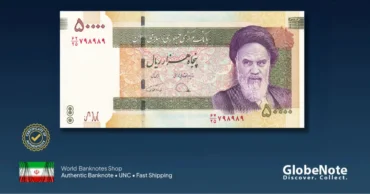
Iran has formally approved a currency redenomination that will remove four zeros from the rial. Under the reform, 10,000 current rials will become 1 new rial, which will be divided into 100 qirans. The change will simplify prices and accounting, but it will not automatically increase purchasing power or stop inflation.
Parliament approved the reform on 5 October 2025, the Guardian Council subsequently validated it, and President Masoud Pezeshkian instructed the Central Bank of Iran to begin preparations in November 2025. As of June 2026, Iran remains in the preparation stage: current rials are still in use and the final new-rial banknote family has not yet entered general circulation.Quick answer
What is Iran’s currency redenomination? Iran is removing four zeros from its currency so that 10,000 old rials equal 1 new rial. The official currency will remain the rial, divided into 100 qirans. The Central Bank has up to two years to prepare, followed by a transition of up to three years in which old and new rials may circulate together.Quick Facts
- Country: Iran
- Current currency: Iranian rial
- ISO code: IRR
- Reform: Removal of four zeros
- Conversion: 10,000 current rials = 1 new rial
- New subunit: 100 qirans = 1 new rial
- Parliamentary approval: 5 October 2025
- Guardian Council approval: November 2025
- Preparation period: Up to two years
- Dual-circulation period: Up to three years
- Current status: Preparatory implementation
- New-rial banknotes: Not yet in general circulation
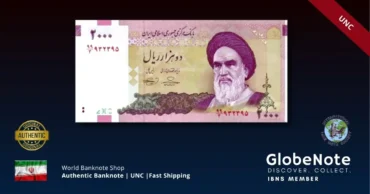
Collect banknotes related to this article
Explore authentic world banknotes connected to this country, region or collecting theme.


What Is Iran’s Currency Redenomination?
A currency redenomination changes the unit used to express prices without directly changing the real value of money. Iran’s reform will remove four zeros from the existing rial, making prices, invoices, bank balances and cash calculations shorter and easier to read. Under the approved conversion, 10,000 current rials will become 1 new rial. An item priced at 1,000,000 current rials would therefore be displayed as 100 new rials after the conversion.
Redenomination does not make goods cheaper. If a product costs the equivalent of a day’s income before the reform, it will still cost the equivalent of a day’s income afterwards. Only the numbers printed on prices, accounts and banknotes change.
Has Iran Approved the Removal of Four Zeros?
Yes. The reform is no longer merely a cabinet proposal. Iran’s Parliament approved the measure on 5 October 2025, with 144 lawmakers voting in favour, 108 voting against and three abstaining. The Guardian Council later determined that the amended legislation was compatible with Iran’s Constitution and Islamic law. In November 2025, President Masoud Pezeshkian formally notified the Central Bank to begin implementation preparations. This is an important change from the earlier version of the plan discussed in August 2025. At that stage, parliamentary and Guardian Council approval were still pending. Those legal steps have now been completed.How the New Rial Conversion Works
The conversion ratio is straightforward: divide a current-rial amount by 10,000 to obtain the value in new rials.| Current amount | New-rial amount |
|---|---|
| 10,000 old rials | 1 new rial |
| 50,000 old rials | 5 new rials |
| 100,000 old rials | 10 new rials |
| 500,000 old rials | 50 new rials |
| 1,000,000 old rials | 100 new rials |
| 5,000,000 old rials | 500 new rials |
| 10,000,000 old rials | 1,000 new rials |
New Rial or Toman: What Will Iran’s Currency Be Called?
The official unit under the approved 2025 reform remains the rial. One new rial will equal 10,000 current rials and will be divided into 100 qirans. The confusion comes from Iran’s long-standing everyday use of the toman. Although prices and official accounts are expressed in rials, many Iranians informally quote prices in tomans, with 1 traditional toman equal to 10 current rials. An earlier reform approved in principle in 2020 proposed making the toman the official currency. That version stalled. The legislation approved in 2025 instead preserves the name rial.Rial and toman explained
- Current official unit: rial
- Current informal unit: 1 toman = 10 current rials
- Approved future unit: new rial
- Future conversion: 1 new rial = 10,000 current rials
- Future subunit: 100 qirans = 1 new rial
Iran Currency Redenomination Timeline
| Date | Development |
|---|---|
| 2019-2020 | An earlier plan proposed replacing the rial with the toman and removing four zeros. Parliament approved the general concept, but implementation stalled. |
| August 2025 | Parliament’s Economic Committee revived the reform and backed retaining the rial as the official currency. |
| 5 October 2025 | The full Parliament approved removing four zeros and introducing the qiran subunit. |
| November 2025 | The Guardian Council approved the amended legislation. |
| 22 November 2025 | President Masoud Pezeshkian instructed the Central Bank to begin implementation preparations. |
| 2025-2027 | The Central Bank receives up to two years to prepare regulations, payment systems, accounting standards, coins and banknotes. |
| Following preparation | Old and new rials may circulate together for up to three years. |
| By approximately 2030 | The old rial could be fully withdrawn if the maximum preparation and transition periods are used. |
The actual launch and final withdrawal dates depend on the Central Bank’s implementation timetable. The dates above describe the maximum periods established by the reform.
When Will Iran Issue New-Rial Banknotes?
No complete family of banknotes denominated solely in the new rial has entered general circulation as of June 2026. The Central Bank must first complete the technical preparation period and announce the official start of the conversion. Iran has, however, been preparing the public visually for redenomination. Several recent notes and Iran cheques show the final four zeros in a lighter style while emphasising a shorter numerical value. This transitional design language appeared before the reform received final approval and continues on the high-denomination cash instruments issued in 2026.Recent high-denomination issues
- 5,000,000-rial Iran cheque: introduced in February 2026, with a visual value of 500 emphasised.
- 10,000,000-rial Iran cheque: introduced in March 2026, with 1,000 displayed prominently and the final four zeros visually reduced.
Why Is Iran Removing Four Zeros?
Years of inflation and currency depreciation have produced prices requiring long strings of zeros. This creates practical problems for shops, banks, accounting systems, invoices and cash handling.- Simpler prices: shorter figures are easier to read and communicate.
- Easier accounting: financial records require fewer digits.
- Cleaner payment systems: software and point-of-sale systems can process shorter values.
- Lower cash-handling complexity: fewer oversized denominations are needed over time.
- Psychological reset: authorities hope a cleaner unit will improve confidence in the national currency.
- Alignment with everyday speech: Iranians already shorten monetary amounts informally.
Will Removing Four Zeros Stop Inflation?
No. Removing zeros does not directly reduce inflation, increase wages or restore the rial’s purchasing power. It changes how monetary values are written, not the economic forces determining those values. A redenomination can simplify transactions and make a currency easier to use. Its long-term success, however, depends on inflation control, government finances, monetary policy, economic growth and confidence in the banking system.
Simple example: changing 1,000,000 old rials into 100 new rials makes the price easier to read. It does not make the item more affordable.
What Will Happen to Old Iranian Rials?
Current rial banknotes will not become worthless overnight. Once the new currency is launched, old and new rials are expected to circulate together during a transition lasting up to three years. Prices may be displayed in both units, while banks and official institutions exchange old notes at the fixed rate of 10,000 old rials for 1 new rial. The Central Bank will gradually withdraw old banknotes according to its implementation timetable. Collectors should distinguish between monetary exchange value and collector value. Even after an old banknote loses legal-tender status, it may retain numismatic interest depending on condition, denomination, signatures, serial numbers and historical importance.What the Reform Means for Banknote Collectors
Currency transitions create natural collecting milestones. Iran’s redenomination could produce several clearly defined groups of collectible material.- Final pre-redenomination notes: the last issues carrying full current-rial values.
- Transitional designs: notes with four zeros visually muted.
- High-denomination Iran cheques: including the 5 million and 10 million rial issues.
- First new-rial banknotes: the first series officially denominated after conversion.
- Signature varieties: issues produced during changes in Central Bank leadership.
- Dual-pricing material: receipts, price lists and official notices showing both units.
- Complete before-and-after sets: equivalent old- and new-rial denominations displayed together.
Collector advice: do not buy alleged “new rial” notes unless their status can be confirmed through the Central Bank or reliable specialist references. Concept designs, fantasy notes and misleading listings may appear before official banknotes are released.
Article revisited on 18/06/2026
Iran Currency Redenomination FAQ
Is Iran removing four zeros from the rial?
Yes. The reform has received parliamentary and Guardian Council approval, and the Central Bank has been instructed to begin preparations.How much will one new Iranian rial be worth?
One new rial will equal 10,000 current rials.Will Iran replace the rial with the toman?
No under the approved 2025 legislation. The official currency will remain the rial. The toman continues to be widely used as an informal unit in everyday speech.What is the qiran?
The qiran, also written qeran or gheran, will be the new subunit. One new rial will contain 100 qirans.When will the new Iranian currency begin?
The Central Bank has up to two years from late 2025 to prepare the conversion. The precise public launch date has not yet been confirmed.Are new-rial banknotes already circulating?
No complete new-rial family is in general circulation as of June 2026. Recent high-denomination Iran cheques remain expressed in current rials, although their designs visually anticipate the removal of four zeros.Will old Iranian banknotes become invalid?
Not immediately. Old and new rials are expected to circulate together for up to three years after the conversion begins.Will redenomination solve Iran’s inflation?
No. Redenomination simplifies prices and accounting but does not by itself address inflation, sanctions, government finances or currency depreciation.Sources and Further Reading
- Reuters – Iranian Parliament approves currency redenomination
- Tehran Times – Parliament approves the four-zero reform
- Italian Trade Agency – Guardian Council approval
- Iran International – Central Bank instructed to begin preparations
- bne IntelliNews – Transition and withdrawal timeline
- Iran International – Introduction of the 5 million rial Iran cheque
- GlobeNote – Iran 5 Million Rial Cheque
- GlobeNote – New Banknotes 2026