
PARAGUAY 2026 CURRENCY UPDATE
Paraguay Unveils New Guaraní Family: 80 Years of Monetary Sovereignty Meet Polymer Innovation
Paraguay is preparing to release an entirely new family of banknotes in 2026, marking eight decades since the guaraní became the nation’s official currency. José Cantero, President of the Central Bank of Paraguay (BCP), announced the ambitious redesign that will replace every denomination currently in circulation—not with larger numbers or flashier colors, but with something far more meaningful: a tribute to the Guaraní people and Paraguay’s six distinct ecological regions.
This isn’t just a cosmetic refresh. The new notes will feature variable sizes to aid the visually impaired, polymer substrates for durability, and designs that celebrate Paraguay’s indigenous heritage on the obverse while showcasing the country’s biodiversity—from the humid Chaco to the Atlantic Forest—on the reverse. It’s a currency that finally looks like the country it represents.
Quick Facts: Paraguay 2026 Banknotes
- Release: 2026 (exact date TBA)
- Denominations: All current values maintained
- Substrate: Polymer (confirmed for 10,000 guaraníes)
- Obverse Theme: Guaraní cultural heritage
- Reverse Theme: Six ecological zones of Paraguay
- Accessibility: Variable sizes + tactile features
- Occasion: 80th anniversary of the guaraní (established 1943)
- Authority: Banco Central del Paraguay
“The new family of banknotes will honor the Guaraní race and showcase the six ecological areas of Paraguay with their flora and fauna—a currency that tells our national story.”
— José Cantero, President, Central Bank of Paraguay
80 Years of the Guaraní: From Post-War Currency to Polymer Pioneer
The guaraní was introduced on October 5, 1943, replacing the peso at a rate of 100 pesos = 1 guaraní. Named after Paraguay’s largest indigenous group, the currency was born during World War II—a period when monetary sovereignty meant everything to a small landlocked nation navigating global upheaval. Fast forward eight decades, and the BCP is celebrating not just with commemorative coins (already released in 2023) or academic publications like “80 años de estabilidad: Fortaleciendo la soberanía monetaria en la era digital,” but with an entirely reimagined banknote series.
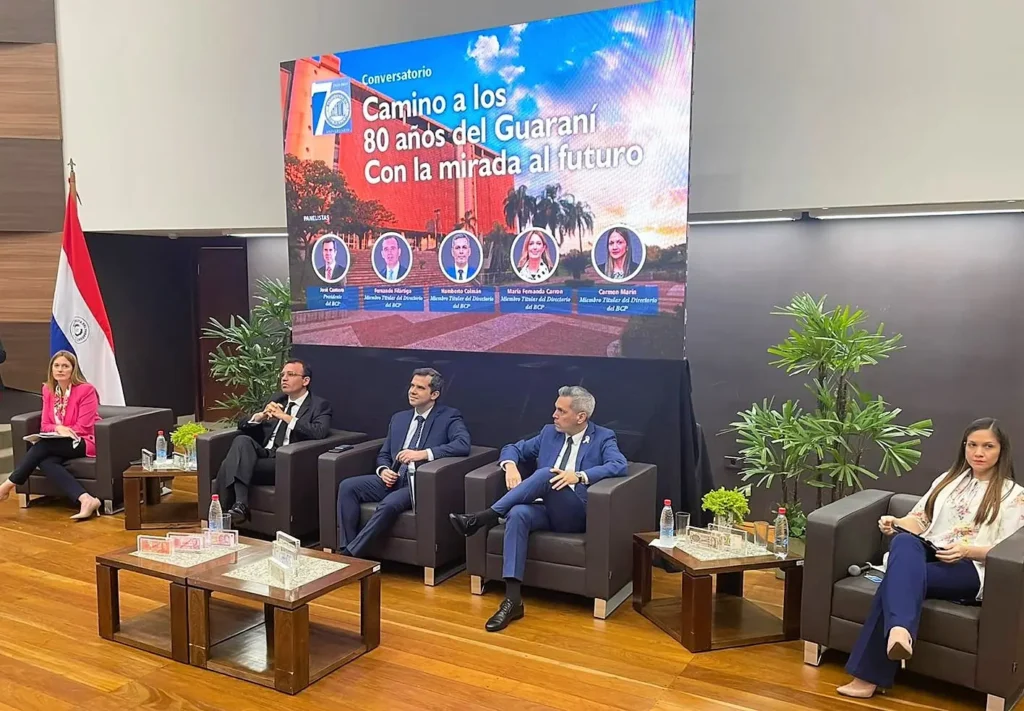
The announcement came during the 2022 conversatorio “Camino a los 80 años del guaraní,” where President Cantero outlined the vision: a modern, durable, and culturally resonant currency family that could serve Paraguay for the next generation. The BCP had already begun testing polymer substrates, starting with the redesigned 10,000 guaraníes note released in 2024—Paraguay’s first full polymer banknote.
Timeline: Paraguay’s Path to Polymer
1943: Guaraní introduced as national currency
2022: BCP announces new family development during 80th anniversary events
2023: 80th commemorative coin released; academic book published
2024: First polymer banknote (10,000 guaraníes) enters circulation
2025: New 100,000 guaraníes Series L released (November)
2026: Complete new family scheduled for rollout
What’s notable is the BCP’s measured approach. Unlike countries that rush polymer conversions or shock citizens with abrupt demonetizations, Paraguay is phasing in the new technology while keeping all existing paper notes valid indefinitely. No panic, no forced exchanges—just a gradual, confidence-building transition that respects both fiscal reality and public trust.
Guaraní Heritage Meets Ecological Diversity: A Design That Finally Makes Sense
Here’s where Paraguay gets it right: instead of generic national heroes recycled from old peso notes or colonial-era buildings nobody under 50 remembers, the new banknotes will feature themes directly linked to the Guaraní people—the indigenous culture that gave the currency its name and still represents a living, breathing part of Paraguayan identity. The obverse of each note will celebrate Guaraní art, language, traditions, or historical figures (exact subjects yet to be disclosed by the BCP).
Flip the notes over, and you’ll find Paraguay’s six ecological zones rendered in detail: the Humid Chaco, Dry Chaco, Central Region, Atlantic Forest (Alto Paraná), Ñeembucú Wetlands, and the Cerrado. Each zone gets its own banknote, complete with endemic flora and fauna. Imagine a currency series where one note shows the jaguar prowling the Atlantic Forest, another the giant anteater in the Chaco, and yet another the caiman basking in wetland reeds. It’s National Geographic meets legal tender.
Why This Design Approach Matters
Cultural Recognition: The Guaraní people are not museum relics—Guaraní is still spoken by millions and remains an official language of Paraguay alongside Spanish.
Environmental Education: Every transaction becomes a micro-lesson in Paraguay’s biodiversity. Kids handling a 50,000 guaraníes note learn about the Pantanal wetlands without opening a textbook.
Tourism Appeal: Collectors and tourists love banknotes that tell authentic stories. Generic presidents? Boring. Capybaras and toucans? Instant Instagram content.
The BCP hasn’t released final artwork yet (security protocols typically delay public previews until weeks before issue), but the thematic framework alone sets these notes apart from the current series, which features historical figures like Mariscal Francisco Solano López and Agustín Pío Barrios. The shift from人物-centric to place-centric design is bold, progressive, and—dare I say—overdue for a country with Paraguay’s natural wealth.
Polymer Substrate, Variable Sizes, and Accessibility: The Technical Leap
Paraguay’s 2026 banknote family represents a significant technological upgrade from the current cotton-based notes. The BCP has confirmed polymer substrates for at least the 10,000 guaraníes denomination (already in circulation since 2024), and industry sources suggest the entire new family will follow suit. Polymer offers three to four times the lifespan of paper, resists moisture and dirt, and enables advanced transparent security features impossible on traditional substrates.
Technical Specifications (Confirmed & Expected)
| Substrate Material | Polymer (confirmed for 10,000 PYG; likely all denominations) |
| Size Strategy | Variable dimensions across denominations (non-uniform) |
| Accessibility Features | Tactile marks for visually impaired; size differentiation |
| Denominations | All current values maintained (2,000 / 5,000 / 10,000 / 20,000 / 50,000 / 100,000 PYG) |
| Obverse Design | Guaraní cultural themes |
| Reverse Design | Six ecological zones with flora/fauna |
| Security Elements | Transparent windows, holographic features, microtext (standard polymer package) |
| Printer/Supplier | Not yet disclosed (possibly De La Rue, G+D, or regional partner) |
The variable sizing is particularly clever. Current guaraní notes are largely uniform in dimension, making it difficult for blind or low-vision users to distinguish denominations by touch alone. The new series will graduate in size—likely with the 2,000 PYG as the smallest and 100,000 PYG as the largest—paired with raised tactile patterns. This follows international best practices from Australia, Canada, and the Eurozone, where size-coding is standard.
What we don’t yet have: official spec sheets detailing exact dimensions, Pantone colors, UV-reactive ink formulations, or the international printer contracted for production. The BCP typically releases these technical documents closer to issue date, balancing transparency with anti-counterfeiting secrecy. Based on regional trends, expect partnerships with established security printers like Giesecke+Devrient (Germany), De La Rue (UK), or possibly Oberthur Fiduciaire (France), all of whom have supplied Latin American polymer notes in recent years.
Security Arsenal: What We Know (and What We’re Waiting to Learn)
While the BCP hasn’t published a full security feature breakdown for the 2026 series, we can extrapolate from Paraguay’s recent polymer experiments and global industry standards. The 10,000 guaraníes polymer note introduced in 2024 already showcases transparent windows, UV-reactive inks, and microprinting—table stakes for modern polymer currency. The 2026 family will almost certainly build on this foundation with additional layers.
Expected Security Features (Based on BCP Trends & Industry Standards)
- Transparent Polymer Windows: Clear zones with intricate holographic imagery, impossible to photocopy
- Color-Shifting Ink (OVI): Optically Variable Ink that changes hue when tilted
- Raised Intaglio Printing: Tactile elements for authenticity verification and accessibility
- Microtext & Fine-Line Patterns: Sub-millimeter text readable only under magnification
- UV Fluorescent Elements: Hidden imagery visible under ultraviolet light
- Serial Numbering: Unique alphanumeric codes (likely horizontal and vertical placement)
- Holographic Foil Strips: Diffractive optical elements with 3D effects
- Shadow Images: Watermark-equivalent translucent designs embedded in polymer
Paraguay’s counterfeiting rates are relatively low compared to neighboring Brazil or Argentina, but the BCP isn’t taking chances. Polymer’s inherent anti-copy properties—especially the transparent substrate—make casual forgery nearly impossible. Add in holographic elements sourced from specialized suppliers (Kurz, SICPA, or similar), and you’ve got a currency that’s easier to authenticate than a concert ticket.
The real test will be public education. Even the most secure banknote fails if cashiers and citizens don’t know what to look for. Expect the BCP to launch awareness campaigns in 2026, possibly including mobile apps (like Australia’s “Check Your Cash” or Canada’s “Bank Note App”) that use smartphone cameras to verify authenticity through augmented reality overlays.
When Will They Arrive? Rollout Strategy and Availability
The BCP has committed to a 2026 release but hasn’t pinpointed exact months or a phased denomination schedule. Based on historical precedent (the 10,000 PYG polymer note took approximately 18 months from announcement to circulation), we can sketch a probable timeline—though the BCP could accelerate or delay based on printer capacity, public readiness, or economic conditions.
Projected Rollout Timeline
Q1 2026 (Jan–Mar): Final artwork unveiled; public awareness campaigns begin; first denominations enter pre-distribution to commercial banks
Q2 2026 (Apr–Jun): Lower denominations (2,000 / 5,000 PYG) likely released first to test public acceptance and ATM compatibility
Q3 2026 (Jul–Sep): Mid-range notes (10,000 / 20,000 PYG) enter circulation; old paper notes remain fully valid
Q4 2026 (Oct–Dec): High denominations (50,000 / 100,000 PYG) complete the family; possible official launch event tied to October 5 (guaraní anniversary)
2027+: Gradual withdrawal of worn paper notes; dual circulation continues indefinitely (no demonetization announced)
Key question for collectors: will there be a simultaneous launch of all six denominations, or a staggered release? Staggered rollouts create more “first issue” milestones (and more collectible variants), but they also test public patience. Paraguay’s conservative monetary policy suggests a careful, phased approach—much like New Zealand’s polymer transition in the 1990s, which took over five years to complete.
ATM and vending machine operators will need firmware updates to recognize the new notes’ dimensions and security features. The BCP will likely work with the banking sector throughout 2025–26 to ensure seamless integration, avoiding the chaos that plagued India’s 2016 demonetization or Australia’s early polymer teething problems.
No demonetization is planned. This is critical: all current guaraní notes—from the oldest Series A cotton-fiber bills to the newest Series L—will remain legal tender. The BCP will simply let natural circulation and central bank withdrawals phase out worn notes over time. For collectors, this means no rush, no panic buying, and plenty of opportunity to acquire both old and new series in pristine condition.
Current vs. 2026 Series: What’s Changing (and What Isn’t)
Paraguay’s existing banknote family has served well for decades, but it’s showing its age. The current series features historical and cultural figures—Mariscal Francisco Solano López, José Asunción Flores, Juana María de Lara, Agustín Pío Barrios—on cotton-fiber substrates with traditional security printing. Functional, yes. Inspiring? Not particularly. The 2026 redesign represents a philosophical and technical leap, though denominational values remain unchanged.
Side-by-Side Comparison
| Feature | Current Series (Pre-2026) | New Series (2026) |
|---|---|---|
| Substrate | Cotton-fiber paper (most notes) | Polymer (confirmed/expected) |
| Denominations | 2,000 / 5,000 / 10,000 / 20,000 / 50,000 / 100,000 PYG | Same six denominations maintained |
| Size Strategy | Largely uniform dimensions | Variable sizes for accessibility |
| Obverse Theme | Historical figures (military, cultural icons) | Guaraní cultural heritage |
| Reverse Theme | Buildings, monuments, historical scenes | Six ecological zones + biodiversity |
| Accessibility | Limited tactile features | Tactile marks + size differentiation |
| Security Level | Standard intaglio, watermarks, threads | Polymer windows, holograms, OVI, UV |
| Lifespan | ~18–24 months (paper notes) | ~60–80 months (polymer estimate) |
The most visible difference will be the reverses: instead of the Palacio de los López or the Panteón Nacional de los Héroes, you’ll see rainforest canopies, wetland ecosystems, and Chaco scrubland—each with scientifically accurate depictions of native species. It’s a move from who we were to where we are, from military glory to environmental stewardship.
For everyday users, the variable sizing will be the biggest adjustment. Wallets designed for uniform-sized bills may need replacing (or at least reorganizing). Cash registers and counting machines will require recalibration. But the payoff—a currency that’s easier to authenticate, harder to counterfeit, and genuinely representative of Paraguay’s identity—is worth the friction.
Collector’s Perspective: Investment Potential and Market Outlook
Paraguay banknotes have historically flown under the radar in global numismatic markets—overshadowed by flashier neighbors like Argentina (with its hyperinflation curiosities) or Brazil (with its colorful Real series). But the 2026 polymer family could change that calculus. Here’s why collectors should pay attention:
Why Paraguay 2026 Notes Matter for Collectors
- First Full Polymer Family: Paraguay’s inaugural complete polymer series—historically significant for a country that’s maintained paper currency for 80 years
- Low Print Runs (Expected): Paraguay’s population (~7 million) means smaller circulation numbers vs. giants like Mexico or Colombia
- Dual-Series Opportunity: Both old cotton-fiber and new polymer notes will circulate simultaneously, creating natural “before/after” collecting pairs
- Thematic Appeal: Biodiversity designs attract crossover interest from natural history collectors, not just pure currency enthusiasts
- 80th Anniversary Context: Milestone-tied releases often command premiums (see: Euro 20th anniversary notes, Australian decimal anniversary sets)
- Emerging Market Potential: As Latin American economies stabilize post-pandemic, regional currency collecting is gaining traction in Asia and Europe
Estimated Market Values (Speculative – Pre-Release)
| 2026 First Issue Set (UNC) | $80–$120 USD (complete 6-note set, uncirculated) |
| Low Serial Numbers (001–100) | +150%–300% premium over face value |
| Replacement Notes (Star/ZZ) | +200%–400% premium (if BCP uses replacement system) |
| Current Series “Last Paper” (UNC) | $50–$80 USD (complete set, before 2026 transition) |
| Matched Paper/Polymer Pairs | $25–$40 per denomination pair (same value, different substrate) |
| Graded PMG/PCGS Gem UNC 66+ | +50%–100% premium over raw UNC examples |
The sweet spot for collectors: acquire current series notes in Gem Uncirculated condition now, while they’re still face value at banks. Once the 2026 series launches, demand for “last paper” examples will spike, especially the 50,000 and 100,000 PYG denominations featuring Agustín Pío Barrios and Carlos Antonio López. These notes are undervalued at present—a complete UNC set can be assembled for under $80 USD, yet they represent the final chapter of Paraguay’s eight-decade paper currency era.
For the 2026 polymer notes, focus on first-release examples with low serial numbers (particularly runs under 001000) and any special collector packaging the BCP might issue. If Paraguay follows the Australian/Canadian model, expect commemorative folders or albums sold directly through the central bank—these typically appreciate 20–40% within the first year if kept sealed.
Risk factors: Paraguay’s collector base is small domestically, so international demand will drive prices. If the BCP prints aggressively to meet commercial needs, scarcity won’t materialize. Conversely, if production is conservative or distribution limited, early buyers could see strong returns. The biodiversity theme is a wildcard—it could attract museum-quality interest or fizzle if artwork disappoints. Either way, this is a low-cost entry point into a historically overlooked series that’s finally getting the design respect it deserves.
References & External Resources
Official Sources
- Banco Central del Paraguay – Nueva Familia de Billetes (Official BCP announcement page)
- Banco Central del Paraguay – Billetes en Circulación (Current series details and security features)
- BCP Noticias (Central bank press releases and updates)
- Evolución de los Billetes – Paraguay Government Portal (Historical evolution of Paraguayan banknotes)
News Coverage & Press Articles
- Última Hora – El BCP anuncia proceso de cambio de la familia de billetes (October 4, 2022 announcement)
- Revista Plus – Paraguay cambiará la familia de billetes (October 5, 2022)
- RDN – BCP lanza nueva serie de billetes de G. 100.000 (November 25, 2025 – Series L release)
- 1000 Noticias – BCP anuncia nueva serie de 100.000 guaraníes (November 2025)
- Hoy – Las series de billetes vigentes (Current circulation details)
Numismatic Industry Sources
- MRI Bankers’ Guide to Foreign Currency – Paraguay New Family 2026
- PolymerNotes.com – Paraguay 10,000 Polymer Banknote (May 26, 2024)
- BanknoteNews – Paraguay Tag Archive
Historical Context & Research
- BCP – 80 años del guaraní: Obra analítica (December 2023 publication)
- Ciao Paraguay – Il Guaraní: La moneta del Paraguay (Historical overview)
- Asunción Times – Decoding the 5,000 Guaraní Note (Current series analysis)
Related Topics
- Hoy – Moneda conmemorativa 80 años del guaraní (2023 commemorative coin)
- Radio Concierto – Guaraní cumple hoy 80 años (October 5, 2023 anniversary)
Note for researchers: Technical specification documents (PDF format) from the BCP regarding security features, exact dimensions, and substrate suppliers have not yet been publicly released as of December 2025. This article will be updated as official documentation becomes available closer to the 2026 issue date.
Disclaimer: Market valuations and investment projections are speculative estimates based on historical precedent from similar polymer transitions in Australia, Canada, and New Zealand. Actual collector premiums will depend on print quantities, public demand, and preservation quality. GlobeNote is not a financial advisor; always conduct independent research before purchasing currency for investment purposes.
This article is part of our New Banknotes 2026 guide.