
Ukraine has unveiled a new 2.000-hryvnia banknote, the highest denomination in the country’s currency system and one of the most symbolically charged banknotes introduced during the war.
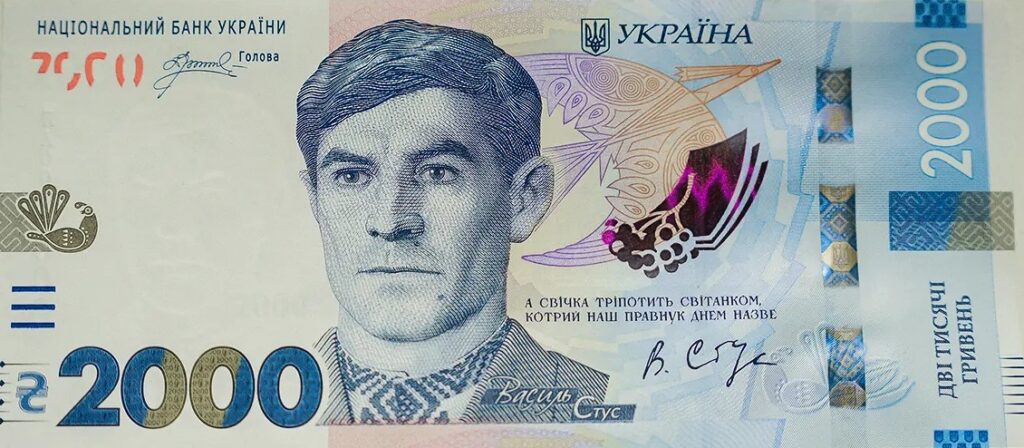
The National Bank of Ukraine, or NBU, announced that the blue note will enter circulation on 4 September 2026. Its front features Ukrainian poet, dissident and human-rights defender Vasyl Stus, while its reverse depicts the Faculty of Philology of Donetsk National University, where he studied.
But the note is more than a new denomination.
It is also a response to profound changes in Ukraine’s economy, the practical difficulties of maintaining payments during wartime and the continuing importance of physical cash when electricity, communications or banking infrastructure are disrupted.
Quick Facts
Essential information about Ukraine’s newly announced 2,000-hryvnia circulating banknote.
- Country Ukraine
- Denomination 2,000 hryvnias
- Issuer National Bank of Ukraine
- Circulation date 4 September 2026
- Main color Blue
- Dimensions 75 × 166 mm
- Obverse Portrait of Vasyl Stus
- Reverse Faculty of Philology of Donetsk National University
- Issue type Regular circulating denomination
- Security features More than 20 reported features
- Previous highest denomination 1,000 hryvnias
- Pick number Not yet officially assigned
The banknote was officially presented on 10 July 2026 and is not yet in circulation at the time of writing.
Why Is Ukraine Introducing a 2,000-Hryvnia Banknote?
The NBU says the decision is based on a combination of economic and operational factors rather than on a single statistic.
Since the introduction of the 1,000-hryvnia banknote in 2019, Ukraine’s average monthly wage has approximately tripled, while consumer prices have roughly doubled. As a result, significantly more banknotes are required to complete the same kinds of cash payments.
The central bank illustrated the change using the average salary. When the 1,000-hryvnia denomination was launched, an average monthly wage paid in cash could be represented by around ten of the highest-value notes. By 2026, more than thirty 1,000-hryvnia notes would be needed.
The amount of physical currency in circulation has also risen dramatically.
Cash in circulation increased from almost UAH 390 billion in 2019 to more than UAH 970 billion by 1 July 2026. Meanwhile, 1,000-hryvnia notes came to represent more than 55% of the total value of banknotes in circulation. According to the NBU, such a concentration in the highest existing denomination indicates a practical need for a larger note.
The new denomination should allow the same monetary value to be transported, processed and stored using fewer individual banknotes.
For the central bank and commercial banks, that means lower production, transportation, collection, sorting and storage costs. For retailers and businesses, it can simplify high-value cash handling. For the public, it means carrying fewer notes for larger payments or cash reserves.
A Cashless Economy That Still Needs Cash
At first glance, the introduction of a larger banknote might appear surprising in a country where digital payments are highly developed.
According to the NBU, 96 out of every 100 card transactions in Ukraine are cashless. Yet the war has demonstrated that a modern financial system cannot depend exclusively on electronic infrastructure.
Card terminals, mobile applications and online banking all rely on electricity, telecommunications and functioning financial networks. In areas affected by attacks, damaged infrastructure or unstable connections, physical currency can remain usable when digital systems cannot.
This is particularly important in frontline communities, where residents may need to make payments during outages or communications failures. The NBU therefore presents cash not as a rival to digital payments, but as a critical layer of financial resilience.
The 2,000-hryvnia banknote sits at the intersection of these two realities: Ukraine is simultaneously one of Europe’s most digitally oriented payment markets and a country where reliable access to physical money can become an emergency necessity.
Who Was Vasyl Stus?
The person chosen for Ukraine’s highest-denomination banknote was not a monarch, military commander or central banker.
Vasyl Stus was a poet, translator, literary critic, human-rights activist and one of the most important figures in the Ukrainian dissident movement.
Born in 1938, Stus studied history and philology in Donetsk. His protests against political repression led to persecution by the Soviet authorities, repeated imprisonment and years in strict-regime labor camps and exile. He joined the Ukrainian Helsinki Group and refused to abandon his political and cultural convictions despite continued pressure.
Much of his work was suppressed or confiscated. Hundreds of poems and translations were reportedly destroyed while he was imprisoned. Stus died on 4 September 1985 in a Soviet special-regime labor camp in the Perm region. His remains were reburied in Kyiv in 1989, during a public procession that became a major demonstration of national solidarity.
He was awarded the Taras Shevchenko State Prize posthumously in 1991 and named a Hero of Ukraine posthumously in 2005.
Placing Stus on the country’s highest-denomination note transforms a practical monetary instrument into a statement about freedom, identity and resistance to political repression.
The Obverse: Vasyl Stus and the Spirit of Resistance
The front of the banknote is dominated by an engraved portrait of Vasyl Stus.
The general palette is blue, with areas of violet, gold, turquoise and pale pink. The visual language follows the style of Ukraine’s modified banknote family introduced between 2014 and 2019, while giving the new denomination a clearly recognizable size and color.
Beside the portrait are artistic elements inspired by the mosaics of Alla Horska, another prominent member of Ukraine’s Sixtiers cultural movement.
One of the most striking motifs is a kestrel inspired by Horska’s monumental work in Mariupol. The NBU interprets the bird, capable of holding its position against powerful winds, as a symbol of the generation that resisted the Soviet system without the protection of an independent Ukrainian state.
The front also includes Stus’s signature and a passage inspired by one of the poems he wrote while imprisoned:
“And the candle flickers with the dawn…”
The typography was influenced by the graphic style of Heorhiy Narbut, whose work helped define the visual identity of the Ukrainian state between 1917 and 1919 and appeared on early Ukrainian banknotes.
The result is a layered design in which poetry, twentieth-century art and the history of Ukrainian currency are folded into the same piece of paper.
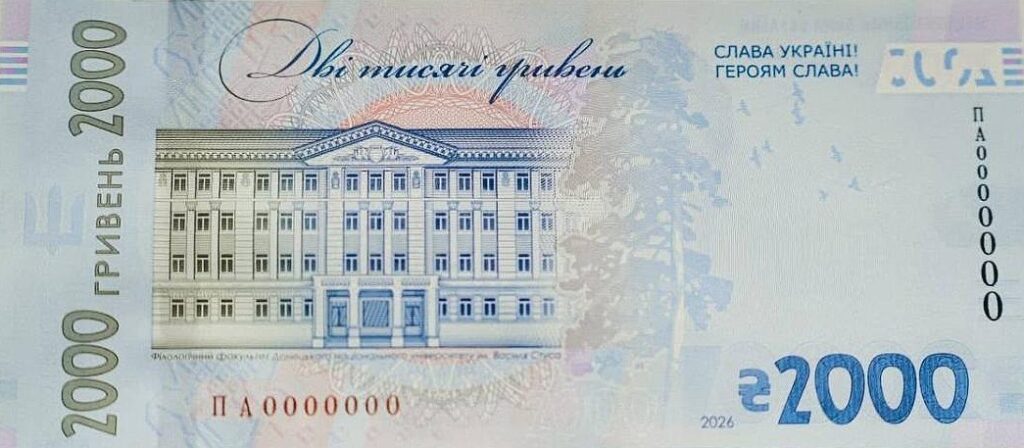
The Reverse: Donetsk National University
The reverse depicts the building of the Faculty of Philology of Donetsk National University, where Stus studied.
This choice connects the banknote directly to his intellectual formation and to the Donetsk region, an important part of his biography and of Ukraine’s cultural geography.
Above the building appears a handwritten-style inscription, while the lower portion contains the denomination, serial numbers and the year 2026.
The reverse also carries the Ukrainian national slogan:
“Glory to Ukraine! Glory to the Heroes!”
Rather than functioning as a decorative backdrop, the university building anchors the note in a real place linked to Stus’s education, language and literary work.
More Than 20 Security Features
The new 2,000-hryvnia banknote incorporates more than twenty security elements using both the banknote paper and advanced printing processes.
Among its principal features are an updated windowed security thread and a SPARK optically variable element. When the banknote is tilted, parts of the design shift from purple to golden green, producing a dynamic movement effect.
Additional reported features include:
- multitone watermark;
- intaglio printing;
- Orlov printing;
- microtext;
- latent images;
- fluorescent elements;
- tactile denomination marks;
- three horizontal lines designed to assist visually impaired users.
These features are intended to make the note easier to authenticate both by the public and through banknote-processing equipment.
A World First for the Security Thread
The most technologically significant element may be the Anima Colour windowed security thread.
According to the NBU, the 2,000-hryvnia note is the first banknote in the world to use this specific polychromatic and animated thread technology. It was produced in blue and yellow for Ukraine.
When the banknote is tilted, the thread produces movement and image-transformation effects. The Ukrainian Trident changes into the hryvnia currency symbol, combining national imagery with an authentication feature.
This makes the new note interesting not only as a new denomination, but also as a potential milestone in modern banknote security.
Why Will It Be Released on 4 September?
The circulation date was deliberately chosen.
On 4 September 1965, during the Kyiv premiere of the film Shadows of Forgotten Ancestors, Vasyl Stus joined Viacheslav Chornovil and Ivan Dziuba in an open public protest against the political arrests and repression of Ukrainian intellectuals.
Exactly twenty years later, on 4 September 1985, Stus died in a Soviet labor camp.
Releasing the banknote on that date connects the beginning of his open resistance with the end of his life.
The date is therefore not merely commemorative. It turns the banknote’s entry into circulation into an act of public remembrance.
Is This a Commemorative Banknote?
The 2,000-hryvnia note commemorates Vasyl Stus and the Ukrainian dissident generation, but it has been announced as a regular circulating denomination, not as a limited commemorative banknote.
It expands Ukraine’s permanent banknote family and is intended to perform a practical role in everyday cash circulation. The commemorative meaning is carried by its subject and release date rather than by a limited collector-only status. This classification is an inference from the way the NBU officially describes its introduction and intended economic function.
What Will the Pick Number Be?
No definitive Pick number had been publicly confirmed at the time of the announcement.
Because the note introduces a completely new denomination and banknote type, it should eventually receive its own catalogue classification. GlobeNote will add the official reference once the relevant catalogue information becomes available.
Collectors should be cautious about provisional numbers used by dealers or social-media posts before a recognized catalogue assignment is published.
Will the New Note Immediately Become Valuable?
A new denomination is not automatically rare.
Its future collector value will depend on factors such as:
- the number printed;
- how widely it circulates;
- future design modifications;
- replacement-note prefixes;
- unusual or low serial numbers;
- production errors;
- condition;
- whether the first issue is later replaced or withdrawn.
Until the banknote enters circulation and reliable market transactions become available, claims about its collector value would be speculation.
GlobeNote market estimates should therefore be added only after sufficient verifiable sales data exists.
Governor of the National Bank of Ukraine Andriy Pyshnyy has announced the expansion of the denominations of Ukraine’s domestic currency: On 4 September 2026, a new 2,000-hryvnia banknote will be introduced into circulation. pic.twitter.com/Jb7cVF2aNk
— National Bank of Ukraine 🇺🇦 (@NBUkraine) July 10, 2026
A Banknote Built for War and Memory
The new 2,000-hryvnia banknote has two distinct purposes.
Economically, it responds to higher prices, rising wages, growing cash circulation and the logistical demands of maintaining access to money during war.
Culturally, it places one of Ukraine’s most important dissident voices on the country’s highest-denomination banknote.
Those purposes are not separate.
The note presents financial resilience as part of national resilience. Its security thread carries the colors of Ukraine. Its imagery links Donetsk, the Sixtiers generation, Ukrainian modernism and the struggle against Soviet repression. Its release date connects public protest with personal sacrifice.
The result is a banknote designed not only to move value, but also to carry memory.
When it enters circulation on 4 September 2026, Ukrainians will not simply receive a larger denomination.
They will receive a compact, highly secured document of sovereignty.
References
This article was prepared using international, Ukrainian and specialist reporting about the newly announced 2,000-hryvnia banknote.
- International reporting Reuters: Ukraine Unveils New 2,000 Hryvnia Bill as War Drives Demand for Cash Reporting on wartime cash resilience, currency circulation and the economic purpose of the new denomination.
- Reuters syndication Euronext: Ukraine Unveils New 2,000 Hryvnia Bill as War Drives Demand for Cash Euronext publication of the Reuters report concerning the new Ukrainian banknote.
- Ukrainian reporting Ukrainian News: Economic Logic Behind the Introduction of the 2,000-Hryvnia Banknote Additional reporting about the central bank’s economic justification for the new denomination.
- Ukrainian news agency Interfax-Ukraine: NBU to Issue UAH 2,000 Banknote Featuring Vasyl Stus Information about the issue date, design, dimensions and reported security features.
- Specialist banknote source MRI Bankers’ Guide: Ukraine to Issue New 2,000-Hryvnia Banknote in September Specialist currency-industry coverage of the announced banknote.
- Supplementary social source Business Ukraine Magazine: Announcement of Ukraine’s New UAH 2,000 Banknote Supplementary social-media coverage of the announcement.
Information may be updated before the banknote enters circulation. GlobeNote will revise its catalogue entry when official catalogue classifications, including the Pick number and verified collector-market data, become available.
Frequently Asked Questions
Direct answers about the release date, design, purpose and security features of Ukraine’s new 2,000-hryvnia banknote.
When will the Ukrainian 2,000-hryvnia banknote enter circulation?
The National Bank of Ukraine plans to introduce the 2,000-hryvnia banknote into circulation on 4 September 2026.
Who appears on the Ukrainian 2,000-hryvnia banknote?
The obverse features Vasyl Stus, a Ukrainian poet, literary critic, human-rights activist and prominent dissident persecuted by the Soviet authorities.
What appears on the reverse of the 2,000-hryvnia banknote?
The reverse depicts the Faculty of Philology of Donetsk National University, where Vasyl Stus studied.
Why is Ukraine introducing a 2,000-hryvnia denomination?
The denomination responds to higher wages and prices, increased cash circulation, the growing use of 1,000-hryvnia notes and the need to make cash storage, transportation and payments more efficient during wartime.
Why does cash remain important in highly digitalized Ukraine?
Cash can continue to function during power failures, telecommunications disruptions or damage to banking infrastructure. It therefore remains an important part of Ukraine’s wartime payment resilience.
What color and size is the new 2,000-hryvnia banknote?
The banknote is predominantly blue and measures 75 × 166 millimeters.
Is the 2,000-hryvnia note a commemorative banknote?
It is intended as a regular circulating denomination, although its portrait, imagery and release date commemorate Vasyl Stus and Ukraine’s dissident generation.
What security features does the 2,000-hryvnia banknote have?
The banknote includes more than twenty reported security elements, including a watermark, intaglio printing, microtext, optically variable features, tactile marks and an advanced windowed security thread.
What is special about the Anima Colour security thread?
The animated windowed thread produces movement and image-transformation effects when the note is tilted. Its blue-and-yellow design incorporates Ukrainian national symbols and the hryvnia currency sign.
Does the new 2,000-hryvnia banknote already have a Pick number?
No definitive Pick number had been publicly confirmed at the time of the announcement. GlobeNote will update the catalogue entry when an authoritative classification becomes available.
Will the new 2,000-hryvnia banknote be valuable to collectors?
A new banknote is not automatically rare. Its collector value will depend on printing quantities, availability, condition, serial numbers, future varieties and verified market transactions after release.