
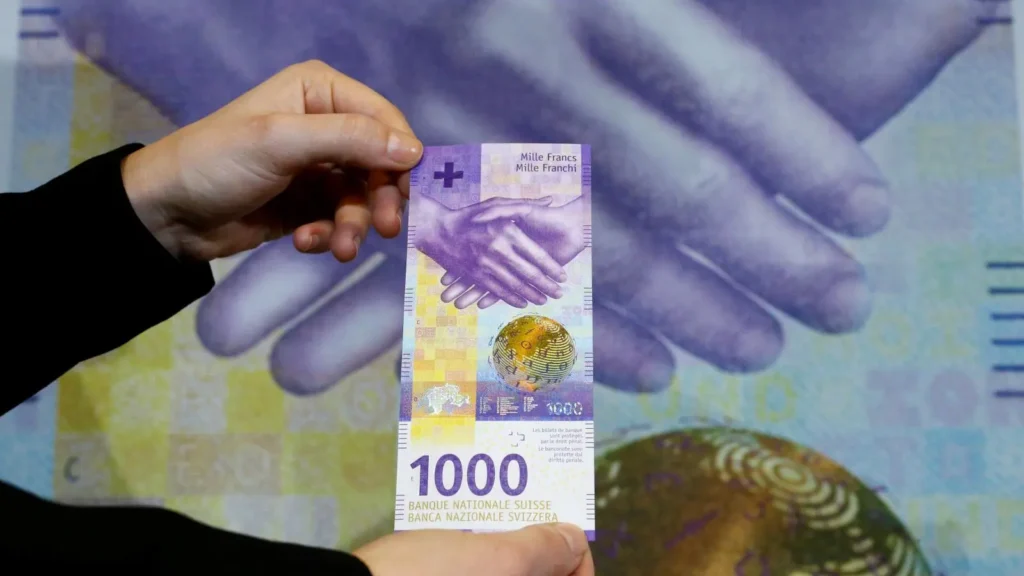
Slide a Swiss 1000 Francs note across the counter and time stops. The barista freezes mid-foam, a spoon hits the floor, and someone checks if there’s a camera crew. This isn’t “paying for coffee”; it’s staging a small economic event. And yet, while half the world panics at the sight of a high-value note, Switzerland simply nods and carries on—because this purple rectangle is engineered like a watch, built like a mountain pass, and secured like the crown jewels.
Where other currencies shout about holograms, the Swiss quietly deploy fourteen coordinated defenses and a three-layer Durasafe® core that shrugs off daily abuse. It’s the Rolls-Royce of cash: understated, over-engineered, and entirely unnecessary—which is precisely why it’s brilliant.
Why Switzerland Defends the 1000 Francs as Fiercely as Its Chocolate
Most countries wage war on cash. They kill off big notes, claiming they fuel tax evasion. Switzerland? They shrug, pour themselves a Rivella, and release a brand-new series. Because here, cash isn’t a relic – it’s a pillar.
The Swiss 1000 Francs note alone represents nearly half of all cash value in circulation. It’s not just money – it’s a pocket-sized savings account. Try suggesting scrapping it and watch Swiss society revolt harder than if you banned fondue. Meanwhile, in the EU the 500 euro was killed off. In Switzerland, they doubled down – because when the Wi-Fi dies, paper still works.
Why Switzerland Still Loves Cash (While Others Try to Kill It)
Elsewhere, big denominations are treated like contraband. In Switzerland, scrapping the 1,000 would cause more outrage than banning fondue. The reason is simple: cash here isn’t a relic; it’s infrastructure— always on, privacy-preserving, and resilient when networks fail. The 1,000-franc note functions less as “change” and more as a pocket-sized store of value, concentrating a huge share of francs in a tiny number of pieces. (At times, thousands have represented roughly ~50–60% of total cash by value—a staggering vote of confidence.)
Translation: try paying for a cappuccino with one and you’ll get the look reserved for people who tip in bullion.
What People Actually Notice
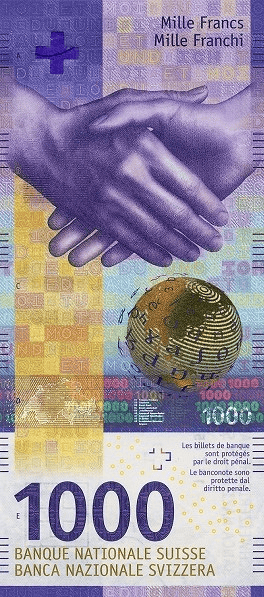
- The handshake — front-and-center symbolism of communication.
- The globe with phonetic symbols — a nod to language as a Swiss superpower.
- The vertical format & strip — it feels modern, and the strip actually does things when you tilt it.
- The Swiss cross window — hold it to the light: cross becomes a flag; instant theatre.
- The “grip” — intaglio printing you can feel even with your eyes closed.
Quick View
- Denomination: CHF 1,000 — 9th Series
- Date of issue: 13 March 2019
- Dimensions: 70 × 158 mm
- Main colour: Purple · Theme: Communication (key motif: language)
- Substrate: Durasafe® hybrid paper–polymer with transparent window
- Printer: Orell Füssli Security Printing (Zurich) · Issuer: Swiss National Bank
Security, the Swiss Way: Overkill Done Right
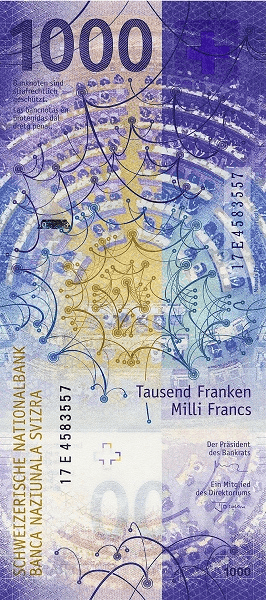
The 1,000 is a choreography of 14 security elements working together. It’s not one gimmick; it’s an ecosystem where each feature confirms the others.
Core features (how to teach your eyes and fingers):
- Globe test: tilt left-right and a violet arc sweeps the globe; tilt back and the globe changes colour.
- Security strip test: rows of red/green numerals slide in opposite directions; the strip also shows a map and inscriptions.
- Cross test: the transparent Swiss cross turns into the flag against the light.
- Intaglio (hand test): raised print on the hand, value and bank name—grippy enough to leave light pigment on paper.
- Microperf® cross: a pin-sharp perforated cross appears in backlight.
- Tactile blocks: short raised lines along both long edges—on the 1,000 there are six blocks per side for quick denomination ID by touch.
- Watermarks: globe and flag in perfect register.
- Microtext: multilingual micro-lettering inside the flag.
- UV & IR: a UV-only globe and fibres; IR patterns that “disappear” under cameras.
- Windowed thread & serials: micro-text in the thread; twin serials in different fonts.
- Tilt: arc on the globe + strip numbers moving opposite ways.
- Backlight: cross → flag + perforated cross.
- Feel: intaglio on the hand and value; run fingers along the edge for the six tactile blocks.
Durasafe®: why the note behaves like a laminate without looking like plastic
The substrate is a three-layer paper–polymer–paper sandwich with a clear core that enables a proper see-through window and novel thread insertion—more durable than pure cotton paper, more refined than glossy polymer. It’s why the Swiss can add a clean window and keep that classic intaglio feel.
From Portraits to “Swiss Characters”: a Tight Timeline
- 6th series (1976): portraits & museum-grade design (now recalled; exchangeable at SNB).
- 7th series (1984): the fabled reserve set designed by Roger & Elisabeth Pfund—printed, never issued, later destroyed.
- 8th series (1995–1998): Zintzmeyer’s classic; withdrawn as of 30 Apr 2021, but redeemable at face value without time limit.
- 9th series (2016–2019): vertical layout, thematic design (“The many facets of Switzerland”), 1,000 issued on 13 Mar 2019.
Design credit: Manuela Pfrunder. Printer: Orell Füssli (Zurich).
Head-to-Head: CHF 1,000 vs Euro, Pound & Canadian Dollar
| Currency | Substrate | Signature features | Reality check |
|---|---|---|---|
| CHF 1,000 (9th) | Durasafe® hybrid | Opposed-motion strip numerals; cross→flag window; assertive intaglio | Tilt + backlight + feel: 3 steps, 5 seconds |
| Euro (Europa series) | Cotton paper | Portrait window; hologram; color-shift inks | Feel, look, tilt; strong, but less “one-glance” theatrical |
| GBP (polymer) | Polymer | Large window + flip hologram | Excellent optics; plasticky touch vs Swiss intaglio bite |
| CAD (polymer) | Polymer | Grand window; maple holography | Flashy and robust; different design philosophy |
The Swiss note wins on coherence: every trick confirms another. It’s less a magic show than a systems-engineering demo.
Who Actually Uses a CHF 1,000 Note (and for What)?
Survey evidence shows thousands are obtained mostly at bank/post counters and used for large purchases (cars, appliances, furniture) or bill payments. Demographically, usage rises with age and income, with a notable tilt toward Ticino. In short: fewer pieces, bigger transactions.
Value: Face, “Intrinsic” and Collectible Premium
Face value: CHF 1,000. Among the highest regular denominations worldwide—one reason it concentrates so much of Switzerland’s cash value.
Intrinsic value: like all fiat notes, essentially the cost of high-end materials and printing (Durasafe® composite, specialty inks/foils, precision intaglio). The “worth” is legal tender status backed by SNB.
Collectible value: because the 9th series is current, most pieces trade near face. Premiums emerge for uncirculated (Gem-graded) examples, fancy or low serials, certain prefixes/runs, printer errors (rare), and documented first-day bundles. For earlier series (e.g., 8th), status changed in 2021: they’re no longer legal tender but remain exchangeable at SNB indefinitely—so numismatic premiums depend on grade, scarcity and demand rather than redemption risk.
Extended Q&A
Is the CHF 1,000 really “more secure” than other OECD notes?
The Swiss 9th series combines multiple independent checks (tilt, touch, backlight, UV, IR) inside a Durasafe® sandwich. The concept is series-wide (shared tests on every denomination), while the 1,000 adds denomination-specific details on the strip (language regions; list of cantons). In practice, counterfeits are exceedingly rare by international standards.
What exactly is on the 1,000’s security strip?
A map showing Switzerland’s language regions and neighbouring countries, plus the names of all Swiss cantons. Under tilt you also get those opposed-motion numerals—visual confirmation that the optics aren’t just printed gloss.
How often are 1,000-franc counterfeits found?
Switzerland detects very few counterfeits overall; historical comparisons show the franc with low counterfeit rates relative to other majors. And the 1,000’s mix of features + cash culture makes quick detection the norm.
Is the 8th series dead?
It lost legal-tender status on 30 April 2021, but—thanks to a legal change—remains exchangeable at the SNB with no time limit.
Who designed the current series and who prints it?
The 9th series design is by Manuela Pfrunder; production is by Orell Füssli Security Printing in Zurich.
What do people actually use the 1,000 for?
Large in-person purchases (cars, appliances, furniture), bill payments at counters, and—as a compact value store. Usage increases with age and income; adoption is notably strong in Ticino.
Test Drive, Final Lap
Put the note down. Tilt—numbers sprint in opposite lines; the globe throws a violet arc. Backlight—cross becomes a flag. Touch—the intaglio grips like fresh tyres on a dry Alpine pass. It doesn’t ask you to trust it. It demonstrates why you should. And that’s why the CHF 1,000 remains the world’s favourite vault you can fold.